 |
|
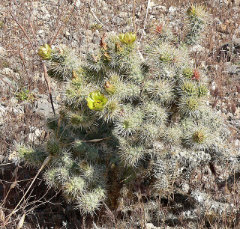
Stan Shebs. Creative Commons Attribution-Share Alike 3.1 |
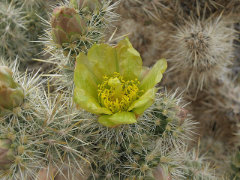 |
| Jim Morefield from Nevada, USA. Creative Commons Attribution-Share Alike 2.0 |
Translate this page:
Summary
Gold and silver chollas are resilient desert cacti recognized for their reflective spines, which range from pale gold to silvery-white depending on light conditions and plant form. These plants contribute structural diversity to desert landscapes and provide seasonal food resources through their stems, flower buds, and fruits. However, their value as a food plant is inconsistent because fruit production is unreliable and harvesting is complicated by formidable spines and glochids. Historically, chollas were important emergency foods in arid regions, but this species appears to have been less significant than some of its relatives due to variable yields. Ecologically, it remains an important native cactus adapted to some of the harshest growing environments in North America.
Physical Characteristics

 Cylindropuntia echinocarpa is an evergreen Shrub growing to 1.8 m (6ft) by 2 m (6ft) at a medium rate.
See above for USDA hardiness. It is hardy to UK zone 8. The flowers are pollinated by Bees, Insects.
It is noted for attracting wildlife.
Suitable for: light (sandy) and medium (loamy) soils, prefers well-drained soil and can grow in nutritionally poor soil. Suitable pH: neutral and basic (mildly alkaline) soils. It cannot grow in the shade. It prefers dry soil and can tolerate drought.
UK Hardiness Map
US Hardiness Map
Synonyms
Cactus echinocarpus (Engelm. & J.M.Bigelow) Lem. Grusonia echinocarpa (Engelm. & J.M.Bigelow) G.D.Rowley. Opuntia echinocarpa Engelm. & J.M.Bigelow.
Plant Habitats
Edible Uses
Edible but unreliable. Stems, flower buds, and fruits can be utilized with proper processing, yet the plant is best regarded as an opportunistic rather than dependable food source [2-3]. Edible Uses & Rating: The stems, flower buds, and fruits are edible, though this species ranks as a moderate-to-low value wild food primarily because dependable harvests are rare. When fruits are present in abundance, they can provide hydration and calories, but in many seasons, they are too scarce to justify targeted foraging. Overall, the plant is best categorized as an opportunistic food rather than a reliable resource [2-3]. Taste, Processing & Kitchen Notes: Detailed flavor descriptions are scarce, largely reflecting the plant’s limited historical culinary importance. Like most chollas, fruits tend toward mild sweetness combined with mucilaginous texture, while stems are typically bland once cooked. Flower buds likely resemble those of related species and benefit from roasting or boiling to soften texture and moderate vegetal flavors. Processing must focus on the complete removal of glochidia. Traditional techniques such as brushing, burning, sieving, or washing reduce but rarely eliminate spine hazards, so careful filtration is essential for any juices or broths derived from the plant [2-3]. Seasonality (Phenology): Gold and silver chollas usually bloom from March through June. Fruits develop afterward and may be harvested from July to October when production occurs. Flower buds are gathered in spring before blooming. Safety & Cautions (Food Use): Dense spines and glochids pose a significant risk of injury. Gloves and tools are mandatory during harvest. Glochids remain hazardous even after cooking and must be removed completely before consumption. Harvest & Processing Workflow: Harvest stems or buds with tongs and protective gloves. Remove glochids through brushing, burning, or mechanical agitation. Buds and stems are typically roasted or boiled. Fruits should be opened carefully to avoid embedding spines in the pulp, and any liquid should be strained through fine filters before use [2-3]. Traditional / Indigenous Use Summary: While chollas broadly were valuable to Indigenous peoples of the Southwest, gold and silver chollas appear to have played a lesser role due to inconsistent fruiting. When available, however, the plant would have served as a supplementary seasonal food similar to related species. Cultivar/Selection Notes: No cultivated varieties are recognized. All plants represent wild desert populations. Look-Alikes & Confusion Risks: This species may be confused with buckhorn or chainfruit cholla. Accurate identification depends on spine coloration, growth habit, and geographic location. Regardless of species, all chollas should be handled with caution.
References More on Edible Uses
Medicinal Uses
Plants For A Future can not take any responsibility for any adverse effects from the use of plants. Always seek advice from a professional before using a plant medicinally.
None Known
References More on Medicinal Uses
The Bookshop: Edible Plant Books
Our Latest books on Perennial Plants For Food Forests and Permaculture Gardens in paperback or digital formats.
Edible Tropical Plants
Food Forest Plants for Hotter Conditions: 250+ Plants For Tropical Food Forests & Permaculture Gardens.
More
Edible Temperate Plants
Plants for Your Food Forest: 500 Plants for Temperate Food Forests & Permaculture Gardens.
More
More Books
PFAF have eight books available in paperback and digital formats. Browse the shop for more information.
Shop Now
Other Uses
Gold and silver cholla are occasionally used in xeriscaping and desert restoration projects. They require minimal care once established, but should be planted where their defensive structure will not pose a hazard. Their reflective spines can provide striking visual contrast in native plant gardens. The species is grown as an ornamental - there are various colour forms and it is sold by nurseries. Gold and silver chollas provide nesting sites for birds, refuge for small mammals, and seasonal nectar for insects. Fallen joints create protective microhabitats that benefit reptiles and rodents while also influencing soil moisture patterns around the plant.
Special Uses
References More on Other Uses
Cultivation details
Gold and silver cholla cacti are resilient desert natives that contribute to ecological stability and visual character in arid landscapes. Although edible, their inconsistent productivity limits their importance as a food plant. Their greatest value lies in habitat support and adaptation to extreme climates. Growing Conditions: This species thrives in full sun, intense heat, and extremely well-drained soils. It tolerates drought, wind exposure, and nutrient-poor substrates with ease. Overwatering is one of the few serious threats in cultivation. Habitat & Range: Gold and silver chollas are characteristic plants of the Colorado Desert, particularly in southwestern Arizona and southeastern California. They occupy desert flats, rocky slopes, and open scrublands, frequently growing alongside creosote bush and other drought-adapted shrubs. Size & Landscape Performance: Most plants grow between 0.6 and 1.8 meters tall with spreads of 1 to 2.5 meters. In landscapes, they function as dramatic accent plants with strong architectural form. Because of their spines, they are best placed away from walkways and recreational areas. Cultivation (Horticulture): Gold and silver cholla are occasionally used in xeriscaping and desert restoration projects. They require minimal care once established, but should be planted where their defensive structure will not pose a hazard. Their reflective spines can provide striking visual contrast in native plant gardens. Pollinators: Flowers attract a variety of native solitary bees, particularly cactus-specialist bees such as Diadasia. Additional pollinators include carpenter bees, leafcutter bees, sweat bees, and occasional beetles. The blooms are structured for daytime pollination and are an important seasonal nectar source in otherwise resource-scarce desert environments. Pests & Problems: Serious pest issues are uncommon. Excess moisture may encourage fungal problems, and occasional insect feeding can occur, but the plant’s structural defenses provide strong natural protection. Identification & Habit: Gold and silver chollas form branching, shrub-like cacti composed of cylindrical joints densely covered in sheathed spines and barbed glochids. Spine coloration often creates a shimmering effect in strong desert light, making the plant highly visible across open terrain. Growth is typically upright with irregular branching, though older plants may appear somewhat rounded. Spring flowers emerge near the ends of stem joints and are followed by spiny fruits. Like other members of the genus, joints can detach and root, contributing to local colony formation. Family: Cactus family (Cactaceae). Genus: Cylindropuntia. Common names: Gold cholla, silver cholla. USDA Hardiness Zones: Approx. Zones 7–10. Typical Height: 0.6–1.8 m. Typical Spread: 1–2.5 m.Cylindropuntia species (commonly known as Cholla) generally exhibit a moderate growth rate compared to other cacti, typically growing between 6 to 12 inches (15–30 cm) per year under optimal conditions. While some specific species are categorized as slow-growing, the genus as a whole is recognized as one of the faster-growing types of cacti in desert landscapes.
References Carbon Farming Information and Carbon Sequestration Information
Temperature Converter
Type a value in the Celsius field to convert the value to Fahrenheit:
Fahrenheit:
The PFAF Bookshop
Plants For A Future have a number of books available in paperback and digital form. Book titles include Edible Plants, Edible Perennials, Edible Trees,Edible Shrubs, Woodland Gardening, and Temperate Food Forest Plants. Our new book is Food Forest Plants For Hotter Conditions (Tropical and Sub-Tropical).
Shop Now
Plant Propagation
Propagation occurs readily through detached stem joints that root after seasonal rains. Seeds may also germinate under favorable desert conditions, though vegetative spread is typically more reliable.
Other Names
If available other names are mentioned here
Gold and Silver Cholla (Cylindropuntia echinocarpa)
Native Range
US. USA. Arizona, California, Mexico Northwest, Nevada, Utah
Weed Potential
Right plant wrong place. We are currently updating this section.
Please note that a plant may be invasive in one area but may not in your area so it's worth checking.
The species is not considered invasive. It expands gradually in suitable habitats but behaves as a stable native component of desert ecosystems.
Conservation Status
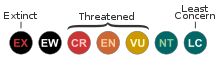
IUCN Red List of Threatened Plants Status : Least Concern.
Growth: S = slow M = medium F = fast. Soil: L = light (sandy) M = medium H = heavy (clay). pH: A = acid N = neutral B = basic (alkaline). Shade: F = full shade S = semi-shade N = no shade. Moisture: D = dry M = Moist We = wet Wa = water.
Now available:
Food Forest Plants for Mediterranean Conditions
350+ Perennial Plants For Mediterranean and Drier Food Forests and Permaculture Gardens.
[Paperback and eBook]
This is the third in Plants For A Future's series of plant guides for food forests tailored to
specific climate zones. Following volumes on temperate and tropical ecosystems, this book focuses
on species suited to Mediterranean conditions—regions with hot, dry summers and cool, wet winters,
often facing the added challenge of climate change.
Read More
Expert comment
Author
(Engelm. & J.M.Bigelow) F.M.Knuth
Botanical References
Links / References
For a list of references used on this page please go here
Readers comment
| Add a comment |
|
If you have important information about this plant that may help other users please add a comment or link below. Only comments or links that are felt to be directly relevant to a plant will be included. If you think a comment/link or information contained on this page is inaccurate or misleading we would welcome your feedback at [email protected]. If you have questions about a plant please use the Forum on this website as we do not have the resources to answer questions ourselves.
* Please note: the comments by website users are not necessarily those held by PFAF and may give misleading or inaccurate information.
|
Subject : Cylindropuntia echinocarpa
|
|
|
|