 |
|
Bernard Gagnon. Creative Commons Attribution-Share Alike 3.0 |
 |
| H. Zell. Creative Commons Attribution-Share Alike 3.0 |
Translate this page:
Summary
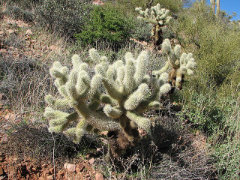
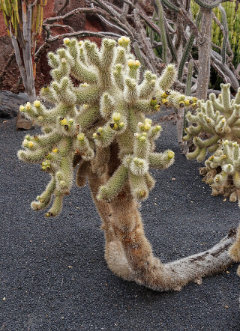
Teddybear cholla is one of the most visually striking and ecologically distinctive cacti of the Sonoran Desert, instantly recognizable by its dense golden spines that give the plant a deceptively soft, plush appearance. Despite its inviting look, it is one of the most aggressively defensive plants in the desert due to extremely detachable joints and dense fields of glochids. Historically, it functioned as a seasonal food resource for Indigenous peoples, particularly as a source of flower buds, fruits, and seeds. While difficult and hazardous to process, it provided reliable nutrition in arid environments where few other calorie-dense plant foods were available. Today, it remains more significant as an ecological keystone species and ethnobotanical resource than as a practical modern wild food plant.
Physical Characteristics

 Cylindropuntia bigelovii is an evergreen Tree growing to 2.5 m (8ft) by 3 m (9ft) at a medium rate.
See above for USDA hardiness. It is hardy to UK zone 9. The flowers are pollinated by Bees, Insects.
It is noted for attracting wildlife.
Suitable for: light (sandy) and medium (loamy) soils, prefers well-drained soil and can grow in nutritionally poor soil. Suitable pH: neutral and basic (mildly alkaline) soils and can grow in very alkaline soils.
It cannot grow in the shade. It prefers dry soil and can tolerate drought.
UK Hardiness Map
US Hardiness Map
Synonyms
Homotypic Synonyms: Grusonia bigelovii (Engelm.) G.D.Rowley. Opuntia bigelovii Engelm.
Plant Habitats
Edible Uses
Edible but highly hazardous to process. Flower buds, fruits, and seeds are usable after intensive processing. Best classified as a traditional survival food plant, not a modern culinary resource [2-3]. Edible Uses & Rating: Teddybear cholla has edible flower buds, fruits, and seeds, though all require intensive processing. It ranks as a low-palatability but high-survival-value food plant. It is not a desirable modern foraging species due to processing difficulty and glochid hazards, but historically it represented a reliable desert calorie source. Among chollas, it is one of the more nutritionally useful species because of its abundant fruits and seeds [2-3]. Taste, Processing & Kitchen Notes The fruits are dry, bland, tangy, slimy, and non-sweet, with no fruity aroma or flavor profile. Texture is dominated by mucilage and fibrous pulp. The flavor is tolerable but not pleasant. The seeds are extremely hard and cannot be eaten whole. Traditional and field-tested processing involves splitting fruits from the concave top using wooden tools to prevent glochids from entering the flesh, then extracting pulp and seeds. Seeds are best prepared as a beverage by pounding into coarse meal, toasting, boiling, and filtering. This produces a highly palatable drink with nutty, rich flavor. Whole fruits may also be processed into cactus juice using similar pounding, boiling, and straining techniques. Flower buds are processed like those of buckhorn cholla through de-spining and pit-roasting or boiling. Glochids are unaffected by cooking and must be physically excluded [2-3]. Seasonality (Phenology) Flowering occurs from March to September. Flower buds are available primarily in spring and early summer. Fruits mature from July through March, often persisting through winter. Seeds are available whenever fruits are present, with peak availability in late summer through winter. Safety & Cautions (Food Use) Extreme glochid hazard makes handling dangerous without protection. Glochids embed easily in skin and are unaffected by cooking. Improper processing can result in internal injury. Consumption without proper de-spining and filtering is unsafe [2-3]. Harvest & Processing Workflow: Harvest is done using tongs and gloves. Fruits are split from the concave top using wooden tools to avoid glochid contamination. Pulp and seeds are extracted mechanically. Seeds are processed by pounding, toasting, boiling, and filtering into beverage form. Whole fruits can be processed into cactus juice using boiling and filtration. Flower buds are harvested in spring, de-spined, and cooked [2-3]. Traditional / Indigenous Use Summary: Teddybear cholla was used by Indigenous peoples of the Southwest as a seasonal food source, particularly for fruits, seeds, and flower buds. Traditional processing methods focused on mechanical de-spining and seed-based food production, especially beverages derived from ground and filtered seed meals. Cultivar/Selection Notes: No cultivars exist. All forms are wild populations. Look-Alikes & Confusion Risks: It may be confused with other densely spined chollas such as chainfruit cholla and buckhorn cholla. Identification should be based on dense golden spines, thick stem joints, and persistent yellow-green fruits. All chollas pose similar handling hazards.
References More on Edible Uses
Medicinal Uses
Plants For A Future can not take any responsibility for any adverse effects from the use of plants. Always seek advice from a professional before using a plant medicinally.
None Known
References More on Medicinal Uses
The Bookshop: Edible Plant Books
Our Latest books on Perennial Plants For Food Forests and Permaculture Gardens in paperback or digital formats.
Edible Tropical Plants
Food Forest Plants for Hotter Conditions: 250+ Plants For Tropical Food Forests & Permaculture Gardens.
More
Edible Temperate Plants
Plants for Your Food Forest: 500 Plants for Temperate Food Forests & Permaculture Gardens.
More
More Books
PFAF have eight books available in paperback and digital formats. Browse the shop for more information.
Shop Now
Other Uses
Teddybear cholla is occasionally cultivated for native landscaping and desert restoration but not for food production. Teddybear cholla is an important desert habitat species. It provides nesting protection for birds, shelter for small mammals, and food resources through fruits and flowers. Detached joints also influence animal movement patterns and create microhabitats that affect plant community structure.
Special Uses
References More on Other Uses
Cultivation details
Teddybear cholla is a visually iconic desert cactus with deep ethnobotanical significance and strong ecological value. While extremely difficult and hazardous to process, it historically served as a reliable food source in arid environments. Today, it is best understood as a survival food plant and ecological keystone species rather than a practical modern wild edible. Growing Conditions: Teddybear cholla thrives in extreme desert environments, requiring full sun, high heat, and well-drained soils. It tolerates drought, nutrient-poor substrates, and intense solar radiation. It is highly sensitive to frost and prolonged soil moisture. Habitat & Range: This species is native to the Sonoran Desert, primarily in southern Arizona, southeastern California, and northwestern Mexico. It occupies desert flats, rocky slopes, sandy plains, and desert scrub ecosystems, often forming dense stands that shape local plant communities. Size & Landscape Performance: Plants typically reach 1–2.5 meters tall with a spread of 1.5–3 meters. In landscapes, it functions as a dominant structural cactus species. It is visually dramatic but hazardous, making it unsuitable for pedestrian-access areas. It is valuable for desert restoration and wildlife habitat but not for residential landscaping. Cultivation (Horticulture): Teddybear cholla is occasionally cultivated for native landscaping and desert restoration but not for food production. It requires full sun, excellent drainage, and minimal irrigation. Human access must be carefully managed due to injury risk. Pollinators: Pollination is primarily carried out by native cactus bees, especially species of Diadasia and Lithurgus. Generalist native bees such as carpenter bees (Xylocopa), leafcutter bees (Megachile), and sweat bees (Halictidae) also contribute. Beetles act as secondary pollinators. The flowers are adapted to diurnal bee pollination and show classic cactus-bee syndromes. Bird and bat pollination are not significant for this species. Pests & Problems: The plant is largely pest-resistant due to its physical defenses. Occasional fungal issues and insect damage may occur in wet years but rarely impact survival. Identification & Habit: Teddybear cholla is a densely branched, shrub-like cactus with thick cylindrical stem segments covered in dense, barbed spines and abundant glochids. The joints detach extremely easily and cling to animals and humans, making the plant notorious for its “jumping cholla” reputation, although this behavior is mechanical rather than active. The plant forms rounded mounds or thickets, often creating visually dominant desert stands. Flowers are borne on stem joints and are followed by persistent yellowish-green fruits that often remain attached through winter. The dense golden spines and thick stem segments make this species easily distinguishable from other chollas. Family: Cactus family (Cactaceae). Genus: Cylindropuntia. Common names: Teddybear cholla. USDA Hardiness Zones: Approx. Zones 8–11. Typical Height: 1–2.5 m. Typical Spread: 1.5–3 m.
References Carbon Farming Information and Carbon Sequestration Information
Temperature Converter
Type a value in the Celsius field to convert the value to Fahrenheit:
Fahrenheit:
The PFAF Bookshop
Plants For A Future have a number of books available in paperback and digital form. Book titles include Edible Plants, Edible Perennials, Edible Trees,Edible Shrubs, Woodland Gardening, and Temperate Food Forest Plants. Our new book is Food Forest Plants For Hotter Conditions (Tropical and Sub-Tropical).
Shop Now
Plant Propagation
Propagation occurs primarily through vegetative fragmentation, with detached joints rooting readily after rainfall. Seed propagation is possible but slow and unpredictable in cultivation.
Other Names
If available other names are mentioned here
Teddy-bear Cholla
Native Range
US. USA. Arizona, California, Mexico Northwest, Nevada, New Mexico.
Weed Potential
Right plant wrong place. We are currently updating this section.
Please note that a plant may be invasive in one area but may not in your area so it's worth checking.
It is not invasive but can expand locally in disturbed desert soils due to efficient vegetative reproduction. In natural systems, it is a stable native species.
Conservation Status
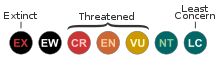
IUCN Red List of Threatened Plants Status : Least Concern.
Growth: S = slow M = medium F = fast. Soil: L = light (sandy) M = medium H = heavy (clay). pH: A = acid N = neutral B = basic (alkaline). Shade: F = full shade S = semi-shade N = no shade. Moisture: D = dry M = Moist We = wet Wa = water.
Now available:
Food Forest Plants for Mediterranean Conditions
350+ Perennial Plants For Mediterranean and Drier Food Forests and Permaculture Gardens.
[Paperback and eBook]
This is the third in Plants For A Future's series of plant guides for food forests tailored to
specific climate zones. Following volumes on temperate and tropical ecosystems, this book focuses
on species suited to Mediterranean conditions—regions with hot, dry summers and cool, wet winters,
often facing the added challenge of climate change.
Read More
Expert comment
Author
(Engelm.) F.M.Knuth
Botanical References
Links / References
For a list of references used on this page please go here
Readers comment
| Add a comment |
|
If you have important information about this plant that may help other users please add a comment or link below. Only comments or links that are felt to be directly relevant to a plant will be included. If you think a comment/link or information contained on this page is inaccurate or misleading we would welcome your feedback at [email protected]. If you have questions about a plant please use the Forum on this website as we do not have the resources to answer questions ourselves.
* Please note: the comments by website users are not necessarily those held by PFAF and may give misleading or inaccurate information.
|
Subject : Cylindropuntia bigelovii
|
|
|
|