 |
|
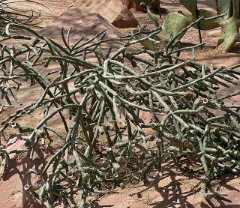
Stan Shebs. Creative Commons Attribution-Share Alike 3.1 |
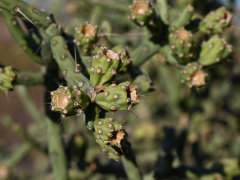 |
| Krzysztof Ziarnek, Kenraiz. Creative Commons Attribution-Share Alike 4.1 |
Translate this page:
Summary
Arizona pencil cholla is a slender, highly branched desert cactus native to the Sonoran Desert and adjacent regions of the southwestern United States. It is characterized by narrow, pencil-like jointed stems, dense armament of spines and glochids, and seasonal production of edible flower buds and fruits. Although difficult to handle and process due to its defensive structures, it historically served as a food resource for Indigenous peoples, particularly the Pima, who processed it using specialized de-spining techniques. As a food plant, it is not highly palatable in raw form but becomes usable after traditional processing and cooking. Ecologically, it is a resilient desert species adapted to extreme aridity, contributing to desert food webs and pollinator networks while providing shelter for wildlife.
Physical Characteristics

 Cylindropuntia arbuscula is an evergreen Tree growing to 3 m (9ft) by 2 m (6ft) at a medium rate.
See above for USDA hardiness. It is hardy to UK zone 9. The flowers are pollinated by Bees, Insects.
It is noted for attracting wildlife.
Suitable for: light (sandy) and medium (loamy) soils, prefers well-drained soil and can grow in nutritionally poor soil. Suitable pH: neutral and basic (mildly alkaline) soils and can grow in very alkaline soils.
It cannot grow in the shade. It prefers dry soil and can tolerate drought.
UK Hardiness Map
US Hardiness Map
Synonyms
Homotypic Synonyms: Grusonia arbuscula (Engelm.) G.D.Rowley. Opuntia arbuscula Engelm.
Plant Habitats
Edible Uses
Edible but labor-intensive. Flower buds and fruits are usable after de-spining and cooking. Not a high-palatable food, but historically important and nutritionally useful. Best classified as a traditional survival food plant, not a modern culinary wild edible [2-3]. Edible Uses & Rating: Arizona pencil cholla has edible flower buds and fruits, traditionally used as food after processing. It ranks as a moderate-value survival and traditional food plant, rather than a high-quality wild vegetable or fruit. The edible parts are usable but require significant labor and specialized handling techniques due to glochids. Historically, it was valued more as a reliable seasonal food source than as a palatable delicacy. Nutritionally, it contributes calories and minerals but is not considered a staple-grade plant in modern foraging contexts [2-3]. Taste, Processing & Kitchen Notes: Raw plant material is not palatable due to mucilage, bitterness, and resinous cactus flavors. Flower buds require de-spining, followed by pit-roasting, boiling, or drying. Traditional processing removes defensive spines first, then applies heat treatment to soften tissues and reduce harsh flavors. Fruits are edible but contain glochids and require brushing, washing, burning, or mechanical abrasion for safe use. Cooking improves texture and flavor but does not eliminate all mucilaginous qualities. Historically, processed buds were used as vegetables and dried for storage. Flavor is mild, earthy, and vegetal after cooking, without sweetness [2-3]. Seasonality (Phenology): Arizona pencil cholla flowers primarily from May to June. Flower buds are harvested in late spring. Fruits develop through summer and mature toward late summer, remaining available into early autumn depending on rainfall and temperature patterns. Safety & Cautions (Food Use): The presence of glochids makes handling dangerous without protection. Glochids are not neutralized by cooking and must be mechanically removed. Improper processing can result in internal injury if ingested. Gloves, tools, and traditional de-spining methods are essential. Consumption without proper preparation is unsafe [2-3]. Harvest & Processing Workflow Harvest requires tongs and thick gloves. Flower buds and fruits must be removed using tools. Traditional de-spining methods include mechanical abrasion in baskets, brushing, burning, rolling in sand, and washing. After de-spining, parts are cooked by boiling, pit-roasting, or drying. Flower buds are typically cooked and eaten fresh or dried for storage. Fruits require glochid removal before any processing [2-3]. Traditional / Indigenous Use Summary: Arizona pencil cholla was used by the Pima Indians, who processed it using the same methods applied to buckhorn cholla. Flower buds were harvested, de-spined using specialized baskets, pit-roasted, and consumed as vegetables or dried for storage. This species formed part of a broader cholla-based seasonal food system in central Arizona. Cultivar/Selection Notes: No cultivars exist. All populations are wild forms with natural morphological variation. Look-Alikes & Confusion Risks: It may be confused with other thin-stemmed chollas such as diamond cholla and branched pencil cholla. Identification should be based on stem thickness, growth form, and habitat. All chollas possess glochids, so misidentification poses handling risks rather than toxicity risks.
References More on Edible Uses
Medicinal Uses
Plants For A Future can not take any responsibility for any adverse effects from the use of plants. Always seek advice from a professional before using a plant medicinally.
None Known
References More on Medicinal Uses
The Bookshop: Edible Plant Books
Our Latest books on Perennial Plants For Food Forests and Permaculture Gardens in paperback or digital formats.
Edible Tropical Plants
Food Forest Plants for Hotter Conditions: 250+ Plants For Tropical Food Forests & Permaculture Gardens.
More
Edible Temperate Plants
Plants for Your Food Forest: 500 Plants for Temperate Food Forests & Permaculture Gardens.
More
More Books
PFAF have eight books available in paperback and digital formats. Browse the shop for more information.
Shop Now
Other Uses
Sometimes planted in desert landscapes for erosion control, wildlife habitat, and native restoration. It requires no irrigation once established and minimal soil preparation. Arizona pencil cholla provides shelter, nesting sites, and food for desert wildlife. Birds nest among its spiny branches for protection from predators. Fruits are consumed by birds, rodents, and desert mammals. The plant contributes to desert biodiversity and microhabitat formation.
Special Uses
References More on Other Uses
Cultivation details
Arizona pencil cholla is a culturally significant desert cactus with historical food value and strong ecological importance. While difficult to process and unpleasant raw, it represents a resilient traditional food plant adapted to extreme desert conditions. Its primary value lies in ethnobotanical knowledge, ecological function, and survival-food potential rather than culinary quality. Growing Conditions: This species thrives in hot, arid climates with intense sun exposure, low humidity, and minimal rainfall. It is adapted to nutrient-poor soils, high temperatures, and extreme drought. It performs best in full sun with excellent drainage and does not tolerate persistent moisture or cold soils. Habitat & Range: Arizona pencil cholla is native to the Sonoran Desert, primarily in southern and central Arizona and adjacent regions. It occurs in desert scrub, rocky slopes, sandy washes, desert flats, and transitional desert grasslands. It is most common in arid lowland environments with sparse vegetation cover. Size & Landscape Performance: Plants typically reach 1–3 meters tall with a spread of 1–2.5 meters. In landscapes, it functions as a structural desert shrub, forming dense, spiny thickets. It provides strong visual structure but is hazardous in human-access areas. It performs well in xeriscaping and desert restoration landscapes. Cultivation (Horticulture): Arizona pencil cholla is rarely cultivated intentionally for food but is sometimes planted in desert landscapes for erosion control, wildlife habitat, and native restoration. It requires no irrigation once established and minimal soil preparation. It should only be planted in areas where human contact is minimal due to glochid hazard. Pollinators: Pollination is primarily carried out by native solitary bees, especially specialist cactus bees such as Diadasia, Perdita, and Lithurgus species. Generalist native bees including carpenter bees (Xylocopa), leafcutter bees (Megachile), and sweat bees (Halictidae) also contribute. Beetles occasionally act as secondary pollinators. The flowers are diurnal and adapted to bee pollination syndromes. Bird pollination is negligible, and nocturnal pollination is minimal. Pests & Problems: The plant is highly resistant to pests due to spines, glochids, and chemical defenses. Occasional fungal infections and insect infestations may occur in unusually wet seasons, but these rarely threaten plant health. Identification & Habit: Arizona pencil cholla is a shrub-forming cactus with thin, cylindrical stem segments that resemble green pencils, giving the species its common name. The joints are narrow, elongated, and densely armed with glochids and detachable spines. Growth form is upright to spreading, with extensive branching that creates a complex, spiny architecture. Like all chollas, the areoles bear glochids—minute, barbed, hair-like spines that detach easily and embed in skin. Leaves are reduced to tiny, temporary structures that fall away early. Flowers emerge from areoles along stem joints, followed by spineless (glochid-only) fruits. The plant is easily distinguished from other chollas by its thin stem segments and dense branching structure. Family: Cactus family (Cactaceae). Genus: Cylindropuntia. Common names: Arizona pencil cholla. USDA Hardiness Zones: Approx. Zones 8–11. Typical Height: 1–3 m. Typical Spread: 1–2.5 m. Cylindropuntia species (commonly known as Cholla) generally exhibit a moderate growth rate compared to other cacti, typically growing between 6 to 12 inches (15–30 cm) per year under optimal conditions. While some specific species are categorized as slow-growing, the genus as a whole is recognized as one of the faster-growing types of cacti in desert landscapes.
References Carbon Farming Information and Carbon Sequestration Information
Temperature Converter
Type a value in the Celsius field to convert the value to Fahrenheit:
Fahrenheit:
The PFAF Bookshop
Plants For A Future have a number of books available in paperback and digital form. Book titles include Edible Plants, Edible Perennials, Edible Trees,Edible Shrubs, Woodland Gardening, and Temperate Food Forest Plants. Our new book is Food Forest Plants For Hotter Conditions (Tropical and Sub-Tropical).
Shop Now
Plant Propagation
Propagation occurs primarily through vegetative fragmentation, with detached stem joints rooting readily in suitable soil. Seed propagation is possible but slow and unreliable in cultivation contexts. Broken joints naturally root after seasonal rains.
Other Names
If available other names are mentioned here
Arizona Pencil Cholla (Cylindropuntia arbuscula), Pencil Cholla.
Native Range
US. USA. Arizona, Mexico Northeast, Mexico Northwest.
Weed Potential
Right plant wrong place. We are currently updating this section.
Please note that a plant may be invasive in one area but may not in your area so it's worth checking.
It is not invasive in managed ecosystems but can spread aggressively in disturbed desert soils through vegetative propagation. In natural habitats, it is a stable native species rather than a problematic colonizer.
Conservation Status
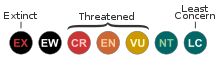
IUCN Red List of Threatened Plants Status : Least Concern.
Growth: S = slow M = medium F = fast. Soil: L = light (sandy) M = medium H = heavy (clay). pH: A = acid N = neutral B = basic (alkaline). Shade: F = full shade S = semi-shade N = no shade. Moisture: D = dry M = Moist We = wet Wa = water.
Now available:
Food Forest Plants for Mediterranean Conditions
350+ Perennial Plants For Mediterranean and Drier Food Forests and Permaculture Gardens.
[Paperback and eBook]
This is the third in Plants For A Future's series of plant guides for food forests tailored to
specific climate zones. Following volumes on temperate and tropical ecosystems, this book focuses
on species suited to Mediterranean conditions—regions with hot, dry summers and cool, wet winters,
often facing the added challenge of climate change.
Read More
Expert comment
Author
(Engelm.) F.M.Knuth
Botanical References
Links / References
For a list of references used on this page please go here
Readers comment
| Add a comment |
|
If you have important information about this plant that may help other users please add a comment or link below. Only comments or links that are felt to be directly relevant to a plant will be included. If you think a comment/link or information contained on this page is inaccurate or misleading we would welcome your feedback at [email protected]. If you have questions about a plant please use the Forum on this website as we do not have the resources to answer questions ourselves.
* Please note: the comments by website users are not necessarily those held by PFAF and may give misleading or inaccurate information.
|
Subject : Cylindropuntia arbuscula
|
|
|
|