 |
|
http://www.npwrc.usgs.gov |
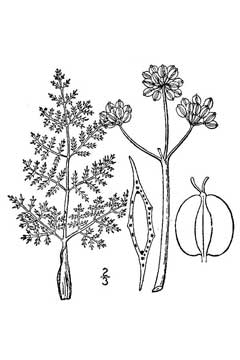 |
| USDA-NRCS PLANTS Database / Britton, N.L., and A. Brown. 1913. An illustrated flora of the northern United States, Canada and the British Possessions. 3 vols. Charles Scribner's Sons, New York. Vol. 2 |
Translate this page:
Summary
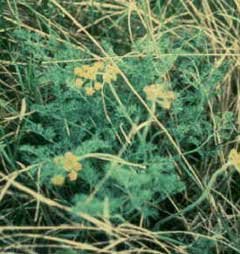
Desert biscuitroot is one of the finest edible members of the Lomatium genus found in the Southwest. Although the above-ground growth is relatively small, the plant produces surprisingly large, carrot-like roots with a pleasant parsnip flavour and excellent culinary qualities. Unlike many biscuitroots, the roots are largely free of harsh resinous flavours, making this one of the best native root vegetables for experienced foragers who can identify it correctly.
Physical Characteristics

 Cogswellia foeniculacea is a PERENNIAL growing to 0.5 m (1ft 8in) by 0.3 m (1ft) at a medium rate.
See above for USDA hardiness. It is hardy to UK zone 6. It is in flower from April to May. The species is hermaphrodite (has both male and female organs) and is pollinated by Insects. The plant is self-fertile.
It is noted for attracting wildlife.
Suitable for: light (sandy) and medium (loamy) soils, prefers well-drained soil and can grow in nutritionally poor soil. Suitable pH: mildly acid, neutral and basic (mildly alkaline) soils. It cannot grow in the shade. It prefers dry or moist soil and can tolerate drought.
UK Hardiness Map
US Hardiness Map
Synonyms
Cogswellia foeniculacea (Nutt.) J.M.Coult. & Rose. Ferula foeniculacea Nutt. Pastinaca foeniculacea (Nutt.) Spreng. Peucedanum foeniculaceum (Nutt.) Nutt.
Plant Habitats
Edible Uses
Desert biscuitroot is among the finest edible native roots of the American Southwest. Its large, nutritious roots have a pleasant parsnip-like flavor that becomes potato-like after cooking, placing it among the highest-quality members of the Lomatium genus. While the leaves are less desirable because of their resinous flavor, the roots make this species an outstanding wild food for experienced foragers able to identify it with confidence [2-3]. The roots, leaves, and young stems are edible, although the roots are by far the preferred food. The leaves can be eaten raw or cooked but are noticeably more resinous than the roots. As with all Lomatium species, soaking or cooking helps reduce naturally occurring phototoxic compounds, and careful identification is essential because members of the genus can resemble the deadly spotted hemlock [2-3]. Edibility Rating: 5 out of 5 – One of the best edible biscuitroots, producing excellent, nutritious roots with a mild flavor and good texture [2-3]. Taste and Preparation: The roots are typically 10–20 mm thick and 15–30 cm long, resembling small carrots. Fresh roots have a pleasant parsnip-like flavor without the harsh resinous aftertaste common in many other Lomatium species. After peeling, boiling softens the naturally fibrous texture and develops a potato-like flavor. The roots can also be roasted or baked. The leaves are edible but considerably less appealing, with noticeable resinous and latex-like flavors that are only slightly reduced by cooking [2-3]. Seasonality (Phenology): Leaves emerge in late winter or early spring. Plants flower in spring, and roots are best harvested while the foliage is still present, before summer dormancy. Traditional Uses: Desert biscuitroot was among the edible biscuitroots gathered by Indigenous peoples of western North America. Although not as extensively documented as cous, its high-quality roots made it a valuable seasonal food resource [2-3]. Safety: Like all members of the Lomatium genus, desert biscuitroot contains furanocoumarins, compounds capable of causing skin irritation and photosensitivity in susceptible individuals. Correct identification is essential because young plants can resemble spotted hemlock (Conium maculatum), one of North America's most poisonous plants. Cooking or soaking helps reduce water-soluble phototoxic compounds [2-3]. Root - cooked[2]. It can be dried and ground into a powder and then be mixed with cereal flours or added to soups etc[46, 61, 105]. Seed[106]. No more details are given, though it is most likely used as an aromatic flavouring in cooked foods[K].
References More on Edible Uses
Medicinal Uses
Plants For A Future can not take any responsibility for any adverse effects from the use of plants. Always seek advice from a professional before using a plant medicinally.
None known
References More on Medicinal Uses
Other Uses
The yellow flower clusters provide an important nectar and pollen source for native bees, flies, and other early-season pollinating insects. The foliage may also be browsed by native herbivores.
Special Uses
References More on Other Uses
Cultivation details
Prefers well-drained sandy or rocky soils in dry climates. It is well adapted to desert environments and open juniper woodland, thriving in full sun with minimal summer moisture. Habitat: Occurs throughout the greater Intermountain Region in desert habitats and juniper woodlands. The edible form described is based on subspecies macdougalii, while other subspecies occur farther west. USDA Hardiness Zones: USDA Zones 5–9 Growth Rate: Moderate. Plants emerge early each spring from perennial roots, then become dormant during hot, dry weather. Mature Size: Typically 15–50 cm (6–20 in.) tall. Cultivation: Best grown in full sun with excellent drainage. It tolerates drought once established but dislikes root disturbance because of its deep perennial taproot. Identification: Desert biscuitroot is a perennial herb with finely divided leaves, compound umbels of yellow flowers, and relatively large carrot-like roots that are noticeably bigger than the modest above-ground growth suggests. Like other Lomatium species, it produces flattened winged fruits that are useful for identification. Similar Species: It resembles other biscuitroots (Lomatium spp.), including Nevada biscuitroot and Great Basin biscuitroot. Before fruit develops, inexperienced foragers may also confuse it with spotted hemlock, making careful identification essential. This is a taxonomically very difficult genus; many of the species now included in it have at times been included in other genera[60].
References Carbon Farming Information and Carbon Sequestration Information
Temperature Converter
Type a value in the Celsius field to convert the value to Fahrenheit:
Fahrenheit:
Plant Propagation
Seed - best sown as soon as it is ripe in a cold frame. Stored seed can be rather slow to germinate, when sown in the spring it usually takes at least 12 months to germinate. Giving it a period of cold stratification might reduce this time. The seedlings need to be pricked out into individual pots as soon as they are large enough to handle, and should be planted out into their permanent positions in the summer. Fresh seed can be sown immediately in situ. Division may be possible in spring or autumn.
Other Names
If available other names are mentioned here
Inyo biscuitroot, Macdougal's biscuitroot.
Native Range
NORTHERN AMERICA: Canada (Saskatchewan, Alberta, Manitoba, British Columbia), United States (Kansas, Missouri, Nebraska, North Dakota, South Dakota, Oklahoma, Colorado, Idaho, Montana, Oregon, Washington, Wyoming, New Mexico, Texas, Arizona, California, Nevada)
Weed Potential
Right plant wrong place. We are currently updating this section.
Please note that a plant may be invasive in one area but may not
in your area so it's worth checking.
Low. A slow-growing native perennial with no invasive tendencies.
Conservation Status
IUCN Red List of Threatened Plants Status : Not Listed.
IUCN Red List
Growth: S = slow M = medium F = fast. Soil: L = light (sandy) M = medium H = heavy (clay). pH: A = acid N = neutral B = basic (alkaline). Shade: F = full shade S = semi-shade N = no shade. Moisture: D = dry M = Moist We = wet Wa = water.
Support Plants For A Future
Plants For A Future relies on regular donations to keep our free database and search facilities going, to pay for ongoing research, improvements and enhancements, and to develop and publish new books.
Read more
Choose Currency
Donate in £ GBP
Donate in $ USD
Donate in € EUR
Securely pay via PayPal or Credit/Debit Card without an account.
Expert comment
Author
(Nutt.) J.M.Coult. & Rose
Botanical References
60274
Links / References
For a list of references used on this page please go here
Readers comment
| Add a comment |
|
If you have important information about this plant that may help other users please add a comment or link below. Only comments or links that are felt to be directly relevant to a plant will be included. If you think a comment/link or information contained on this page is inaccurate or misleading we would welcome your feedback at [email protected]. If you have questions about a plant please use the Forum on this website as we do not have the resources to answer questions ourselves.
* Please note: the comments by website users are not necessarily those held by PFAF and may give misleading or inaccurate information.
|
Subject : Cogswellia foeniculacea
|
|
|
|