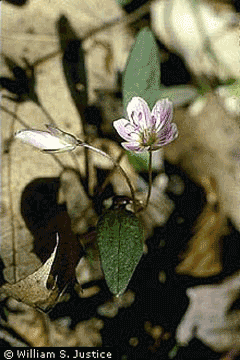
 |
|
William S. Justice @ USDA-NRCS PLANTS Database |
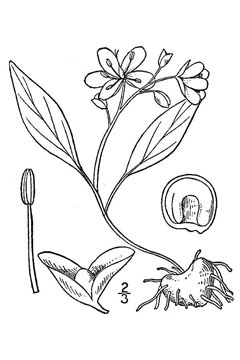 |
| USDA-NRCS PLANTS Database / Britton, N.L., and A. Brown. 1913. An illustrated flora of the northern United States, Canada and the British Possessions. Vol. 2: 38. |
Translate this page:
Summary
Physical Characteristics

 Claytonia_caroliniana is a PERENNIAL growing to 0.1 m (0ft 4in).
See above for USDA hardiness. It is hardy to UK zone 6. It is in flower in March, and the seeds ripen in May. The species is hermaphrodite (has both male and female organs).
Suitable for: light (sandy) and medium (loamy) soils and prefers well-drained soil. Suitable pH: mildly acid soils. It cannot grow in the shade. It prefers moist soil.
UK Hardiness Map
US Hardiness Map
Synonyms
Plant Habitats
Edible Uses
Root - raw or cooked like potatoes[2, 22, 46, 62, 85, 183, 257]. Rich in starch, it has a pleasant nutty flavour[105, K]. Leaves and stems - raw or cooked[62]. A very mild flavour, they are best mixed with stronger tasting leaves[183].
References More on Edible Uses
Medicinal Uses
Plants For A Future can not take any responsibility for any adverse effects from the use of plants. Always seek advice from a professional before using a plant medicinally.
None known
References More on Medicinal Uses
Other Uses
References More on Other Uses
Cultivation details
Prefers a damp peaty soil and a position in full sun[1, 164]. Requires a lime-free soil[164]. The plant is heat tolerant in zones 6 through 1. (Plant Hardiness Zones show how well plants withstand cold winter temperatures.
Plant Heat Zones show when plants would start suffering from the heat.
The Plant Heat Zone map is based on the number of "heat days" experienced in a given area where the temperature climbs to over 86 degrees F (30°C).
At this temperature, many plants begin to suffer physiological damage. Heat Zones range from 1 (no heat days) to 12 (210 or more heat days).
For example Heat Zone. 11-1 indicates that the plant is heat tolerant in zones 11 through 1.) For polyculture design as well as the above-ground architecture (form - tree, shrub etc. and size shown above) information on the habit and root pattern is also useful and given here if available. Ephemeral emerging in spring and dying back by summer every year [1-2]. A clumping mat former. Forming a dense prostrate carpet spreading indefinitely [1-2]. The root pattern is a corm swelling at the stem base [1-2].
References Carbon Farming Information and Carbon Sequestration Information
Temperature Converter
Type a value in the Celsius field to convert the value to Fahrenheit:
Fahrenheit:
Plant Propagation
Seed - surface sow on a peat based compost in spring in a cold frame. Germination usually takes place within 2 - 4 weeks at 10°c[164]. When large enough to handle, prick the seedlings out into individual pots and grow them on in the cold frame for at least their first winter. Plant them out in late spring or early summer after the last expected frosts. Division of offsets in spring or autumn.
Other Names
If available other names are mentioned here
Native Range
NORTHERN AMERICA: Connecticut, Georgia, Indiana, Iowa, Kentucky, Maine, Maryland, Massachusetts, Michigan, Minnesota, New Brunswick, New Hampshire, New York, Newfoundland, North Carolina, Nova Scotia, Ohio, Ontario, Pennsylvania, Prince Edward I., Québec, Tennessee, Vermont, Virginia, West Virginia, Wisconsin,
Weed Potential
Right plant wrong place. We are currently updating this section.
Please note that a plant may be invasive in one area but may not
in your area so it's worth checking.
Conservation Status
IUCN Red List of Threatened Plants Status :
IUCN Red List
Growth: S = slow M = medium F = fast. Soil: L = light (sandy) M = medium H = heavy (clay). pH: A = acid N = neutral B = basic (alkaline). Shade: F = full shade S = semi-shade N = no shade. Moisture: D = dry M = Moist We = wet Wa = water.
Support Plants For A Future
Plants For A Future relies on regular donations to keep our free database and search facilities going, to pay for ongoing research, improvements and enhancements, and to develop and publish new books.
Read more
Choose Currency
Donate in £ GBP
Donate in $ USD
Donate in € EUR
Securely pay via PayPal or Credit/Debit Card without an account.
Expert comment
Author
Michx.
Botanical References
43200270
Links / References
For a list of references used on this page please go here
Readers comment