 |
|
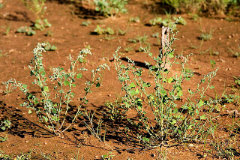
Patrick Alexander from Las Cruces, NM. Creative Commons Zero, Public Domain Dedication |
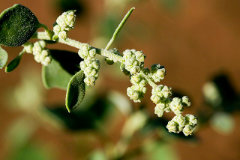 |
| Patrick Alexander from Las Cruces, NM. Creative Commons Zero, Public Domain Dedication |
Translate this page:
Summary
Taxonomic Note: This genus was formerly classified in the family Chenopodiaceae. Modern classifications include it within the Amaranthaceae.
Watson’s goosefoot is a strong-scented Chenopodium species native to the interior Southwest, including Arizona, New Mexico, Colorado, and adjacent regions. It thrives in dry foothills, shrublands, prairies, badlands, and disturbed soils, producing abundant seed crops that historically supported Indigenous subsistence in arid landscapes. The Navajo and other groups gathered the seeds as a dependable grain, though the plant’s aromatic, resinous foliage makes the leaves far less desirable than those of mild Chenopodium species. Like many Dysphania-adjacent taxa, Watson’s goosefoot contains aromatic oils that can be harmful in quantity, making it primarily a seed plant rather than a leafy green. Its seeds, once cooked, resemble quinoa in flavour and function and remain one of the more useful wild grains of the Southwestern interior.
Physical Characteristics

 Chenopodium watsonii is a ANNUAL growing to 0.6 m (2ft) by 0.3 m (1ft in) at a fast rate.
See above for USDA hardiness. It is hardy to UK zone 5. The flowers are pollinated by Wind.
It is noted for attracting wildlife.
Suitable for: light (sandy) and medium (loamy) soils, prefers well-drained soil and can grow in nutritionally poor soil. Suitable pH: neutral and basic (mildly alkaline) soils and can grow in very alkaline and saline soils.
It cannot grow in the shade. It prefers dry or moist soil and can tolerate drought.
UK Hardiness Map
US Hardiness Map
Synonyms
Homotypic Synonyms: C. olidum S.Watson. Heterotypic Synonyms: C. glabrescens (Aellen) Wahl. C. watsonii f. glabrescens Aellen.
Plant Habitats
Edible Uses
Leaves are unsuitable and potentially unsafe due to aromatic toxins. Seeds are excellent when cooked, easy to harvest, and traditionally significant. Watson’s goosefoot is a seed-plant, not a green, and should be treated as such. Edible Uses & Rating: Watson’s goosefoot provides edible seeds and, historically, these seeds represented the primary food value of the species. Leaves are not recommended due to their resinous compounds and strong scent, which aligns the plant with the more toxic Dysphania subgroup. Seeds, however, are nutritious, abundant, and of good quality once cooked, comparable in flavour and texture to other Chenopodium grains. This species receives a high rating for seeds and a very low rating for leaves, making it a specialised but reliable grain source for skilled foragers [2-3]. Taste, Processing & Kitchen Notes: Fresh leaves are strongly aromatic, resinous, and often unpleasant, carrying overtones reminiscent of epazote or other Dysphania species. Their bitterness and herbal intensity make them unsuitable for salads or potherbs. Seeds, by contrast, taste mild and nutty once cooked, similar to quinoa and Fremont’s or pitseed goosefoot. Toasting enhances flavour by adding a delicate roasted aroma while reducing the sharpness associated with raw resinous chaff. Boiling produces a soft grain-like porridge that pairs well with both savoury and sweet preparations. As with most chenopods, combining toasting followed by boiling produces the richest and most balanced flavour [2-3]. Seasonality (Phenology): Watson’s goosefoot germinates in late spring as soils warm. Vegetative growth follows through early summer, with flowering typically occurring mid- to late summer. Seeds mature from late summer into early autumn. Plants often persist as dried stalks with seeds well into fall, enabling extended harvesting windows. Safety & Cautions (Food Use): Like all strong-scented goosefoots and especially those formerly grouped with Dysphania, Watson’s goosefoot contains aromatic oils that may include ascaridole or related compounds. These substances can be harmful if consumed in quantity and may produce gastrointestinal or neurological symptoms. Leaves should not be eaten. Seeds are generally safe when cooked thoroughly. Avoid raw seed consumption 2-3]. Harvest & Processing Workflow: Harvest seeds once the plants turn red-brown and dry, stripping mature inflorescences into a container. Allow seeds to dry further before winnowing. Due to the plant’s resinous nature, some chaff carries strong aromas; winnowing, sieving, and rinsing can reduce these. Seeds may then be toasted, boiled, or ground into flour. Foragers typically prioritise seed-rich areas and collect multiple plants at once due to the species’ high yield. Cultivar / Selection Notes: No cultivars exist. Populations show variation in colour intensity, aroma, and seed size, but all share similar culinary and ecological characteristics. Look-Alikes & Confusion Risks: Watson’s goosefoot may resemble Dysphania graveolens or Dysphania botrys, all of which possess aromatic, resinous foliage. Unlike the mild Chenopodiums (e.g., C. album, C. berlandieri), Watson’s goosefoot is strongly scented, allowing quick distinction by smell and leaf texture. It should not be confused with the mild, powdery-leaved goosefoots preferred as leafy greens. Traditional / Indigenous Use Summary: The Navajo of Arizona are recorded as gathering Watson’s goosefoot seeds as a food resource. The species likely contributed to broader Southwestern seed-gathering traditions, particularly in regions where dependable grain crops were scarce. Leaves do not appear to have been used traditionally. Seeds, however, provided a shelf-stable, calorie-dense grain suitable for grinding into meal or cooking into porridges.
References More on Edible Uses
Medicinal Uses
Plants For A Future can not take any responsibility for any adverse effects from the use of plants. Always seek advice from a professional before using a plant medicinally.
None Known
References More on Medicinal Uses
The Bookshop: Edible Plant Books
Our Latest books on Perennial Plants For Food Forests and Permaculture Gardens in paperback or digital formats.
Edible Tropical Plants
Food Forest Plants for Hotter Conditions: 250+ Plants For Tropical Food Forests & Permaculture Gardens.
More
Edible Temperate Plants
Plants for Your Food Forest: 500 Plants for Temperate Food Forests & Permaculture Gardens.
More
More Books
PFAF have eight books available in paperback and digital formats. Browse the shop for more information.
Shop Now
Other Uses
This species does not offer ornamental value in conventional landscaping but performs reliably as a pioneer species in restoration settings, contributing to soil nutrient cycling and supporting seed-eating wildlife. Ecology & Wildlife: Seeds are eaten by small mammals and granivorous birds, making the plant an important component of desert and foothill food webs. Its aromatic foliage may deter some herbivores but provides shelter for ground-dwelling insects. As a disturbance-tolerant plant, it plays a role in soil stabilisation and colonisation following erosion events.
Special Uses
References More on Other Uses
Cultivation details
A strongly aromatic goosefoot of the arid interior Southwest, valued for its abundant, nutritious seeds but limited in leafy use due to resinous chemistry. It is hardy, drought-tolerant, and ecologically important, and its seeds offer a reliable wild grain where few comparable resources exist. Growing Conditions This species excels in dry, open habitats with full sun and mineral soils. It tolerates alkaline ground, gravel, sandy washes, and disturbed sites such as road edges and eroded slopes. It is drought-tolerant once established and often appears spontaneously in areas that experience periodic soil disruption. Moisture increases plant size but does not significantly alter seed quality. Habitat & Range: Watson’s goosefoot is native to the American Southwest, primarily Arizona, New Mexico, and Colorado, with occurrences in adjacent states depending on elevation and habitat. It inhabits woodlands, juniper savannas, prairies, shrublands, badlands, and disturbed areas. It is especially common in regions where monsoon moisture supports late-season annuals. Size & Landscape Performance: Plants generally reach 20–60 cm in height, though nutrient-rich or moister soils may support larger individuals. This species does not offer ornamental value in conventional landscaping but performs reliably as a pioneer species in restoration settings, contributing to soil nutrient cycling and supporting seed-eating wildlife. Cultivation (Horticulture): Although rarely cultivated intentionally, Watson’s goosefoot grows easily under garden conditions that mimic its native habitat—warm, dry, open ground with moderate fertility. If cultivated for seeds, spacing plants to encourage branching increases yields. Excess irrigation promotes vegetative growth but may dilute aromatic compounds slightly in the leaves, though they remain unpalatable. Pests & Problems: Watson’s goosefoot exhibits high tolerance to drought, heat, and poor soils, and suffers few pest issues. Occasional leaf damage from insects or fungal spotting does not significantly affect growth. Seed predation may reduce yields but rarely eliminates harvestable quantities. Cultivar / Selection Notes: No cultivars exist. Populations show variation in colour intensity, aroma, and seed size, but all share similar culinary and ecological characteristics. Pollination: Watson’s goosefoot is wind-pollinated, like most members of the genus. Dense clusters of small flowers produce large volumes of pollen, ensuring high seed set in open, breezy habitats. Identification & Habit: Watson’s goosefoot grows as a green to reddish-green upright herb, usually 20–60 cm tall, with branching stems that may become bushy in favourable conditions. The leaves are variable in shape—often lanceolate to rhombic, with entire, toothed, or weakly lobed margins—and are characteristically resinous or strong-smelling when crushed. Surfaces often bear glands or fine granules, giving the plant a slightly rough texture. Flowers appear as inconspicuous green clusters forming tight glomerules along upper stems. As the plant matures, it transitions from green to reddish or bronze hues, eventually drying to a brittle tan as seeds ripen. This species occurs widely across drylands and tolerates alkaline or disturbed soils well.
References Carbon Farming Information and Carbon Sequestration Information
Temperature Converter
Type a value in the Celsius field to convert the value to Fahrenheit:
Fahrenheit:
The PFAF Bookshop
Plants For A Future have a number of books available in paperback and digital form. Book titles include Edible Plants, Edible Perennials, Edible Trees,Edible Shrubs, Woodland Gardening, and Temperate Food Forest Plants. Our new book is Food Forest Plants For Hotter Conditions (Tropical and Sub-Tropical).
Shop Now
Plant Propagation
Watson’s goosefoot propagates exclusively by seed. Seeds germinate readily with warm soil temperatures and no stratification requirements. Self-seeding is common where plants are allowed to complete their life cycle.
Other Names
If available other names are mentioned here
Homotypic Synonyms: Chenopodium olidum S.Watson. Heterotypic Synonyms: Chenopodium glabrescens (Aellen) Wahl. Chenopodium watsonii f. glabrescens Aellen
Native Range
US. USA. Alberta, Arizona, California, Colorado, Kansas, Montana, New Mexico, Saskatchewan, South Dakota, Utah, Wyoming.
Weed Potential
Right plant wrong place. We are currently updating this section.
Please note that a plant may be invasive in one area but may not in your area so it's worth checking.
This species has moderate weed potential in disturbed arid regions, though it is far less aggressive than Chenopodium album. It establishes readily but is easily controlled by hand-pulling or cultivation. Because it is native and participates in local ecological cycles, its presence is rarely problematic.
Conservation Status
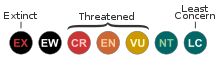
IUCN Red List of Threatened Plants Status : Not available
Growth: S = slow M = medium F = fast. Soil: L = light (sandy) M = medium H = heavy (clay). pH: A = acid N = neutral B = basic (alkaline). Shade: F = full shade S = semi-shade N = no shade. Moisture: D = dry M = Moist We = wet Wa = water.
Now available:
Food Forest Plants for Mediterranean Conditions
350+ Perennial Plants For Mediterranean and Drier Food Forests and Permaculture Gardens.
[Paperback and eBook]
This is the third in Plants For A Future's series of plant guides for food forests tailored to
specific climate zones. Following volumes on temperate and tropical ecosystems, this book focuses
on species suited to Mediterranean conditions—regions with hot, dry summers and cool, wet winters,
often facing the added challenge of climate change.
Read More
Expert comment
Author
A.Nelson
Botanical References
Links / References
For a list of references used on this page please go here
Readers comment
| Add a comment |
|
If you have important information about this plant that may help other users please add a comment or link below. Only comments or links that are felt to be directly relevant to a plant will be included. If you think a comment/link or information contained on this page is inaccurate or misleading we would welcome your feedback at [email protected]. If you have questions about a plant please use the Forum on this website as we do not have the resources to answer questions ourselves.
* Please note: the comments by website users are not necessarily those held by PFAF and may give misleading or inaccurate information.
|
Subject : Chenopodium watsonii
|
|
|
|