 |
|
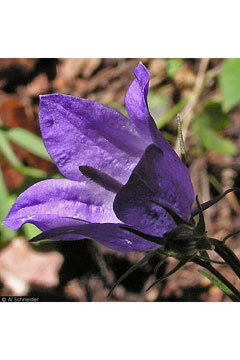
Al Schneider @ USDA-NRCS PLANTS Database |
 |
|
Translate this page:
Summary
Parry’s bellflower is a small, delicate perennial of high-elevation meadows in the central and southern Rocky Mountains. Its leaves and flowers are edible, though the yield is low and harvesting enough for a meal is labor-intensive. The mild, lettuce-like flavour makes it a minor supplementary wild food traditionally of little importance to Indigenous groups. It is primarily valued for its beauty, its presence in moist alpine ecosystems, and its distinctively campanulate flowers.
Physical Characteristics

 Campanula parryi is a PERENNIAL growing to 0.3 m (1ft) by 0.5 m (1ft 8in) at a fast rate.
See above for USDA hardiness. It is hardy to UK zone 4. The species is hermaphrodite (has both male and female organs) and is pollinated by Bees, flies, beetles, Lepidoptera (Moths & Butterflies). The plant is self-fertile.
Suitable for: light (sandy) and medium (loamy) soils and prefers well-drained soil. Suitable pH: neutral and basic (mildly alkaline) soils. It can grow in semi-shade (light woodland) or no shade. It prefers moist soil.
UK Hardiness Map
US Hardiness Map
Synonyms
Plant Habitats
Cultivated Beds;
Edible Uses
A charming alpine edible of very minor food importance. Its value lies in botanical interest more than nutrition. The edible parts are the fresh leaves and flowers. Their flavour resembles mild lettuce with a faint marshy overtone. They lack bitterness, astringency, or harshness, making them safe raw or cooked. However, the plants are extremely small, with only a handful of usable leaves per individual, giving them a low food-value rating. Stems are tough, wiry, and can splinter, so they must be avoided [2-3]. Taste, Processing & Kitchen Notes: Fresh leaves are tender and pleasant, easily incorporated into salads or as garnish. Cooking reduces the subtle marshy aspect but does not improve yield. Because the stems are inedible and fibrous, harvesters must pluck individual leaves, which is tedious. Flowers add visual interest and a mild vegetal sweetness [2-3]. Seasonality (Phenology): Mountain bluebells flower from June through September. Leaves emerge soon after snowmelt and remain usable through much of the season. The edible period aligns with high-elevation summer. Harvest & Processing Workflow: Harvest involves plucking individual leaves from large colonies—extremely time-consuming. Edible yield is small and best suited to supplementary use. Look-Alikes & Confusion Risks: Roundleaf bluebell (C. rotundifolia) is extremely similar. Differentiation depends on the presence of rounded basal leaves in rotundifolia. Both are edible. Traditional / Indigenous Use Summary: There is no substantial record of Native American consumption. The plant’s size and limited food value kept it from being a significant resource.
References More on Edible Uses
Medicinal Uses
Plants For A Future can not take any responsibility for any adverse effects from the use of plants. Always seek advice from a professional before using a plant medicinally.
Antiphlogistic Miscellany Miscellany Poultice Skin
The root is antiphlogistic[155]. A poultice made from the chewed root has been applied to bruises[257]. The plant has been taken by pregnant women who desired a female child[257]. The dried plant has been used as a dusting powder to treat sores[257]. The chewed blossoms have been applied to the skin as a depilatory[257].
References More on Medicinal Uses
The Bookshop: Edible Plant Books
Our Latest books on Perennial Plants For Food Forests and Permaculture Gardens in paperback or digital formats.
Edible Tropical Plants
Food Forest Plants for Hotter Conditions: 250+ Plants For Tropical Food Forests & Permaculture Gardens.
More
Edible Temperate Plants
Plants for Your Food Forest: 500 Plants for Temperate Food Forests & Permaculture Gardens.
More
More Books
PFAF have eight books available in paperback and digital formats. Browse the shop for more information.
Shop Now
Other Uses
Miscellany Miscellany
The chewed blossoms are depilatory[155]. Ecology & Wildlife: Pollination is largely performed by small bees, including halictids and solitary alpine species, along with occasional syrphid flies. Flowers are structured to favour insect pollination. Wildlife browsing is minimal due to the plant’s small size.
Special Uses
References More on Other Uses
Cultivation details
This species prefers cool, moist meadows, especially those saturated with snowmelt. It performs best in well-drained but moist soils, with full sun at high elevations or partial sun in lower sites. It is well adapted to cold climates, corresponding roughly to USDA Zones 3–7, depending on site exposure. Prefers a moist but well-drained, rich sandy loam and a neutral or alkaline soil in sun or partial shade[1, 200]. Plants grow and spread freely in any light soil and do well when hanging over a wall[221]. Plants are hardy to at least -15°c[200]. The species in this genus do not often hybridize and so seed can generally be relied upon to come true[221]. The plants are self-fertile[221]. Seed is freely produced in British gardens[221]. Plants are very attractive to slugs[221]. Members of this genus are rarely, if ever, troubled by browsing deer[233]. Identification & Habit: This perennial grows 5–30 cm tall, forming small colonies of thin, wiry stems arising from a narrow rootstock. Leaves are alternate, with lower blades oblanceolate and upper blades linear and grass-like. Surfaces are generally hairless, margins smooth or minutely toothed. Flowers are upright, bluish-purple, bell-shaped, 5-lobed, and 11–22 mm long, occurring singly or a few together in loose racemes. Capsules are upright, three-celled, releasing seeds through pores near the top—an important Campanula characteristic. Habitat & Range: Found primarily in northern Arizona, northern New Mexico, Utah, Colorado, Wyoming, and Idaho. It grows in montane and subalpine meadows, wet slopes, and streamside openings. Size & Landscape Performance: Typically 5–30 cm tall with minimal spread. In cultivation, it requires cool summers and consistent moisture. It is better suited as an alpine ornamental than a food plant, though it is rarely grown horticulturally. Cultivation (Horticulture): Germination requires cool, moist conditions. Plants benefit from snow cover in winter and mild summers. They may fail in hot, low-elevation gardens. They prefer humus-rich soils and good drainage with steady moisture. Pests & Problems: No major issues. Plants may suffer from desiccation during drought or heat waves.
References Carbon Farming Information and Carbon Sequestration Information
Temperature Converter
Type a value in the Celsius field to convert the value to Fahrenheit:
Fahrenheit:
The PFAF Bookshop
Plants For A Future have a number of books available in paperback and digital form. Book titles include Edible Plants, Edible Perennials, Edible Trees,Edible Shrubs, Woodland Gardening, and Temperate Food Forest Plants. Our new book is Food Forest Plants For Hotter Conditions (Tropical and Sub-Tropical).
Shop Now
Plant Propagation
Seed - surface sow spring in a cold frame. The seed usually germinates in 2 - 4 weeks at 18°c[138]. When they are large enough to handle, prick the seedlings out into individual pots and grow them on in a cold frame for at least their first winter. Plant them out into their permanent positions in late spring or early summer, after the last expected frosts. Basal cuttings in spring[1]. Harvest the shoots when they are about 10 - 15cm long with plenty of underground stem. Pot them up into individual pots and keep them in light shade in a cold frame or greenhouse until they are rooting well. Plant them out in the summer. Division in spring or autumn[111]. Difficult, because the long runners do not take kindly to separation from the parent plant and are difficult to establish[221].
Other Names
If available other names are mentioned here
Parry’s Bellflower / Scotch Bellflower / Mountain Bluebell (Campanula parryi)
Native Range
NORTHERN AMERICA: United States (Colorado (Rocky Mtns.), Idaho, Montana, Washington, Wyoming (south), New Mexico, Arizona (mountains), Utah)
Weed Potential
Right plant wrong place. We are currently updating this section.
Please note that a plant may be invasive in one area but may not in your area so it's worth checking.
No weed potential. This species is delicate, slow-spreading, and restricted to natural mountain environments.
Conservation Status
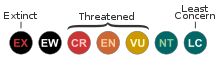
IUCN Red List of Threatened Plants Status :
| Related Plants
|
| Latin Name | Common Name | Habit | Height | Hardiness | Growth | Soil | Shade | Moisture | Edible | Medicinal | Other |
| Adenophora denticulata | | Perennial | 0.5 |
6-9
| | LM | N | M | 2 | 0 | |
| Adenophora divaricata | | Perennial | 1.0 |
-
| | LM | N | M | 2 | 0 | |
| Adenophora lamarkii | | Perennial | 0.6 |
5-9
| | LM | N | M | 2 | 0 | |
| Adenophora latifolia | | Perennial | 0.5 |
-
| | LM | N | M | 2 | 0 | |
| Adenophora liliifolia | Ladybells, Lilyleaf | Perennial | 0.5 |
3-8
| M | LM | N | M | 2 | 0 | |
| Adenophora nikoensis | | Perennial | 0.3 |
5-9
| | LM | N | M | 2 | 0 | |
| Adenophora remotiflora | | Perennial | 1.0 |
5-9
| | LM | N | M | 2 | 1 | |
| Adenophora stricta | Sha Shen, Ladybells | Perennial | 1.0 |
7-9
| | LM | N | M | 2 | 1 | |
| Adenophora triphylla | Nan Sha Shen | Perennial | 1.0 |
6-9
| | LM | N | M | 2 | 1 | |
| Adenophora verticillata | | Perennial | 1.0 |
6-9
| | LM | SN | M | 2 | 2 | |
| Agapanthus campanulatus | | Bulb | 0.6 |
6-9
| | LM | SN | M | 0 | 1 | |
| Asyneuma pulchellum | | Perennial | 0.0 |
-
| | LMH | SN | M | 0 | 0 | 2 |
| Asyneuma salignum | | Perennial | 0.0 |
-
| | LMH | SN | M | 0 | 0 | 2 |
| Azorina vidalii | | Shrub | 0.3 |
8-11
| | LM | N | DM | 3 | 0 | 0 |
| Campanula alliariifolia | Cornish Bellflower | Perennial | 0.7 |
3-7
| M | LM | SN | M | 3 | 0 | 3 |
| Campanula carpatica | Tussock Bellflower, Carpathian Bellflower, Carpathian Harebell | Perennial | 0.3 |
3-8
| S | LM | SN | M | 3 | 0 | 2 |
| Campanula carpatica turbinata | | Perennial | 0.3 |
3-7
| | LM | N | M | 3 | 0 | 2 |
| Campanula cochleariifolia | Fairies Thimbles | Perennial | 0.2 |
5-9
| | LM | N | M | 4 | 0 | |
| Campanula edulis | | Perennial | 0.2 |
-
| | LM | SN | M | 2 | 0 | |
| Campanula fenestrellata | Adriatic Bellflower | Perennial | 0.2 |
5-9
| M | LM | SN | M | 4 | 0 | |
| Campanula garganica | Adriatic Bellflower | Perennial | 0.2 |
4-8
| | LM | N | M | 3 | 0 | |
| Campanula glomerata | Clustered Bellflower, Dane's blood, Clustered Bellflower | Perennial | 1.0 |
4-9
| M | LM | SN | M | 4 | 0 | 0 |
| Campanula lactiflora | Milky Bellflower | Perennial | 1.0 |
4-8
| | LM | SN | M | 3 | 0 | |
| Campanula lasiocarpa | Mountain harebell | Perennial | 0.2 |
4-8
| | L | N | M | 2 | 0 | |
| Campanula latifolia | Large Campanula, Giant bellflower | Perennial | 1.5 |
3-7
| | LM | FS | DM | 3 | 1 | |
| Campanula latiloba | | Perennial | 0.9 |
3-7
| M | LM | SN | M | 3 | 0 | 3 |
| Campanula medium | Canterbury Bells, Cup and Saucer, Canterbury Bells | Biennial | 1.2 |
6-8
| M | LM | SN | M | 2 | 0 | 1 |
| Campanula persicifolia | Harebell, Peachleaf bellflower | Perennial | 1.0 |
3-7
| | LM | SN | M | 4 | 0 | |
| Campanula portenschlagiana | Adria Bellflower | Perennial | 0.3 |
3-7
| F | LM | SN | M | 3 | 0 | 3 |
|
|
Growth: S = slow M = medium F = fast. Soil: L = light (sandy) M = medium H = heavy (clay). pH: A = acid N = neutral B = basic (alkaline). Shade: F = full shade S = semi-shade N = no shade. Moisture: D = dry M = Moist We = wet Wa = water.
Now available:
Food Forest Plants for Mediterranean Conditions
350+ Perennial Plants For Mediterranean and Drier Food Forests and Permaculture Gardens.
[Paperback and eBook]
This is the third in Plants For A Future's series of plant guides for food forests tailored to
specific climate zones. Following volumes on temperate and tropical ecosystems, this book focuses
on species suited to Mediterranean conditions—regions with hot, dry summers and cool, wet winters,
often facing the added challenge of climate change.
Read More
Expert comment
Author
Gray.
Botanical References
60200
Links / References
For a list of references used on this page please go here
Readers comment
| Add a comment |
|
If you have important information about this plant that may help other users please add a comment or link below. Only comments or links that are felt to be directly relevant to a plant will be included. If you think a comment/link or information contained on this page is inaccurate or misleading we would welcome your feedback at [email protected]. If you have questions about a plant please use the Forum on this website as we do not have the resources to answer questions ourselves.
* Please note: the comments by website users are not necessarily those held by PFAF and may give misleading or inaccurate information.
|
Subject : Campanula parryi
|
|
|
|