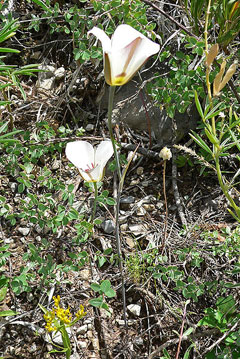
 |
|
http://commons.wikimedia.org/wiki/User:Stan_Shebs |
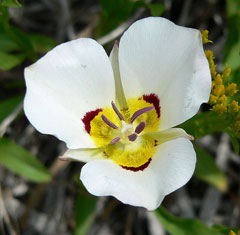 |
| http://commons.wikimedia.org/wiki/User:Stan_Shebs |
Translate this page:
Summary
The Sego Lily, Utah’s state flower, is one of North America’s most iconic wild lilies—renowned for both its elegant beauty and its historical importance as a survival food. In the mid-1800s, early Mormon settlers relied on its edible bulbs to endure crop failures, a legacy that earned the flower reverence throughout the Great Basin. Native Americans had already long prized Calochortus nuttallii as a reliable wild carbohydrate source. Its tulip-like blossoms—white, cream, or pinkish with striking purple or yellow basal markings—adorn sagebrush valleys, foothills, and mountain meadows each spring, symbolizing resilience and sustenance.
Physical Characteristics

 Calochortus nuttallii is a BULB growing to 0.2 m (0ft 8in).
See above for USDA hardiness. It is hardy to UK zone 3. It is in flower in June. The species is hermaphrodite (has both male and female organs) and is pollinated by Insects.
Suitable for: light (sandy) and medium (loamy) soils and prefers well-drained soil. Suitable pH: mildly acid, neutral and basic (mildly alkaline) soils. It cannot grow in the shade. It prefers dry or moist soil.
UK Hardiness Map
US Hardiness Map
Synonyms
C. luteus. non Dougl.
Plant Habitats
East Wall. By. South Wall. By.
Edible Uses
Edible Parts: Flowers Leaves Root Seed
Edible Uses:
Bulb - raw or cooked[207]. Remove the outer husk. Excellent raw, the flavour is greatly improved by slow cooking[183]. The bulbs are said to have a crisp nut-like texture and a pleasant flavour when cooked. The bulbs can also be dried and ground into a powder[207] which can be used with cereal flours when making bread[212]. Leaves - cooked as a potherb[183]. It is hard to obtain a sufficient quantity and this use of the leaves will weaken the plants so is not to be recommended[K]. Seed - ground into a powder[183]. Flowers and flower buds - raw. A tasty addition to the salad bowl[183]. Edible Uses & Rating: The bulbs are edible and were a significant traditional food for Native Americans and later for Mormon pioneers. The seeds are also edible but have a harsh, bitter taste that limits their value. The leaves are rarely used [2-3]. Edibility rating: 5/5 for bulbs; 1/5 for seeds and leaves. Taste, Processing & Kitchen Notes: Fresh bulbs are crisp, moist, and starchy, with a subtle sweetness reminiscent of young potatoes or parsnips. Roasted or baked bulbs develop a richer, chestnut-like flavor and tender texture. Boiling yields a milder, more uniform taste, excellent in soups or mashed preparations. The bulbs’ small size makes collection labor-intensive, but their high carbohydrate value and pleasant taste justify the effort [2-3]. The seeds can be toasted for flavor enhancement, releasing a warm, grain-like aroma akin to baked goods. However, their flavor is erratic—ranging from nutty to bitter—and some sources note potential toxicity or acridity, making them a poor staple. Grinding, boiling, and filtering the seeds into a broth produces a mild, palatable beverage [2-3]. Seasonality (Phenology): Sego Lilies bloom April to July, depending on elevation and moisture. The basal leaf emerges in early spring, followed by flowering in late spring and fruiting through midsummer. After seed dispersal, the entire plant dries and becomes dormant by late summer. Bulbs can be collected year-round but are easiest to locate after flowering, when withered stems and capsules mark their positions. Safety & Cautions (Food Use): The bulbs are safe to eat when cooked; raw consumption may cause mild digestive upset. Seeds should be approached with caution due to possible acrid compounds. Avoid collecting in protected or ecologically sensitive areas, as C. nuttallii is Utah’s state flower and culturally significant. Harvest & Processing Workflow: Bulbs are easiest to harvest after flowering, when seed capsules mark their location. Carefully loosen the soil around each bulb to avoid breaking it. Wash, peel, and cook by roasting, baking, or boiling for 15–30 minutes. For long-term use, bulbs may be dried and stored, then rehydrated before cooking. Traditional / Indigenous Use Summary: The Ute, Paiute, Goshute, and Shoshone peoples used C. nuttallii bulbs as a nutritious, starchy staple, roasting or boiling them much like potatoes. During periods of scarcity, they were a vital famine food. Early Mormon settlers in Utah likewise depended on the bulbs for survival in the 1840s, leading to the plant’s recognition as a symbol of divine providence and resilience. The flower continues to hold cultural and spiritual significance, representing renewal, sustenance, and perseverance.
References More on Edible Uses
Medicinal Uses
Plants For A Future can not take any responsibility for any adverse effects from the use of plants. Always seek advice from a professional before using a plant medicinally.
None known
References More on Medicinal Uses
The Bookshop: Edible Plant Books
Our Latest books on Perennial Plants For Food Forests and Permaculture Gardens in paperback or digital formats.
Edible Tropical Plants
Food Forest Plants for Hotter Conditions: 250+ Plants For Tropical Food Forests & Permaculture Gardens.
More
Edible Temperate Plants
Plants for Your Food Forest: 500 Plants for Temperate Food Forests & Permaculture Gardens.
More
More Books
PFAF have eight books available in paperback and digital formats. Browse the shop for more information.
Shop Now
Other Uses
C. nuttallii is a standout for rock gardens, native meadow restorations, and drought-tolerant landscapes, offering high visual appeal with minimal maintenance. Ecology & Wildlife: The showy flowers supply nectar and pollen to native bees and bee flies, supporting early-summer pollinator networks in mountain valleys. Bulbs are occasionally consumed by ground squirrels, voles, and pocket gophers, though this rarely threatens populations. The species helps stabilize shallow soils and contributes to biodiversity in arid and semi-arid ecosystems. Early Mormon settlers in Utah depended on the bulbs for survival in the 1840s, leading to the plant’s recognition as a symbol of divine providence and resilience. The flower continues to hold cultural and spiritual significance, representing renewal, sustenance, and perseverance.
Special Uses
References More on Other Uses
Cultivation details
Identification & Habit: Calochortus nuttallii is a perennial herb emerging from a rounded underground bulb, typically 1–2 cm in diameter. The plant grows 15–40 cm tall, producing one to several upright, cup-shaped flowers, each 4–6 cm across. The petals are white to creamy, often marked at the base with a distinct purple or maroon crescent and bordered by fine hairs surrounding a yellow or green nectar gland. Sepals are narrower and usually greenish or tinged purple. A single basal leaf, narrow and grass-like (up to 20 cm long), appears early in spring and withers by the time flowers open. After pollination, the plant forms a three-angled capsule, 2–4 cm long, containing numerous flat, tan seeds arranged in two rows per chamber. Pollination is primarily carried out by native solitary bees (Anthophora, Osmia, Perdita spp.), which are drawn to the flower’s high-contrast nectar guides and fragrant secretions. Occasionally, syrphid flies and bee flies also visit, supplementing pollination in upland habitats. Requires a deep very well-drained fertile sandy soil in a warm sunny position and must be kept dry from mid summer to late autumn[1, 90, 200]. This is a rather difficult plant to cultivate in Britain, it is very cold hardy but is intolerant of wetness especially in the winter[42, 90]. It is easiest to grow in a bulb frame[90] but is worth trying outdoors at the base of a south-facing wall, especially with shrubs that like these conditions[120]. Bulbs can be lifted as soon as the foliage dies down in the summer and stored overwinter in a cool dry place, replanting in spring[138]. Another report says that the bulbs should be replanted immediately[1]. Bulbs frequently divide after flowering, the bulblets taking 2 years to reach flowering size[200]. Hand pollination is necessary if seed is required[1]. A very ornamental plant[1], it is the state flower of Utah[85, 95].
References Carbon Farming Information and Carbon Sequestration Information
Temperature Converter
Type a value in the Celsius field to convert the value to Fahrenheit:
Fahrenheit:
The PFAF Bookshop
Plants For A Future have a number of books available in paperback and digital form. Book titles include Edible Plants, Edible Perennials, Edible Trees,Edible Shrubs, Woodland Gardening, and Temperate Food Forest Plants. Our new book is Food Forest Plants For Hotter Conditions (Tropical and Sub-Tropical).
Shop Now
Plant Propagation
Seed - sow as soon as ripe or early spring in a cold frame in a very sharply draining medium. Stratification may be helpful. Germination usually takes place within 1 - 6 months at 15°c[138]. Leave the seedlings undisturbed for their first two years growth[138], but give them an occasional liquid feed to ensure they do not become nutrient deficient. It is quite difficult to get the seedlings through their first period of dormancy since it is all too easy either to dry them out completely or keep them too moist when they will rot[214]. After their second year of growth, pot up the dormant bulbs in late summer and grow them on for at least another 2 years in the greenhouse before trying them outside. Seedlings take about 5 - 7 years to come into flower[214]. Division of the bulbs as soon as the foliage dies down. One report says that the bulbs must be planted into their permanent positions immediately[1], whilst another says that they can be stored overwinter and replanted in the spring[138]. Stem bulbils, harvested from the stems after flowering[200]. They can be stored cool and dry then planted in pots in the cold frame in the spring.
Other Names
If available other names are mentioned here
Sego Lily (Calochortus nuttallii Torr. & A. Gray)
Native Range
NORTHERN AMERICA: United States (Nebraska (northwest), North Dakota (southwest), South Dakota (west), Colorado (west), Idaho (southeast), Montana, Wyoming, New Mexico (northwest), Arizona (north), Nevada, Utah)
Weed Potential
Right plant wrong place. We are currently updating this section.
Please note that a plant may be invasive in one area but may not in your area so it's worth checking.
None. Calochortus nuttallii is delicate, slow-growing, and non-invasive. It depends on undisturbed soil and specific seasonal rhythms, making it vulnerable to overharvesting and habitat degradation.
Conservation Status
IUCN Red List of Threatened Plants Status : Not Listed.

Growth: S = slow M = medium F = fast. Soil: L = light (sandy) M = medium H = heavy (clay). pH: A = acid N = neutral B = basic (alkaline). Shade: F = full shade S = semi-shade N = no shade. Moisture: D = dry M = Moist We = wet Wa = water.
Now available:
Food Forest Plants for Mediterranean Conditions
350+ Perennial Plants For Mediterranean and Drier Food Forests and Permaculture Gardens.
[Paperback and eBook]
This is the third in Plants For A Future's series of plant guides for food forests tailored to
specific climate zones. Following volumes on temperate and tropical ecosystems, this book focuses
on species suited to Mediterranean conditions—regions with hot, dry summers and cool, wet winters,
often facing the added challenge of climate change.
Read More
Expert comment
Author
Torr.&A.Gray.
Botanical References
60270
Links / References
For a list of references used on this page please go here
Readers comment