 |
|
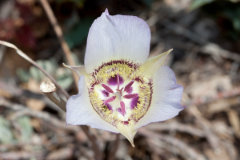
Bill Bouton from San Luis Obispo, CA, USA Attribution-Share Alike 2.0 |
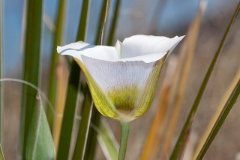 |
| Bill Bouton from San Luis Obispo, CA, USA Attribution-Share Alike 2.0 |
Translate this page:
Summary
The Arizona or Doubting Mariposa Lily is a delicate, drought-tolerant perennial native to the desert grasslands and foothills of the southwestern United States, particularly Arizona and New Mexico. Emerging from a small bulb, this lily produces striking, tulip-like flowers in spring—white to pale lavender with darker veins and a conspicuous nectar gland at each petal’s base. Although all Calochortus species have edible bulbs, many are protected or rare; collection should be avoided in conservation areas. The bulbs were a traditional food source among Indigenous peoples and early settlers.
Physical Characteristics

 Calochortus ambiguus is a BULB growing to 0.2 m (0ft 8in) by 0.1 m (0ft 4in) at a medium rate.
See above for USDA hardiness. It is hardy to UK zone 7. The flowers are pollinated by Bees, Insects.
It is noted for attracting wildlife.
Suitable for: light (sandy) and medium (loamy) soils, prefers well-drained soil and can grow in nutritionally poor soil. Suitable pH: neutral and basic (mildly alkaline) soils and can grow in very alkaline soils.
It cannot grow in the shade. It prefers dry or moist soil and can tolerate drought.
UK Hardiness Map
US Hardiness Map
Synonyms
Homotypic Synonyms: C. watsonii var. ambiguus M.E.Jones
Plant Habitats
Edible Uses
The bulbs are edible when cooked, offering a mild, potato-like flavor and soft texture. The bulbs were roasted or boiled by Native American peoples, notably the Apache and Hopi. Because of their small size, collecting enough bulbs for a meal is labor-intensive, but they are rich in starch and energy. The edibility rating is 4/5 for the bulb and 1/5 for other plant parts, which are minimal and of low nutritional value [2-3]. Taste, Processing & Kitchen Notes: Fresh bulbs are crisp and faintly sweet. When roasted or boiled, they develop a smooth, floury texture similar to parsnips or new potatoes. A light roasting or ash baking brings out a subtle nutty aroma. The bulbs lack bitterness or onion-like flavor, distinguishing them from many other bulbous plants. Indigenous cooking methods included roasting in earth ovens or boiling in clay pots [2-3]. Seasonality (Phenology): Flowering: April–June, depending on elevation and moisture. Fruiting: May–July. Dormancy: Plants die back completely by midsummer, leaving no above-ground trace until the following spring. Bulb harvest: Best conducted immediately after flowering or once seed capsules mature. Safety & Cautions (Food Use): Edible when cooked; raw bulbs may cause mild stomach upset due to saponins. Avoid collecting in protected habitats. Harvest & Processing Workflow: Dig bulbs carefully during or just after flowering using a narrow trowel. Rinse, peel outer tunic, and roast or boil 15–20 minutes. Drying or roasting for storage is possible but reduces flavor. Traditional / Indigenous Use Summary: Consumed as a starchy emergency food by southwestern tribes such as the Apache, Hopi, and Zuni. Bulbs were eaten roasted, boiled, or ground into flour. The plant also held ceremonial value, with flowers occasionally used as offerings.
References More on Edible Uses
Medicinal Uses
Plants For A Future can not take any responsibility for any adverse effects from the use of plants. Always seek advice from a professional before using a plant medicinally.
None Known
References More on Medicinal Uses
The Bookshop: Edible Plant Books
Our Latest books on Perennial Plants For Food Forests and Permaculture Gardens in paperback or digital formats.

Edible Tropical Plants
Food Forest Plants for Hotter Conditions: 250+ Plants For Tropical Food Forests & Permaculture Gardens.
More

Edible Temperate Plants
Plants for Your Food Forest: 500 Plants for Temperate Food Forests & Permaculture Gardens.
More

More Books
PFAF have eight books available in paperback and digital formats. Browse the shop for more information.
Shop Now
Other Uses
Xeric native gardens and wildflower restorations. Traditional / Indigenous Use Summary: The plant also held ceremonial value, with flowers occasionally used as offerings. Ecology & Wildlife: Supports native bee pollinators and small beetles. The flowers’ nectar glands provide early-season resources in desert ecosystems. Bulbs may be consumed by rodents, including ground squirrels and pocket gophers. A beautiful and ecologically resilient desert bulb with a long cultural history as a wild food. It exemplifies adaptation to drought and nutrient-poor soils while producing edible bulbs.
Special Uses
References More on Other Uses
Cultivation details
Identification & Habit: A small herbaceous perennial, Calochortus ambiguus arises from an ovoid bulb 1–2 cm in diameter. Stems are slender, 10–40 cm tall, usually unbranched, and bear one to three grass-like leaves. Flowers are cup-shaped with three broad petals and three narrower sepals, the petals displaying a whitish-pink to lavender hue with darker markings and a distinctive central nectar gland. The interior may be spotted or fringed. Fruits are erect, three-angled capsules that dry to a tan color. Pollination is primarily by native solitary bees (Anthophoridae, Andrenidae) and occasionally small butterflies and beetles, which are attracted by the conspicuous coloration and sugary secretions of the petal glands. Growing Conditions: Prefers well-drained sandy or gravelly soils in open grasslands, pinyon-juniper woodlands, and desert foothills. It thrives in full sun, tolerates alkaline conditions, and survives extended summer drought via dormancy. USDA Hardiness Zones: 6–9. Habitat & Range: Native to Arizona, New Mexico, and northern Mexico, typically found between 1,000 and 2,000 m elevation on dry slopes, mesas, and desert grasslands. Often associated with Agave, Yucca, and Bouteloua species in open habitats. Size & Landscape Performance: Height ranges 10–40 cm, width 10–15 cm. The plant’s fine, grassy foliage and elegant flowers make it desirable for xeric native gardens and wildflower restorations. In cultivation, it benefits from rocky mulch and deep, dry summer dormancy. Cultivation (Horticulture): Requires dry summers and moderate winter moisture; well-suited to rock gardens. Fertilization should be avoided, as rich soils diminish bulb hardiness. Pests & Problems: Generally pest-free. In cultivation, bulbs may rot in poorly drained soils. Fungal blight occasionally affects leaves under humid conditions.
References Carbon Farming Information and Carbon Sequestration Information
Temperature Converter
Type a value in the Celsius field to convert the value to Fahrenheit:
Fahrenheit:
The PFAF Bookshop
Plants For A Future have a number of books available in paperback and digital form. Book titles include Edible Plants, Edible Perennials, Edible Trees,Edible Shrubs, Woodland Gardening, and Temperate Food Forest Plants. Our new book is Food Forest Plants For Hotter Conditions (Tropical and Sub-Tropical).
Shop Now
Plant Propagation
Best from seed sown in fall; bulbs may be divided after dormancy.
Other Names
If available other names are mentioned here
Arizona or Doubting Mariposa Lily (Calochortus ambiguus (M.E. Jones) Ownbey)
Native Range
US. USA. Arizona, Mexico Northwest, New Mexico, Utah
Weed Potential
Right plant wrong place. We are currently updating this section.
Please note that a plant may be invasive in one area but may not in your area so it's worth checking.
None. Calochortus ambiguus is not aggressive and tends to decline in disturbed areas.
Conservation Status
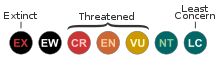
IUCN Red List of Threatened Plants Status : Not available
Growth: S = slow M = medium F = fast. Soil: L = light (sandy) M = medium H = heavy (clay). pH: A = acid N = neutral B = basic (alkaline). Shade: F = full shade S = semi-shade N = no shade. Moisture: D = dry M = Moist We = wet Wa = water.
Now available:
Food Forest Plants for Mediterranean Conditions
350+ Perennial Plants For Mediterranean and Drier Food Forests and Permaculture Gardens.
[Paperback and eBook]
This is the third in Plants For A Future's series of plant guides for food forests tailored to
specific climate zones. Following volumes on temperate and tropical ecosystems, this book focuses
on species suited to Mediterranean conditions—regions with hot, dry summers and cool, wet winters,
often facing the added challenge of climate change.
Read More
Expert comment
Author
(M.E. Jones) Ownbey
Botanical References
Links / References
For a list of references used on this page please go here
Readers comment
| Add a comment |
|
If you have important information about this plant that may help other users please add a comment or link below. Only comments or links that are felt to be directly relevant to a plant will be included. If you think a comment/link or information contained on this page is inaccurate or misleading we would welcome your feedback at [email protected]. If you have questions about a plant please use the Forum on this website as we do not have the resources to answer questions ourselves.
* Please note: the comments by website users are not necessarily those held by PFAF and may give misleading or inaccurate information.
|
Subject : Calochortus ambiguus
|
|
|
|