 |
|
http://commons.wikimedia.org/wiki/User:Stan_Shebs |
 |
|
Translate this page:
Summary
Sahara mustard (Brassica tournefortii) is an aggressive but remarkably useful winter annual mustard that dominates the sandy flats, washes, and dunes of the Sonoran and Mojave deserts. It’s both a highly invasive weed and a reliable wild food resource, offering edible leaves, roots, and seeds during the cool season when few other desert edibles are available. Its tender young rosettes are among the first greenery to appear after winter rains, making it one of the earliest and most abundant edible plants of the desert floor. The plant’s roots and seeds are nutritious and calorie-rich, and even though the leaves can be raspy and pungent, they are edible when young or well cooked. Sahara mustard is thus a paradoxical plant—detested by ecologists but cherished by survivalists and foragers. USDA Hardiness Zones: 8–11 (annual). Height: typically 30–90 cm. Spread: variable, up to 1 m across in mature rosettes. Sahara mustard is an invasive menace from an ecological standpoint but an edible boon for those who understand its timing and preparation. With mild roots, spicy greens, and abundant seeds, it is arguably the most productive wild edible of the American desert winter. Harvesting it responsibly—removing entire plants before seed set—both yields food and aids in controlling its spread.
Physical Characteristics

 Brassica tournefortii is a ANNUAL growing to 0.6 m (2ft) by 1 m (3ft 3in).
See above for USDA hardiness. It is hardy to UK zone 8. The species is hermaphrodite (has both male and female organs) and is pollinated by Insects.
Suitable for: light (sandy) and medium (loamy) soils and prefers well-drained soil. Suitable pH: mildly acid, neutral and basic (mildly alkaline) soils. It cannot grow in the shade. It prefers moist soil.
UK Hardiness Map
US Hardiness Map
Synonyms
Plant Habitats
Cultivated Beds;
Edible Uses
Edible Parts: Leaves Oil Shoots
Edible Uses: Oil
Leaves and young shoots - cooked[177, 183]. An edible oil is obtained from the seed[177, 183]. Edible Uses & Rating: All major parts—leaves, roots, and seeds—are edible, though their suitability varies by age and preparation. Young leaves: best in early winter as tender rosettes; edible raw or cooked. Roots: when young, juicy and mild; when old, woody and fibrous. Seeds: edible raw, toasted, or ground; mildly spicy, like mustard seed [2-3]. As a whole, B. tournefortii is a 4/5 survival resource for its abundance, caloric potential, and long availability, though the texture and flavor of mature leaves limit its culinary versatility. Taste, Processing & Kitchen Notes: Leaves taste mildly mustard-like when young, becoming increasingly sharp, hot, or even “fire-breathing” with age. Dense hairs give a raspy texture that softens with boiling. Even after cooking, some coarseness may persist. They’re best treated as potherbs—blanched or boiled and added to soups or beans. Roots, when fresh after winter rains, are thick, white, and mildly sweet with a crisp, turnip-like texture. They can be sliced, boiled, or roasted for a pleasant vegetable dish. Seeds can be toasted and ground to make a pungent mustard paste or seasoning. The flavor is rich and spicy without bitterness. However, seed quality declines rapidly once molds set in later in spring; only fresh, clean seedpods should be used [2-3]. Culinary Tip: Young rosettes (less than 15 cm across) have the best flavor and least hairiness. Older plants can be stripped of outer leaves and boiled twice to reduce heat and texture. Seasonality (Phenology): Germination follows autumn or early winter rains (November–January). Rosette stage: winter to early spring. Flowering: January to May, depending on rainfall and temperature. Seed maturation: March–June; seedpods may persist nearly year-round on dried plants. Dormancy: during hot, dry summers, plants die back but leave seed banks that germinate next season. In frost-free desert zones, plants can remain green year-round following periodic rain. Look-Alikes & Confusion Risks: Easily mistaken for other wild mustards (Sinapis arvensis, Eruca vesicaria, Raphanus sativus), but Sahara mustard is distinguished by its raspy leaves, dense desert growth, and short-beaked siliques. The flowers resemble those of wild radish but lack the purple or pink veining. Traditional/Indigenous Use Summary: Desert dwellers and indigenous peoples of North Africa and the Middle East have long utilized B. tournefortii as a winter green and seed crop. In North America, foragers—both Native and settler—collected the young rosettes for cooking greens and ground seeds into pastes. Today, survivalists value it as one of the most dependable edible weeds of the Sonoran Desert. Overall Plant Summary: Sahara mustard is an invasive menace from an ecological standpoint but an edible boon for those who understand its timing and preparation. With mild roots, spicy greens, and abundant seeds, it is arguably the most productive wild edible of the American desert winter. Harvesting it responsibly—removing entire plants before seed set—both yields food and aids in controlling its spread.
References More on Edible Uses
Medicinal Uses
Plants For A Future can not take any responsibility for any adverse effects from the use of plants. Always seek advice from a professional before using a plant medicinally.
None known
References More on Medicinal Uses
The Bookshop: Edible Plant Books
Our Latest books on Perennial Plants For Food Forests and Permaculture Gardens in paperback or digital formats.

Edible Tropical Plants
Food Forest Plants for Hotter Conditions: 250+ Plants For Tropical Food Forests & Permaculture Gardens.
More

Edible Temperate Plants
Plants for Your Food Forest: 500 Plants for Temperate Food Forests & Permaculture Gardens.
More

More Books
PFAF have eight books available in paperback and digital formats. Browse the shop for more information.
Shop Now
Other Uses
Oil
Ecology & Wildlife: Dense stands alter wildflower composition and reduce habitat quality for insects and small mammals. Few native herbivores consume it, likely due to its raspy hairs and pungent flavor. However, it can provide early nectar sources for desert pollinators and occasional forage for livestock when young.
Special Uses
References More on Other Uses
Cultivation details
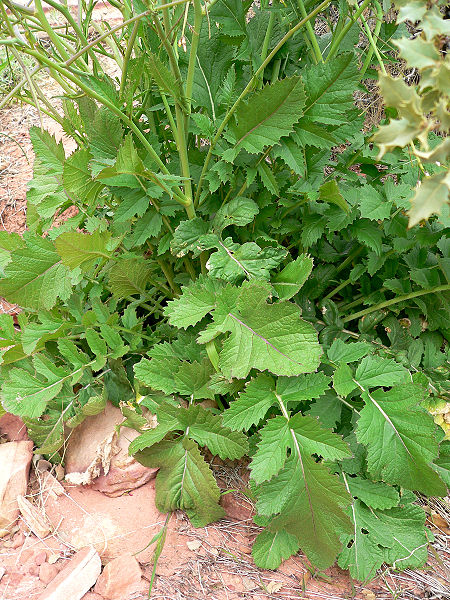
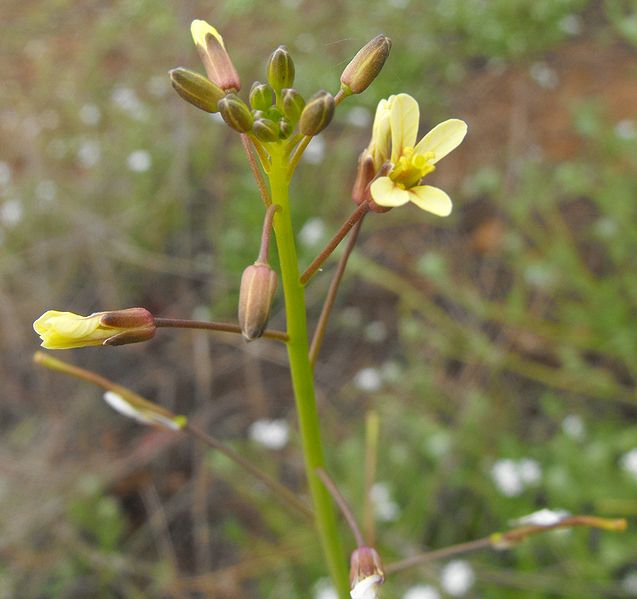
Identification & Habit: A coarse, aromatic annual herb in the mustard family (Brassicaceae). Plants begin as dense leafy rosettes with pinnately divided basal leaves covered in short, stiff, raspy hairs. As the season progresses, the plant sends up tall, branching flowering stems bearing bright yellow, four-petaled flowers typical of the mustard family. Leaves toward the top of the plant are smaller, less divided, and sometimes sessile (attached directly to the stem). The seedpods (siliques) are 25–65 mm long, cylindrical, hairless, and end in a short conical beak that does not contain seeds. Each pod holds a single row of tiny, round, yellowish-brown seeds. Stems and leaves are rough to the touch due to stiff, unbranched hairs. Mature plants become straw-colored and brittle, often forming dense, tumbleweed-like clusters. Growing Conditions: Thrives in sandy, disturbed soils with good drainage, full sun, and occasional moisture. It prefers arid to semi-arid climates with mild winters. Tolerates alkaline and saline soils, extreme heat, and drought once established. Optimal growth follows winter rainfall, when soil moisture is high and temperatures range 10–25°C. Habitat & Range: Native to North Africa and the Middle East, Brassica tournefortii has naturalized throughout the American Southwest, where it dominates sandy washes, dunes, and roadsides. It is now found from southern California and Arizona to Texas, and northward into Nevada and Utah. It is one of the most conspicuous invasive species in the Sonoran and Mojave deserts, forming vast monocultures that suppress native wildflowers. Size & Landscape Performance: In favorable conditions, rosettes can reach 1 m across before flowering. Flowering stems may reach up to 90 cm tall, producing hundreds of pods. The plant’s high seed yield ensures persistence even in poor soils. In cultivation, it performs aggressively and is not recommended outside controlled environments. Cultivation (Horticulture): Because it is invasive, cultivation is discouraged except for educational or research purposes. However, in controlled conditions it behaves like other cool-season mustards: sow in autumn in sandy soil, keep moist until established, and harvest leaves when young. It reseeds prolifically and should be harvested before flowering to prevent spread. Pests & Problems: Generally disease- and pest-free in the wild. The main issue for human use is fungal infection in seeds late in the season, indicated by gray mold or blackened seeds. These are unsafe to consume and should be discarded. Leaf miners and aphids may appear in dense stands but are rarely consequential.
References Carbon Farming Information and Carbon Sequestration Information
Temperature Converter
Type a value in the Celsius field to convert the value to Fahrenheit:
Fahrenheit:
The PFAF Bookshop
Plants For A Future have a number of books available in paperback and digital form. Book titles include Edible Plants, Edible Perennials, Edible Trees,Edible Shrubs, Woodland Gardening, and Temperate Food Forest Plants. Our new book is Food Forest Plants For Hotter Conditions (Tropical and Sub-Tropical).
Shop Now
Plant Propagation
Seed - sow spring in situ.
Other Names
If available other names are mentioned here
Asian mustard; long-fruit turnip; Mediterranean mustard; Mediterranean turnip; pale cabbage; Sahara mustard; tournefort’s birdrape; tournefort’s mustard; wild turnip.
Spanish: mostaza; mostaza del desierto; mostaza del Sahara.
French: chou de tournefort.
Arabic: qarras; shiltam.
Finland: välimerenkaali.
Italy: cavolo di tournefort.
UK: bresychen welw.
Native Range
TEMPERATE ASIA: United Arab Emirates, Bahrain, Kuwait, Oman, Qatar, Saudi Arabia, Cyprus, Iran, Iraq, Israel, Jordan, Lebanon, Syria, Turkey, Azerbaijan, Turkmenistan, Uzbekistan TROPICAL ASIA: Pakistan EUROPE: Greece (incl. Crete), Italy (incl. Sardinia, Sicily), Spain (east & south) AFRICA: Algeria (north), Egypt, Libya (north), Morocco, Tunisia
Weed Potential
Right plant wrong place. We are currently updating this section.
Please note that a plant may be invasive in one area but may not in your area so it's worth checking.
Highly invasive annual herb and is recorded as negatively affecting native species in some US states and Australia. Its fast growth rates enable it to monopolize soil moisture and light and mature before native wildflowers [1d].
Conservation Status
IUCN Red List of Threatened Plants Status : This taxon has not yet been assessed .
| Related Plants
|
| Latin Name | Common Name | Habit | Height | Hardiness | Growth | Soil | Shade | Moisture | Edible | Medicinal | Other |
| Alliaria petiolata | Garlic Mustard | Biennial | 1.0 |
5-8
| | LMH | FS | MWe | 3 | 2 | 1 |
| Alyssum alyssoides | Pale Madwort | Annual | 0.2 |
4-8
| F | LM | SN | DM | 2 | 0 | 0 |
| Arabidopsis thaliana | Thale Cress, Mouseear cress | Annual/Biennial | 0.5 |
0-0
| | LMH | SN | DM | 0 | 1 | 1 |
| Arabis alpina | Alpine Rock Cress, Alpine rockcress | Perennial | 0.2 |
4-8
| | LM | SN | M | 2 | 0 | |
| Arabis caucasica | Rock Cress, Wall Rockcress | Perennial | 0.2 |
4-9
| M | LMH | SN | DM | 2 | 0 | 3 |
| Arabis hirsuta | Hairy rockcress, Mountain rockcress, Creamflower rockcress | Biennial/Perennial | 0.6 |
4-8
| | LMH | SN | DM | 1 | 0 | |
| Arabis lyrata | Rock Cress, Kamchatka rockcress, Lyrate rockcress | Biennial/Perennial | 0.3 |
4-8
| | LMH | SN | DM | 1 | 0 | |
| Arabis pendula | | Biennial | 0.9 |
-
| | LMH | FSN | M | 1 | 0 | |
| Arabis sagittata | | Biennial/Perennial | 0.6 |
-
| | LMH | SN | DM | 1 | 0 | |
| Arabis serrata | | Perennial | 0.3 |
6-9
| | LMH | SN | M | 1 | 0 | |
| Armoracia rusticana | Horseradish, Red Cole | Perennial | 0.7 |
4-9
| F | LMH | SN | M | 3 | 3 | 2 |
| Aubrieta deltoidea | Aubretia, Lilacbush, False Rockcress | Perennial | 0.2 |
4-9
| M | LM | SN | DM | 0 | 0 | 3 |
| Aurinia saxatilis | Golden Alyssum, Basket of gold | Perennial | 0.3 |
4-10
| M | LMH | N | DM | 0 | 0 | 3 |
| Barbarea australis | | Biennial/Perennial | 0.5 |
-
| | LMH | SN | M | 2 | 1 | |
| Barbarea orthoceras | American Yellowrocket | Perennial | 0.5 |
3-8
| | LMH | SN | M | 3 | 0 | 1 |
| Barbarea stricta | Small-flowered winter-cress | Biennial | 0.8 |
3-10
| F | LMH | N | MWe | 2 | 0 | 0 |
| Barbarea verna | Land Cress, Early yellowrocket | Biennial | 0.3 |
4-9
| | LMH | SN | M | 3 | 0 | 1 |
| Barbarea vulgaris | Yellow Rocket, Garden yellowrocket | Perennial | 0.4 |
3-9
| | LMH | SN | M | 3 | 1 | 1 |
| Brassica balearica | | Perennial | 0.0 |
-
| | LMH | N | M | 1 | 0 | |
| Brassica carinata | Abyssinian Cabbage | Annual | 1.0 |
9-12
| F | LMH | SN | M | 4 | 2 | 3 |
| Brassica cretica | Mustard | Perennial | 1.0 |
0-0
| | LMH | N | M | 2 | 0 | |
| Brassica elongata | Elongated mustard | Biennial/Perennial | 0.9 |
0-0
| | LMH | SN | M | 2 | 0 | 2 |
| Brassica juncea | Brown Mustard | Annual | 0.8 |
6-9
| | LMH | SN | M | 4 | 2 | 2 |
| Brassica juncea crispifolia | Curled Mustard | Annual | 0.3 |
6-9
| F | LMH | SN | M | 4 | 2 | 2 |
| Brassica juncea foliosa | Leaf Mustard | Annual | 0.3 |
6-9
| F | LMH | SN | M | 4 | 2 | 2 |
| Brassica juncea integrifolia crispifolia | Curled Mustard | Annual | 0.3 |
6-10
| F | LMH | SN | M | 4 | 2 | 2 |
| Brassica juncea integrifolia rugosa | Head Mustard | Annual | 0.6 |
6-10
| F | LMH | SN | M | 4 | 2 | 2 |
| Brassica juncea integrifolia strumata | Large Petiole Mustard | Annual | 0.8 |
6-10
| F | LMH | SN | M | 4 | 2 | 2 |
| Brassica juncea integrifolia subintegrifolia | Leaf Mustard | Annual | 0.3 |
6-10
| F | LMH | SN | M | 4 | 2 | 2 |
| Brassica juncea multiceps | Green In The Snow | Annual | 0.4 |
6-9
| F | LMH | SN | M | 4 | 2 | 2 |
|
|
Growth: S = slow M = medium F = fast. Soil: L = light (sandy) M = medium H = heavy (clay). pH: A = acid N = neutral B = basic (alkaline). Shade: F = full shade S = semi-shade N = no shade. Moisture: D = dry M = Moist We = wet Wa = water.
Now available:
Food Forest Plants for Mediterranean Conditions
350+ Perennial Plants For Mediterranean and Drier Food Forests and Permaculture Gardens.
[Paperback and eBook]
This is the third in Plants For A Future's series of plant guides for food forests tailored to
specific climate zones. Following volumes on temperate and tropical ecosystems, this book focuses
on species suited to Mediterranean conditions—regions with hot, dry summers and cool, wet winters,
often facing the added challenge of climate change.
Read More
Expert comment
Author
Gouan.
Botanical References
74
Links / References
For a list of references used on this page please go here
Readers comment