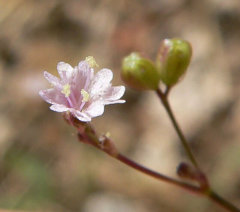
 |
|
Stan Shebs Creative Commons Attribution-Share Alike 3.0 |
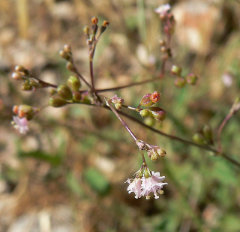 |
| Stan Shebs Creative Commons Attribution-Share Alike 3.0 |
Translate this page:
Summary
Coulter’s spiderling is a small, wiry Boerhavia native to the hot, summer-rain deserts of the U.S. Southwest and northern Mexico. It leafs out rapidly after monsoon moisture, flowers modestly, then withers as heat and drought return. Although some Native American groups ate the shoots and leaves, the plant is high in oxalates and typically causes a burning sensation in the mouth and throat; even with boiling, the irritation persists and flavor remains poor. As a foraged vegetable it is best regarded as a famine or curiosity food rather than a staple. Horticulturally it is a resilient annual to short-lived perennial for extremely dry sites and native restoration mixes where a quick green-up after summer rains is desired. USDA Hardiness Zones 9–11 (dies back or behaves as a warm-season annual in colder zones); typical size 10–30 cm tall and 20–60 cm spread, often broader than tall.
Physical Characteristics

 Boerhavia coulteri is a ANNUAL growing to 0.3 m (1ft) by 0.6 m (2ft in) at a fast rate.
See above for USDA hardiness. It is hardy to UK zone 10 and is frost tender. The flowers are pollinated by Insects.
It is noted for attracting wildlife.
Suitable for: light (sandy) and medium (loamy) soils, prefers well-drained soil and can grow in nutritionally poor soil. Suitable pH: neutral and basic (mildly alkaline) soils and can grow in very alkaline and saline soils.
It cannot grow in the shade. It prefers dry or moist soil and can tolerate drought.
UK Hardiness Map
US Hardiness Map
Synonyms
Homotypic Synonyms: Senkenbergia coulteri Hook.f.
Plant Habitats
Edible Uses
Edible Uses & Rating: Shoots and leaves have been eaten traditionally, but strong oxalate levels make them irritating, with a burning sensation that increases with quantity. Boiling does not adequately remove the irritation. Other parts are not recommended as food. As a practical wild edible this species ranks very low. Edibility rating: 1/5 (emergency only) [2-3]. Taste, Processing & Kitchen Notes: Raw leaves present a fleeting suggestion of green beans and spinach overlaid by a peculiar, resinous “chemical” note; within a few bites a throat/mouth burn develops. Boiling softens texture to a spinach-like mush but does not meaningfully reduce the oxalate burn or improve flavor. Shoots may be marginally milder than mature leaves, yet still irritating. There is no reliable processing method (blanching, multiple water changes, drying) that yields consistently palatable results; consequently, routine culinary use is not advised [2-3]. Seasonality (Phenology): Germinates rapidly after summer monsoon rains; vegetative growth and flowering occur from mid-summer into early autumn, followed by quick fruit set and senescence as soils dry. In frost-free microsites it may persist or resprout, but most plants behave as fast-cycling annuals. Harvest & Processing Workflow: If documentation or tasting is required: harvest very young shoots/leaves immediately after a rain when turgid. Rinse thoroughly. Briefly blanch and test a tiny portion; discontinue if any burn develops. There is no safe or effective home method to convert this plant into a regular potherb; do not attempt seed use.Look-Alikes & Confusion Risks: Readily confused with other Boerhavia (e.g., B. coccinea, B. spicata, B. wrightii) that share the thin, wiry habit and tiny, 5-lobed flowers; all are broadly similar in edibility (poor) and chemistry (oxalates). Distinguish from Mirabilis (four-o’clocks) by the small, funnelform flowers and club-ribbed anthocarps of Boerhavia versus larger showy perianths in Mirabilis. Seedlings can resemble small Amaranthus; check for opposite, unequal leaves and sticky ribbed fruits as plants mature. Traditional/Indigenous Use Summary: Ethnobotanical notes record shoots and leaves eaten by some Native American groups despite irritation, likely as opportunistic greens following monsoon rains. Use appears limited and situational rather than a staple, aligning with modern field experience of poor palatability.
References More on Edible Uses
Medicinal Uses
Plants For A Future can not take any responsibility for any adverse effects from the use of plants. Always seek advice from a professional before using a plant medicinally.
None Known
References More on Medicinal Uses
The Bookshop: Edible Plant Books
Our Latest books on Perennial Plants For Food Forests and Permaculture Gardens in paperback or digital formats.
Edible Tropical Plants
Food Forest Plants for Hotter Conditions: 250+ Plants For Tropical Food Forests & Permaculture Gardens.
More
Edible Temperate Plants
Plants for Your Food Forest: 500 Plants for Temperate Food Forests & Permaculture Gardens.
More
More Books
PFAF have eight books available in paperback and digital formats. Browse the shop for more information.
Shop Now
Other Uses
Ecology & Wildlife: Flowers provide small quantities of nectar/pollen for minute desert pollinators during the monsoon window. The plant’s rapid boom-and-bust cycle converts brief moisture pulses into seed and modest cover, contributing to patchy ground-layer diversity. Sticky or ribbed anthocarps aid epizoochorous dispersal (on fur, feathers, clothing).
Special Uses
References More on Other Uses
Cultivation details
A tough, monsoon-responsive desert annual/short-lived perennial that briefly greens the landscape and supports small pollinators, but offers minimal edible value and significant sensory drawbacks. Best appreciated as a native component of desert ecology, not as a foraging target. Identification & Habit: Coulter’s spiderling is a low, often sprawling annual or short-lived perennial with multiple thin, green to reddish, wiry branches arising from a small crown. Leaves are opposite but often unequal in each pair, simple, entire to faintly wavy, and variable in shape from narrow-lanceolate to rounded; surfaces are thin and quickly wilt in dry air. Inflorescences are open cymes borne on threadlike stalks; individual flowers are tiny, white to pinkish, 5-lobed, and funnel-bell shaped. Fruits are distinctive club- to ob-pyramidal anthocarps with 3–5 ribs or angles; surfaces can be tacky, aiding dispersal. Plants emerge quickly after summer rains, set many small fruits, and then senesce. Growing Conditions: Best in very well-drained sandy or gravelly soils with full, intense sun, reflective heat, and episodic summer moisture. Extremely drought-tolerant between rain pulses; over-irrigation or heavy, wet soils reduce vigor. Neutral to slightly alkaline substrates are typical; salinity tolerance is moderate. Habitat & Range: Native to deserts and desert grasslands—roadsides, washes, open flats, and disturbed sites—across Arizona, New Mexico, southern Nevada, far west Texas, and into northern Mexico. Most abundant where summer rainfall is reliable. Size & Landscape Performance; Plants are typically 10–30 cm tall and wider than tall, forming loose, open mats or airy mounds to 20–60 cm across. In designed landscapes it offers ephemeral, quick green-up after summer storms, filling gaps among cacti and stones, then quietly disappearing as heat and drought resume. Cultivation (Horticulture): Treat as a warm-season annual in most settings. Direct-sow just before expected summer rains or irrigate sparingly to mimic a storm event, then allow soil to dry between pulses. No fertilization is needed; excess nutrients encourage rank, floppy growth. Because it is visually delicate and short-lived, it is best used in naturalistic desert plantings or habitat restoration rather than formal beds.
References Carbon Farming Information and Carbon Sequestration Information
Temperature Converter
Type a value in the Celsius field to convert the value to Fahrenheit:
Fahrenheit:
The PFAF Bookshop
Plants For A Future have a number of books available in paperback and digital form. Book titles include Edible Plants, Edible Perennials, Edible Trees,Edible Shrubs, Woodland Gardening, and Temperate Food Forest Plants. Our new book is Food Forest Plants For Hotter Conditions (Tropical and Sub-Tropical).
Shop Now
Plant Propagation
Seed is straightforward: sow shallowly (lightly covered) onto warm, free-draining media; germination follows moisture pulses. No stratification is required. Transplanting is possible at small size but seedlings establish best in place. Vegetative propagation is impractical given the wiry habit and short lifecycle.
Other Names
If available other names are mentioned here
Boerhavia coulteri (Coulter’s Spiderling)
Native Range
US. USA. Arizona, California, Mexico Northeast, Mexico Northwest, Mexico Southwest, New Mexico, Texas, Utah
Weed Potential
Right plant wrong place. We are currently updating this section.
Please note that a plant may be invasive in one area but may not in your area so it's worth checking.
Low to moderate in disturbed desert soils where moisture pulses occur; fruits can cling or tumble short distances, aiding local spread. It seldom persists with regular irrigation or competition from robust perennials. In gardens it is usually a self-limiting opportunist, not a persistent nuisance.
Conservation Status
IUCN Red List of Threatened Plants Status : Not available

Growth: S = slow M = medium F = fast. Soil: L = light (sandy) M = medium H = heavy (clay). pH: A = acid N = neutral B = basic (alkaline). Shade: F = full shade S = semi-shade N = no shade. Moisture: D = dry M = Moist We = wet Wa = water.
Now available:
Food Forest Plants for Mediterranean Conditions
350+ Perennial Plants For Mediterranean and Drier Food Forests and Permaculture Gardens.
[Paperback and eBook]
This is the third in Plants For A Future's series of plant guides for food forests tailored to
specific climate zones. Following volumes on temperate and tropical ecosystems, this book focuses
on species suited to Mediterranean conditions—regions with hot, dry summers and cool, wet winters,
often facing the added challenge of climate change.
Read More
Expert comment
Author
(Hook.f.) S.Watson
Botanical References
Links / References
For a list of references used on this page please go here
Readers comment
| Add a comment |
|
If you have important information about this plant that may help other users please add a comment or link below. Only comments or links that are felt to be directly relevant to a plant will be included. If you think a comment/link or information contained on this page is inaccurate or misleading we would welcome your feedback at [email protected]. If you have questions about a plant please use the Forum on this website as we do not have the resources to answer questions ourselves.
* Please note: the comments by website users are not necessarily those held by PFAF and may give misleading or inaccurate information.
|
Subject : Boerhavia coulteri
|
|
|
|