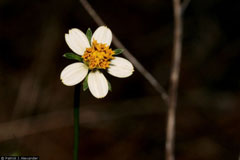
 |
|
Patrick J. Alexander @ USDA-NRCS PLANTS Database |
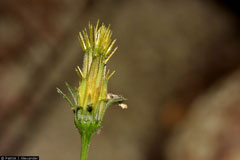 |
| Patrick J. Alexander @ USDA-NRCS PLANTS Database |
Translate this page:
Summary
Bigelow’s beggartick is a native annual herb of moist canyons and streambanks in the Southwest and northern Mexico. Though notorious for its clinging barbed seeds, it has surprising culinary and ethnobotanical value. The leaves and flowers are edible and make a pleasant herbal tea, and the plant is widely appreciated by pollinators. Its delicate form, golden-yellow disks, and fine, lacy leaves lend charm to riparian meadows—while its barbed fruits ensure unforgettable encounters.
Physical Characteristics

 Bidens bigelovii is a ANNUAL/PERENNIAL growing to 0.8 m (2ft 7in).
See above for USDA hardiness. It is hardy to UK zone 6. The species is hermaphrodite (has both male and female organs) and is pollinated by Insects.
Suitable for: light (sandy), medium (loamy) and heavy (clay) soils. Suitable pH: mildly acid, neutral and basic (mildly alkaline) soils. It cannot grow in the shade. It prefers moist soil.
UK Hardiness Map
US Hardiness Map
Synonyms
Plant Habitats
Cultivated Beds;
Edible Uses
Edible Parts:
Edible Uses: Tea
A tea is made from the flowering tips[177]. Edible Uses & Rating: Leaves and young shoots are edible raw or cooked, and flowers can be steeped as tea. Seeds (cypselae) should not be eaten due to barbed awns that pose choking hazards [2-3]. Edibility rating: 3/5) — good leafy vegetable, unsafe seeds. Taste, Processing & Kitchen Notes: Fresh leaves are similar to lettuce but with a salty, fishy, resinous accent that becomes milder after brief boiling. Texture is soft, pleasant, neither fibrous nor slimy. Cooked leaves are excellent as potherbs or teas, pairing well with rice, fish, and beans. Flower and leaf tea is reddish-brown, aromatic, and captures the appealing flavor components—one of the better native herbal teas of the Southwest [2-3]. The cypselae can be used only after toasting, pounding, boiling, and filtering to make a beverage that tastes fruit-like, faintly marine, and unique—but ingesting unprocessed cypselae is dangerous [2-3]. Seasonality (Phenology): Leaves: mid-summer to autumn. Flowers: July–October. Seeds: autumn, often sticking to clothes after field contact. Traditional / Indigenous Use Summary: Native peoples and early settlers in Texas brewed flower tea for relaxation and mild stomach upset. Leaves used as food and herbal tonic.
References More on Edible Uses
Medicinal Uses
Plants For A Future can not take any responsibility for any adverse effects from the use of plants. Always seek advice from a professional before using a plant medicinally.
None known
References More on Medicinal Uses
The Bookshop: Edible Plant Books
Our Latest books on Perennial Plants For Food Forests and Permaculture Gardens in paperback or digital formats.
Edible Tropical Plants
Food Forest Plants for Hotter Conditions: 250+ Plants For Tropical Food Forests & Permaculture Gardens.
More
Edible Temperate Plants
Plants for Your Food Forest: 500 Plants for Temperate Food Forests & Permaculture Gardens.
More
More Books
PFAF have eight books available in paperback and digital formats. Browse the shop for more information.
Shop Now
Other Uses
Suitable for pollinator gardens, riparian restoration, or ephemeral wetland cover. Ecology & Wildlife: Provides nectar for small bees, hoverflies, and butterflies. Seeds feed finches and rodents. Important late-season floral resource.
Special Uses
References More on Other Uses
Cultivation details
Identification & Habit: Annual herb 20–90 cm tall. Stems slender, branching; leaves alternate or opposite, compound or 2–3-pinnately incised. Flower heads radiate or discoid, clustered on long stalks; rays white (<7 mm) and disks yellow. Involucres narrowly bell-shaped (2–4 mm); receptacles chaffy. Fruits cypselae, linear-fusiform, 4-angled, with 2–3 awns; outer cypselae 6–9 mm, inner 10–15 mm. Blooms July–October. Bark or woody tissue absent; annual life cycle. Growing Conditions: Prefers moist canyon soils, drainage lines, and shaded seeps. Thrives in loams or silts with steady moisture and full to partial sun. USDA Zones 5–10. Habitat & Range: Native to Arizona, New Mexico, Texas, and northern Mexico; moist low–mid elevation canyons. Size & Landscape Performance: Compact annual (20–90 cm × 30 cm). Suitable for pollinator gardens, riparian restoration, or ephemeral wetland cover. Growing Conditions: Prefers moist canyon soils, drainage lines, and shaded seeps. Thrives in loams or silts with steady moisture and full to partial sun. USDA Zones 5–10. Habitat & Range: Native to Arizona, New Mexico, Texas, and northern Mexico; moist low–mid elevation canyons. Size & Landscape Performance: Compact annual (20–90 cm × 30 cm). Suitable for pollinator gardens, riparian restoration, or ephemeral wetland cover. Readily grown from seed. Maintain moist but well-drained soil. Dies back after fruiting; self-sows lightly. Pests & Problems: Generally free of pests; aphids or leaf miners may occur. Look-Alikes & Confusion Risks: Similar to B. cernua and B. leptocephala; identification requires checking ray flower length (<7 mm) and narrow involucres. Cultivar/Selection Notes: No named cultivars; occasionally included in native riparian seed mixes.
References Carbon Farming Information and Carbon Sequestration Information
Temperature Converter
Type a value in the Celsius field to convert the value to Fahrenheit:
Fahrenheit:
The PFAF Bookshop
Plants For A Future have a number of books available in paperback and digital form. Book titles include Edible Plants, Edible Perennials, Edible Trees,Edible Shrubs, Woodland Gardening, and Temperate Food Forest Plants. Our new book is Food Forest Plants For Hotter Conditions (Tropical and Sub-Tropical).
Shop Now
Plant Propagation
Seed - we have no information for this species but suggest sowing the seed in a greenhouse in the spring. Surface-sow or only just cover the seed and do not allow the compost to dry out. When they are large enough to handle, prick the seedlings out into individual pots and grow them on in the greenhouse for at least their first winter. Plant them out into their permanent positions in late spring or early summer, after the last expected frosts. Division in spring.
Other Names
If available other names are mentioned here
Bigelow’s Beggartick (Bidens bigelovii A. Gray)
Native Range
NORTHERN AMERICA: United States (Oklahoma, Colorado, New Mexico, Texas, Arizona), Mexico (Baja California Sur, Chihuahua, Coahuila de Zaragoza, Durango, Nuevo León, San Luis Potosí, Sinaloa, Sonora, Tamaulipas, Zacatecas, Aguascalientes, Chiapas, Ciudad de México, Colima, Guanajuato, Guerrero, Hidalgo, Jalisco, México, Michoacán de Ocampo, Morelos, Oaxaca, Puebla, Querétaro, Tlaxcala, Veracruz de Ignacio de la Llave)
Weed Potential
Right plant wrong place. We are currently updating this section.
Please note that a plant may be invasive in one area but may not in your area so it's worth checking.
Low to moderate—colonizes disturbed wet soils but easily managed.
Conservation Status
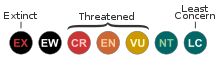
IUCN Red List of Threatened Plants Status : Not available
Growth: S = slow M = medium F = fast. Soil: L = light (sandy) M = medium H = heavy (clay). pH: A = acid N = neutral B = basic (alkaline). Shade: F = full shade S = semi-shade N = no shade. Moisture: D = dry M = Moist We = wet Wa = water.
Now available:
Food Forest Plants for Mediterranean Conditions
350+ Perennial Plants For Mediterranean and Drier Food Forests and Permaculture Gardens.
[Paperback and eBook]
This is the third in Plants For A Future's series of plant guides for food forests tailored to
specific climate zones. Following volumes on temperate and tropical ecosystems, this book focuses
on species suited to Mediterranean conditions—regions with hot, dry summers and cool, wet winters,
often facing the added challenge of climate change.
Read More
Expert comment
Author
A.Gray.
Botanical References
Links / References
For a list of references used on this page please go here
Readers comment
| Add a comment |
|
If you have important information about this plant that may help other users please add a comment or link below. Only comments or links that are felt to be directly relevant to a plant will be included. If you think a comment/link or information contained on this page is inaccurate or misleading we would welcome your feedback at [email protected]. If you have questions about a plant please use the Forum on this website as we do not have the resources to answer questions ourselves.
* Please note: the comments by website users are not necessarily those held by PFAF and may give misleading or inaccurate information.
|
Subject : Bidens bigelovii
|
|
|
|