 |
|
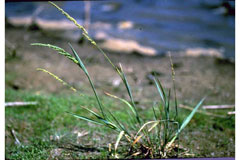
Gary Larson @ USDA-NRCS PLANTS Database / USDA NRCS. 1992. Western wetland flora: Field office guide to plant species. West Region, Sacramento. |
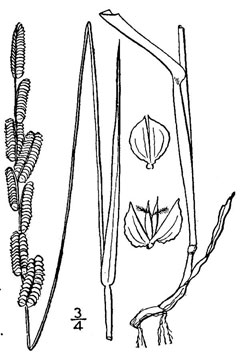 |
| USDA-NRCS PLANTS Database / Britton, N.L., and A. Brown. 1913. An illustrated flora of the northern United States, Canada and the British Possessions. Vol. 1: 228. |
Translate this page:
Summary
American sloughgrass is a cool-season annual or short-lived perennial grass native to northern North America, thriving in marshes, wet meadows, sloughs, irrigation ditches, and shallow lake margins. It’s one of the few native wetland cereals with grains large enough to harvest, historically gathered by Indigenous peoples of the Northwest for food much like wild rice (Zizania palustris). The small, clean-shelled grains are edible, mild, and nutrient-rich—making this species of occasional ethnobotanical and ecological interest. Though less known than wild rice, it represents a potentially valuable wild wetland grain adapted to cold, flooded environments.
Physical Characteristics

 Beckmannia syzigachne is a PERENNIAL growing to 1 m (3ft 3in) by 0.5 m (1ft 8in).
See above for USDA hardiness. It is hardy to UK zone 4 and is not frost tender. It is in flower from May to June, and the seeds ripen from July to August. The species is hermaphrodite (has both male and female organs) and is pollinated by Wind.
Suitable for: light (sandy), medium (loamy) and heavy (clay) soils. Suitable pH: mildly acid, neutral and basic (mildly alkaline) soils and can grow in very alkaline and saline soils.
It can grow in semi-shade (light woodland) or no shade. It prefers moist or wet soil and can grow in water.
UK Hardiness Map
US Hardiness Map
Synonyms
Plant Habitats
Bog Garden; Cultivated Beds;
Edible Uses
Seed - cooked[2, 46, 61, 105, 161]. A mild flavour, it can be ground into a flour and used as a cereal. The seed is very small but is easily harvested[K]. It does then have to be separated from its husk, which is a very fiddly operation. Some N. American Indian tribes burn the husks of grass seeds[K]. Ripe grains (seeds)- Use: Cooked whole like wild rice or pounded into meal for porridge, flatbreads, or gruel. Flavor: Mild, nutty, cereal-like; similar to small wild rice kernels. Nutritional value: Not well-studied, but similar to other wetland cereals—moderate protein (~10%), complex carbohydrates (~70%), and trace minerals (Fe, Mg, Zn). Edibility rating: 3.5 / 5 — wholesome and palatable, though tedious to harvest [2-3]. Taste, Processing & Kitchen Notes: Harvest when seed heads begin to droop and turn golden-brown. Seeds fall easily when mature; hand-stripping or gentle beating into a canoe, basket, or tarp works well. Processing steps: 1. Dry the seed heads in the sun or over low heat. 2. Thresh by rubbing or treading to separate grains. 3. Winnow in light breeze to remove chaff. 4. Parboil or toast lightly before storage to improve flavor and reduce spoilage. 5. Cook like rice (simmer 20–30 min) or grind for meal. Taste is mild and starchy, similar to brown rice with a faint grassy aroma; texture tender but slightly chewy [2-3].
References More on Edible Uses
Medicinal Uses
Plants For A Future can not take any responsibility for any adverse effects from the use of plants. Always seek advice from a professional before using a plant medicinally.
None known
References More on Medicinal Uses
The Bookshop: Edible Plant Books
Our Latest books on Perennial Plants For Food Forests and Permaculture Gardens in paperback or digital formats.
Edible Tropical Plants
Food Forest Plants for Hotter Conditions: 250+ Plants For Tropical Food Forests & Permaculture Gardens.
More
Edible Temperate Plants
Plants for Your Food Forest: 500 Plants for Temperate Food Forests & Permaculture Gardens.
More
More Books
PFAF have eight books available in paperback and digital formats. Browse the shop for more information.
Shop Now
Other Uses
The plant is used for making bedding and pillows[257]. Ecology & Wildlife: Food source: Seeds eaten by ducks, geese, and shorebirds; foliage grazed by muskrats and deer. Habitat value: Stabilizes soft substrates, improves water quality, and contributes to wetland plant diversity.
Special Uses
References More on Other Uses
Cultivation details
Prefers a moist to wet soil, succeeding in shallow water[K]. Tolerates saline soils[74]. Tolerates a pH in the range 5.8 to 7.6. We have no specific information on the hardiness of this species, but we have grown it successfully outdoors in Cornwall and, judging by its range, it should be cold-hardy in most if not all of Britain[K]. Some botanists treat this species as no more than a synonym of B. eruciformis. Seasonality (Phenology): Germination: spring (in flooded or saturated soils). Growth: vigorous through early summer in shallow standing water. Bloom: July–August. Seed harvest: September–October—as water recedes and heads ripen. Seeds are synchronous, allowing efficient one-time harvest, though yields depend heavily on site hydrology. abitat & Range Native range: Northern and western North America from California, Nevada, and New Mexico north through the Great Plains and into Canada and Alaska.
Common in: Marshes and sloughs, Edges of ponds and ditches, Seasonally flooded fields, Irrigation channels and low swales. Often co-occurs with sedges, cattails, bulrushes, and wild rice, contributing to wetland biodiversity and serving as nesting cover for waterfowl.
References Carbon Farming Information and Carbon Sequestration Information
Temperature Converter
Type a value in the Celsius field to convert the value to Fahrenheit:
Fahrenheit:
The PFAF Bookshop
Plants For A Future have a number of books available in paperback and digital form. Book titles include Edible Plants, Edible Perennials, Edible Trees,Edible Shrubs, Woodland Gardening, and Temperate Food Forest Plants. Our new book is Food Forest Plants For Hotter Conditions (Tropical and Sub-Tropical).
Shop Now
Plant Propagation
Seed - surface sow in spring in pots in a cold frame. Do not let the soil dry out. Very quick germination[K]. When they are large enough to handle, prick the seedlings out into individual pots and plant them out into their permanent positions in the summer. If there is sufficient seed, it can be sown in situ in the spring. Division in spring. Very easy, larger divisions can be planted straight into their permanent positions whilst smaller clumps are best potted up and kept in a cold frame until they are growing away well.
Other Names
If available other names are mentioned here
American Sloughgrass (Beckmannia syzigachne (Steud.) Fernald)
Native Range
TEMPERATE ASIA: Russian Federation-Western Siberia (Western Siberia (south)), Russian Federation-Eastern Siberia (Eastern Siberia (south)), Kazakhstan, Mongolia, Russian Federation-Far East (Far East), China (north), Japan NORTHERN AMERICA: Canada (Yukon, Québec, Ontario, Saskatchewan, Alberta, Manitoba, British Columbia), United States (Alaska, Michigan, Iowa (north), Minnesota, Nebraska (north), North Dakota, South Dakota, Wisconsin, Colorado, Idaho, Montana, Oregon, Washington, Wyoming, New Mexico (north), California (north), Nevada, Utah) EUROPE: Russian Federation-European part (European part (southeast))
Weed Potential
Right plant wrong place. We are currently updating this section.
Please note that a plant may be invasive in one area but may not in your area so it's worth checking.
Low. A native grass that reproduces mainly in wet sites; does not persist in dry uplands or cultivated fields.
Conservation Status
IUCN Red List of Threatened Plants Status :
Growth: S = slow M = medium F = fast. Soil: L = light (sandy) M = medium H = heavy (clay). pH: A = acid N = neutral B = basic (alkaline). Shade: F = full shade S = semi-shade N = no shade. Moisture: D = dry M = Moist We = wet Wa = water.
Now available:
Food Forest Plants for Mediterranean Conditions
350+ Perennial Plants For Mediterranean and Drier Food Forests and Permaculture Gardens.
[Paperback and eBook]
This is the third in Plants For A Future's series of plant guides for food forests tailored to
specific climate zones. Following volumes on temperate and tropical ecosystems, this book focuses
on species suited to Mediterranean conditions—regions with hot, dry summers and cool, wet winters,
often facing the added challenge of climate change.
Read More
Expert comment
Author
(Steud.)Fernald.
Botanical References
5074
Links / References
For a list of references used on this page please go here
Readers comment
| Add a comment |
|
If you have important information about this plant that may help other users please add a comment or link below. Only comments or links that are felt to be directly relevant to a plant will be included. If you think a comment/link or information contained on this page is inaccurate or misleading we would welcome your feedback at [email protected]. If you have questions about a plant please use the Forum on this website as we do not have the resources to answer questions ourselves.
* Please note: the comments by website users are not necessarily those held by PFAF and may give misleading or inaccurate information.
|
Subject : Beckmannia syzigachne
|
|
|
|