 |
|
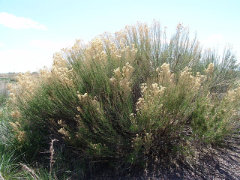
Drew Avery Creative Commons Attribution 2.0 |
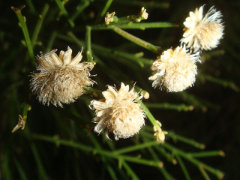 |
| Miwasatoshi Creative Commons Attribution-Share Alike 4.0 |
Translate this page:
Summary
A resilient desert riparian pioneer, broom baccharis excels at stabilizing sandy soils, supporting late-season pollinators, and enduring heat, alkalinity, and drought. It is easy to grow, fast, and forgiving, but can be weedy in disturbed sites and messy (female fluff). As food, it contributes chiefly a pleasant, woodsy seed tea; foliage is not edible. In restoration and xeriscapes, it’s a workhorse—best specified as male plants to limit reseeding and fluff. A fast-growing, dioecious desert shrub of the Sonoran and Mojave margins, broom baccharis forms narrow, broom-like green wands that leaf sparsely and flower late in the season. It is an important riparian/arroyo colonizer and erosion stabilizer, valuable to late-season pollinators—but of limited food value. Traditional use centers on a mild seed/twig tea; foliage is acrid and potentially irritating. In landscapes it is tough, drought-hardy, and salt/alkali tolerant, but can seed around aggressively (especially female plants) and create copious wind-borne fluff.
Physical Characteristics

 Baccharis sarothroides is a SHRUB growing to 3 m (9ft) by 3 m (9ft) at a fast rate.
See above for USDA hardiness. It is hardy to UK zone 9 and is not frost tender. The flowers are pollinated by Bees, Insects.
It is noted for attracting wildlife.
Suitable for: light (sandy) and medium (loamy) soils, prefers well-drained soil and can grow in nutritionally poor soil. Suitable pH: neutral and basic (mildly alkaline) soils and can grow in very alkaline soils.
It cannot grow in the shade. It prefers dry or moist soil and can tolerate drought.
UK Hardiness Map
US Hardiness Map
Synonyms
B. sarothroides var. pluricephala Jeps.
Plant Habitats
Edible Uses
Edibility Summary: Edible part: Seeds (tea); twigs occasionally for medicinal tea. Flavor: Pine-wood/evergreen, mild resin. Processing: Always filter to remove pappus; foliage not edible [2-3]. Rating: 1/5 (beverage only; negligible calories). • Seeds: brewed as a light herbal beverage (tea); twigs sometimes included for medicinal tea. •Leaves/shoots: not recommended—intensely acrid from sesquiterpene lactones and resinous “baccharis oils.” Taste, Processing & Kitchen Notes: Seed tea has a fresh-cut pine lumber aroma with clean woodsy/evergreen notes and a mild, slightly resinous taste. Heads are very cottony; always filter the infusion (fine cloth/coffee filter) to remove pappus hairs. Foliage bitterness is not appreciably reduced by boiling [2-3]. Traditional/Indigenous Use Summary: Along the lower Colorado and Gila Rivers, seeds were brewed as a beverage and twigs brewed as a medicinal tea (notably for colds). Uses are beverage/medicinal, not caloric staples, reflecting the acrid nature of foliage and the mildness of seed tea.
References More on Edible Uses
Medicinal Uses
Plants For A Future can not take any responsibility for any adverse effects from the use of plants. Always seek advice from a professional before using a plant medicinally.
None Known
References More on Medicinal Uses
The Bookshop: Edible Plant Books
Our Latest books on Perennial Plants For Food Forests and Permaculture Gardens in paperback or digital formats.
Edible Tropical Plants
Food Forest Plants for Hotter Conditions: 250+ Plants For Tropical Food Forests & Permaculture Gardens.
More
Edible Temperate Plants
Plants for Your Food Forest: 500 Plants for Temperate Food Forests & Permaculture Gardens.
More
More Books
PFAF have eight books available in paperback and digital formats. Browse the shop for more information.
Shop Now
Other Uses
Wind/erosion break, revegetation of washes, wildlife cover, tough xeriscape screen (choose male plants to avoid fluff). Ecology & Wildlife: • Pollinators: Late-season resource for native bees, syrphids, and small wasps; dioecious flowering extends nectar/pollen availability. • Birds: Dense twigs provide cover and perches; some finches utilize seed down in nest lining. • Soils: Pioneer/colonizer on disturbed alluvium; roots stabilize banks and trap sediment. • Facilitation: Shade and windbreak for seedlings of other desert natives.
Special Uses
References More on Other Uses
Cultivation details
Identification & Habit: Upright, narrow, many-branched shrub, typically 1–3 m tall (to 4 m in ideal sites), with fastigiate, strongly angled green branchlets that give a “broomed” look. Leaves are alternate, sparse, linear to scale-like (<2 cm) and often shed early; stems remain photosynthetic. Heads are discoid (no showy rays); male and female on separate plants. Female heads produce abundant silky pappus at fruiting (classic “snow” in desert washes). Cypsela with ~10 ribs; pappus bristles ~6–11 mm, longer than styles.Growing Conditions: •Light: Full sun. •Soil: Sand, sandy loam, decomposed granite; alkaline and saline-tolerant; thrives in well-drained, periodically moist alluvium (washes, arroyos) but survives extended drought once established. •Water: Low after establishment; appreciates occasional deep soak along natural drainages. •pH: 7.0–8.5+. •Heat/cold: Hot summer tolerant; light to moderate frost tolerant (Zones 8–11). Size & Landscape Performance: Height/Spread: 1–3 m H × 1–2.5 m W; narrowly upright in youth, fuller with age. Growth rate: Fast—often 1–1.5 m in the first 2–3 years with minimal irrigation. Longevity: Short- to medium-lived shrub (often 10–20 years). Establishment: Plant in fall–winter for cool-season rooting; stake in windy sites first year. •Irrigation: Deep, infrequent soaks first 1–2 summers; then largely rain-fed. •Pruning: Late winter; can be coppiced or hedged to maintain form and reduce seed set; remove crossing, weak or storm-damaged wood. •Soil improvement: None required; avoid rich, wet soils (invites rank growth & pests). •Companions: Creosote bush, bursage, mesquite, desert willow; useful as a nurse shrub for slower perennials. Pests & Problems: Generally tough. In watered landscapes, soft growth can develop, prone to scale insects and sooty mold; occasional spider mites in extreme heat/drought; bagworms are sporadic. Over-irrigation and heavy clay + heat can cause root stress and dieback. Cultivar/Selection Notes: No formal cultivars in commerce. For gardens, select male plants vegetatively to avoid winter seed “snow.” Some nurseries label it as “Desert Broom (male).” Look-Alikes & Confusion Risks: •Seepwillow baccharis (B. salicifolia) – broader, willow-like lanceolate leaves, many more leaves retained; twigs less broom-like. •Coyote brush (B. pilularis) – coastal, denser foliage, different range. •Non-Baccharis “brooms” (e.g., Cytisus, Genista) – pea-family shrubs with conspicuous pea-flowers, not discoid heads; different fruit/seed. •Tamarix – plume-like seed fluff on feathery, scale-leaf twigs; very different texture and pink flower spikes. Seasonality (Phenology): •Leaf flush: late winter–spring (sparse overall). •Flowering: late summer–autumn (often after monsoon rains). •Seed set / best tea harvest: late autumn into winter, when female heads are fluffy.
References Carbon Farming Information and Carbon Sequestration Information
Temperature Converter
Type a value in the Celsius field to convert the value to Fahrenheit:
Fahrenheit:
The PFAF Bookshop
Plants For A Future have a number of books available in paperback and digital form. Book titles include Edible Plants, Edible Perennials, Edible Trees,Edible Shrubs, Woodland Gardening, and Temperate Food Forest Plants. Our new book is Food Forest Plants For Hotter Conditions (Tropical and Sub-Tropical).
Shop Now
Plant Propagation
eed: Abundant on female shrubs. Collect fluffy heads in late fall; dry, then winnow/hand-rub to free cypselae. Surface-sow (light-requiring) on sandy mix; keep evenly moist but well-aired; germination typically within 2–4 weeks in cool bright conditions. • Cuttings: Semi-hardwood tip cuttings late summer–early fall; use coarse, well-drained medium; rooting hormone helpful. • Vegetative selection: For landscapes, propagate male plants to avoid nuisance seed fluff.
Other Names
If available other names are mentioned here
Desertbroom, Desert broom, Sarothra baccharis
Native Range
U.S. Arizona, California, Mexico Northeast, Mexico Northwest, New Mexico, Texas
Weed Potential
Right plant wrong place. We are currently updating this section.
Please note that a plant may be invasive in one area but may not in your area so it's worth checking.
Moderate to high in disturbed desert/urban edges: prolific wind-dispersed seed, rapid juvenile growth, and tolerance of poor, alkaline soils. Typically restricted to arroyos, roadsides, and neglected lots; seldom invades intact, shaded, or mesic habitats. Manage by pruning post-bloom on male-only plantings or removing female inflorescences before fluff.
Conservation Status
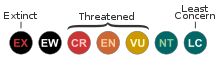
IUCN Red List of Threatened Plants Status : Not available
Growth: S = slow M = medium F = fast. Soil: L = light (sandy) M = medium H = heavy (clay). pH: A = acid N = neutral B = basic (alkaline). Shade: F = full shade S = semi-shade N = no shade. Moisture: D = dry M = Moist We = wet Wa = water.
Now available:
Food Forest Plants for Mediterranean Conditions
350+ Perennial Plants For Mediterranean and Drier Food Forests and Permaculture Gardens.
[Paperback and eBook]
This is the third in Plants For A Future's series of plant guides for food forests tailored to
specific climate zones. Following volumes on temperate and tropical ecosystems, this book focuses
on species suited to Mediterranean conditions—regions with hot, dry summers and cool, wet winters,
often facing the added challenge of climate change.
Read More
Expert comment
Author
A. Gray
Botanical References
Links / References
For a list of references used on this page please go here
Readers comment
| Add a comment |
|
If you have important information about this plant that may help other users please add a comment or link below. Only comments or links that are felt to be directly relevant to a plant will be included. If you think a comment/link or information contained on this page is inaccurate or misleading we would welcome your feedback at [email protected]. If you have questions about a plant please use the Forum on this website as we do not have the resources to answer questions ourselves.
* Please note: the comments by website users are not necessarily those held by PFAF and may give misleading or inaccurate information.
|
Subject : Baccharis sarothroides
|
|
|
|