 |
|
edibleplants.org |
 |
| Thayne Tuason wikimedia.org |
Translate this page:
Summary
Taxonomic Note: This genus was formerly classified in the family Asclepiadaceae. Modern classifications include it within the Apocynaceae.
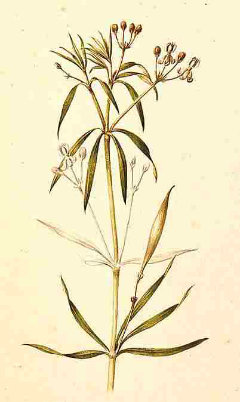
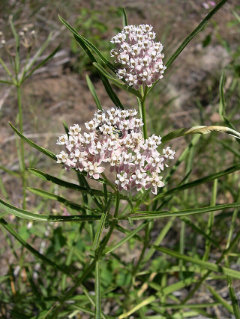
Asclepias fascicularis is an erect, herbaceous perennial plant producing a cluster of slender, usually branched stems 40 - 100cm tall from a rather stout, woody rootstock[200 , 908 ]. Like most, if not all Asclepias species, the plants are likely to have been utilized for foods and other materials by the native North American tribes. See Asclepias syriaca for some idea of these potential uses[K ]. There has been a lot of confusion over the correct identity of this species. Asclepias mexicana Cav., a species restricted to central Mexico, has long been wrongly reported as occurring in the western states of the USA, whereas the actual species that occurs there is Asclepias fascicularis Decne. (with a range from Baja California and Arizona north to Washington)[908 ]. All the records for plant uses contained here were originally reported for Asclepias mexicana, but their range was given as the western states of the USA. It is therefore clear that the true species referred to is Asclepias fascicularis[K ]. Mexican milkweed produces edible leaves and flowers when thoroughly cooked, and these were eaten as vegetables by Native Americans in California. The plant is toxic if eaten raw and dangerous to livestock, so extreme caution is necessary. It grows in USDA Zones 7–10 and is not generally considered invasive [2-3].
Physical Characteristics

 Asclepias fascicularis is a PERENNIAL growing to 0.8 m (2ft 7in) by 0.4 m (1ft 4in) at a fast rate.
See above for USDA hardiness. It is hardy to UK zone 8 and is not frost tender. The flowers are pollinated by Bees, Insects, Lepidoptera (Moths & Butterflies).
It is noted for attracting wildlife.
Suitable for: light (sandy) and medium (loamy) soils, prefers well-drained soil and can grow in nutritionally poor soil. Suitable pH: mildly acid, neutral and basic (mildly alkaline) soils. It cannot grow in the shade. It prefers dry or moist soil and can tolerate drought.
UK Hardiness Map
US Hardiness Map
Synonyms
A. fasciculata Hemsl. A. macrophylla Nutt. A. mexicana non Cav.
Plant Habitats
Edible Uses
Young blossoms - cooked[161 , 177 ]. Some caution is advised, see the notes on toxicity at the top of the page. Mexican milkweed (Asclepias fascicularis), a perennial of the dogbane family (Apocynaceae), grows from California and Nevada north to Washington and Idaho and south into the Baja Peninsula. Like other milkweeds, it contains toxic cardenolides in its milky sap, which can cause serious health effects if eaten raw, and must always be approached with great caution. The leaves and flowers were cooked and eaten as vegetables by Native American groups in California, but no other parts of this species are reported as food. It is important to note that milkweeds remain poisonous when dried and are especially dangerous to livestock; as little as half a pound of fresh leaves can be lethal to a 100-pound sheep. Although cooking can neutralize toxins in edible species, raw consumption is unsafe, and foragers must be extremely careful with this genus. Mexican milkweed typically blooms from June to August, providing a limited seasonal opportunity for harvest.
References More on Edible Uses
Medicinal Uses
Plants For A Future can not take any responsibility for any adverse effects from the use of plants. Always seek advice from a professional before using a plant medicinally.
None known
References More on Medicinal Uses
The Bookshop: Edible Plant Books
Our Latest books on Perennial Plants For Food Forests and Permaculture Gardens in paperback or digital formats.
Edible Tropical Plants
Food Forest Plants for Hotter Conditions: 250+ Plants For Tropical Food Forests & Permaculture Gardens.
More
Edible Temperate Plants
Plants for Your Food Forest: 500 Plants for Temperate Food Forests & Permaculture Gardens.
More
More Books
PFAF have eight books available in paperback and digital formats. Browse the shop for more information.
Shop Now
Other Uses
Rubber can be made from latex contained in the leaves and the stems[112 ].
Special Uses
References More on Other Uses
Cultivation details
Asclepias fascicularis is a plant mainly in Mediterranean climates with hot summers and cool or even cold winters, with most precipitation falling in the cooler months. Outside of this climate, the plant will require well-drained soil and hot summers, with some protection in cold winters, if it is to thrive. This protection can often be applied as a mulch, though it would need to be removed before new growth begins in the spring; otherwise, slug damage is very likely to occur[K ]. Prefers well-drained light, rich, or peaty soil in a sunny position[1, 200 ]. Succeeds in poor soils. Many members of this genus seem to be particularly prone to damage by slugs. The young growth in spring is especially vulnerable, but older growth is also attacked, and well-established plants are destroyed in wet years[K ]. Plants resent root disturbance and are best planted into their final positions whilst small[134 ]. The flower of many members of this genus can trap insects between its anther cells - the struggles of the insect in escaping (especially bees and wasps) pulls with it the pollinium (sacs of pollen), which are then transported to the next flower and deposited there, ensuring pollination of the flower[207 , 908 ].
References Carbon Farming Information and Carbon Sequestration Information
Temperature Converter
Type a value in the Celsius field to convert the value to Fahrenheit:
Fahrenheit:
The PFAF Bookshop
Plants For A Future have a number of books available in paperback and digital form. Book titles include Edible Plants, Edible Perennials, Edible Trees,Edible Shrubs, Woodland Gardening, and Temperate Food Forest Plants. Our new book is Food Forest Plants For Hotter Conditions (Tropical and Sub-Tropical).
Shop Now
Plant Propagation
Seed - best sown in a greenhouse as soon as it is ripe in the autumn or in late winter[134 , 169 ]. We have also had good results from sowing the seed in the greenhouse in early spring[K ], though stored seed might need 2 - 3 weeks cold stratification[134 ]. Germination usually takes place in 1 - 3 months at 18°c[134 ]. As soon as the seedlings are large enough to handle, prick them out into individual pots and grow them on in the greenhouse for their first winter. Plant out when they are in active growth in late spring or early summer and give them some protection from slugs until they are growing away strongly. Division in spring. With great care since the plant resents root disturbance. Pot the divisions up and place them in a lightly shaded position in the greenhouse until they are growing away strongly, then plant them out in the summer, giving them some protection from slugs until they are established.. Basal cuttings in late spring. Use shoots about 10cm long with as much of their white underground stem as possible. Pot them up individually and place them in a lightly shaded position in a greenhouse until they are rooting and growing actively. If the plants grow sufficiently, they can be put into their permanent positions in the summer, otherwise keep them in the greenhouse until the following spring and when they are in active growth plant them out into their permanent positions. Give them some protection from slugs until they are established.
Other Names
If available other names are mentioned here
Mexican milkweed, Asclepias fascicularis
Native Range
Native to: USA. California, Idaho, Mexico Northwest, Nevada, Oregon, Utah, Washington.
Weed Potential
Right plant wrong place. We are currently updating this section.
Please note that a plant may be invasive in one area but may not in your area so it's worth checking.
Mexican milkweed is native to western North America and is adapted to dry, sunny habitats. Based on its natural distribution, it is best suited to USDA Hardiness Zones 7–10, where winters are relatively mild. It is a native species in its U.S. range and is not considered invasive, though, like other milkweeds, it can be locally abundant where conditions are favorable.
Conservation Status
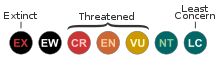
IUCN Red List of Threatened Plants Status : Least Concern
| Related Plants
|
| Latin Name | Common Name | Habit | Height | Hardiness | Growth | Soil | Shade | Moisture | Edible | Medicinal | Other |
| Asclepias asperula | Spider milkweed | Perennial | 0.6 |
5-9
| M | LM | SN | DM | 4 | 1 | 3 |
| Asclepias brachystephana | Bract milkweed | Perennial | 0.3 |
0-0
| | L | SN | DM | 0 | 0 | 2 |
| Asclepias californica | California Milkweed, Greene's milkweed | Perennial | 0.5 |
0-0
| | L | SN | DM | 2 | 1 | 2 |
| Asclepias currasavica | Blood Flower | Perennial | 2.0 |
10-12
| F | LMH | N | M | 0 | 1 | 2 |
| Asclepias decumbens | | Perennial | 0.9 |
-
| | L | SN | DM | 2 | 0 | 2 |
| Asclepias eriocarpa | Woollypod Milkweed | Perennial | 0.9 |
6-10
| | L | SN | DM | 2 | 2 | 3 |
| Asclepias erosa | Desert Milkweed | Perennial | 0.8 |
0-0
| | L | N | DM | 3 | 0 | 3 |
| Asclepias galioides | Bedstraw Milkweed | Perennial | 0.4 |
-
| | L | SN | DM | 2 | 1 | 2 |
| Asclepias hallii | Purple Silkweed, Hall's milkweed | Perennial | 1.0 |
3-7
| | LM | SN | DM | 3 | 1 | 3 |
| Asclepias incarnata | Swamp Milkweed, Swamp Butterfly Weed, Marsh Milkweed | Perennial | 1.2 |
3-8
| M | LM | SN | DMWe | 3 | 2 | 3 |
| Asclepias involucrata | Dwarf Milkweed | Perennial | 0.0 |
-
| | L | SN | DM | 2 | 1 | 2 |
| Asclepias lanceolata | Purple Silkweed, Fewflower milkweed | Perennial | 1.2 |
4-8
| | LM | SN | DM | 2 | 1 | 3 |
| Asclepias latifolia | Broadleaf Milkweed | Perennial | 0.8 |
-
| | L | SN | DM | 0 | 1 | 2 |
| Asclepias mexicana | | Perennial | 0.8 |
5-9
| | L | SN | DM | 1 | 0 | 2 |
| Asclepias ovalifolia | Oval-leaf milkweed | Perennial | 0.6 |
5-9
| | LM | SN | DM | 2 | 0 | 3 |
| Asclepias pumila | Low Milkweed, Plains milkweed | Perennial | 0.4 |
5-9
| | LM | SN | DM | 2 | 1 | 3 |
| Asclepias purpurascens | Purple Milkweed | Perennial | 0.8 |
-
| | LM | SN | DM | 2 | 1 | 3 |
| Asclepias quadrifolia | Fourleaf Milkweed | Perennial | 0.5 |
4-8
| | LM | SN | DM | 2 | 2 | 3 |
| Asclepias rubra | Red Silkweed | Perennial | 1.2 |
4-8
| | LM | SN | DM | 3 | 1 | 3 |
| Asclepias speciosa | Showy Milkweed | Perennial | 0.8 |
3-9
| | LM | SN | DM | 4 | 2 | 3 |
| Asclepias subulata | Rush Milkweed | Perennial | 2.0 |
5-9
| | L | SN | DM | 0 | 1 | 3 |
| Asclepias subverticillata | Poison Milkweed | Perennial | 0.4 |
6-10
| F | LM | N | DM | 1 | 0 | 0 |
| Asclepias sullivantii | Prairie milkweed | Perennial | 1.2 |
0-0
| | L | SN | DM | 0 | 0 | 3 |
| Asclepias syriaca | Common Milkweed, Silkweed, Milkweed | Perennial | 1.0 |
3-8
| M | LM | SN | DM | 3 | 2 | 3 |
| Asclepias tuberosa | Pleurisy Root, Butterfly milkweed, Rolfs' milkweed, Indian Paintbrush | Perennial | 0.8 |
3-9
| M | LM | SN | DM | 3 | 3 | 4 |
| Asclepias viridiflora | Green Milkweed, Green comet milkweed | Perennial | 1.0 |
0-0
| | LM | SN | DM | 3 | 2 | 3 |
|
Growth: S = slow M = medium F = fast. Soil: L = light (sandy) M = medium H = heavy (clay). pH: A = acid N = neutral B = basic (alkaline). Shade: F = full shade S = semi-shade N = no shade. Moisture: D = dry M = Moist We = wet Wa = water.
Now available:
Food Forest Plants for Mediterranean Conditions
350+ Perennial Plants For Mediterranean and Drier Food Forests and Permaculture Gardens.
[Paperback and eBook]
This is the third in Plants For A Future's series of plant guides for food forests tailored to
specific climate zones. Following volumes on temperate and tropical ecosystems, this book focuses
on species suited to Mediterranean conditions—regions with hot, dry summers and cool, wet winters,
often facing the added challenge of climate change.
Read More
Expert comment
Author
Decne.
Botanical References
Links / References
For a list of references used on this page please go here
A special thanks to Ken Fern for some of the information used on this page.
Readers comment
| Add a comment |
|
If you have important information about this plant that may help other users please add a comment or link below. Only comments or links that are felt to be directly relevant to a plant will be included. If you think a comment/link or information contained on this page is inaccurate or misleading we would welcome your feedback at [email protected]. If you have questions about a plant please use the Forum on this website as we do not have the resources to answer questions ourselves.
* Please note: the comments by website users are not necessarily those held by PFAF and may give misleading or inaccurate information.
|
Subject : Asclepias fascicularis
|
|
|
|