 |
|
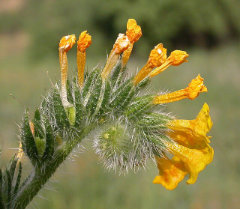
Curtis Clark, licensed as noted Creative Commons Attribution-Share Alike 2.5 |
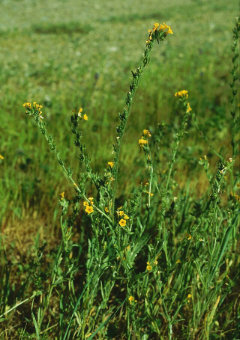 |
| Franz Xaver Creative Commons Attribution-Share Alike 3.0 |
Translate this page:
Summary
Common fiddleneck (Amsinckia intermedia) is a fast-growing annual wildflower of arid western North America that produces coiled, yellow-orange flower heads carpeting landscapes in spring. While young boiled leaves taste pleasant, all parts contain dangerous pyrrolizidine alkaloids, making them unsafe for human use, and the seeds are bitter and impractical to harvest. Toxic to livestock and unsuitable as food, its main value lies in supporting pollinators and covering disturbed soils. Edibility rating: 1/5. Common fiddleneck (Amsinckia intermedia), along with other species in the genus such as A. menziesii and A. tessellata, belongs to the borage family (Boraginaceae) and is widely distributed across arid and semi-arid regions of the western United States. While these plants have been used traditionally as spring greens, they pose a significant risk because they contain pyrrolizidine alkaloids, toxic compounds known to cause liver damage in humans and serious poisoning in grazing animals such as cattle and horses. These alkaloids are cumulative, building up in the body over time, meaning that even small, repeated exposures can eventually lead to serious health problems. Ordinary preparation methods like boiling, baking, or drying do not remove these toxins, so consumption is not recommended. Although ethnobotanical accounts note that Native peoples such as the Kawaiisu, Pima, and Gosiute occasionally ate the leaves or seeds, modern assessments strongly advise caution. Young leaves, when boiled, lose their harsh hairs and develop a spinach-like flavor, producing a mild, green broth, but this palatability masks the underlying toxicity. Older leaves quickly become covered in needle-like bristles, making them irritating to handle and unsuitable for raw use. Seeds, which are actually small nutlets, are even less appealing—bitter, medicinal, and challenging to process, with sharp hairs that make cleaning and winnowing hazardous. Their texture is bran-like and unpleasant, and no reliable way exists to separate the seed from the shell in useful quantities. Ecologically, fiddlenecks are aggressive colonizers, carpeting desert landscapes in late winter and spring after rains. Their coiled flower heads, which uncurl like the neck of a violin (hence the name), produce a profusion of orange to yellow blooms, making them conspicuous. They play a role in early-season forage for pollinators, but because of their toxicity, they are avoided by livestock. Overall, while common fiddleneck may once have been used sparingly as a famine food or emergency green, today it is best regarded as unsafe for human consumption and more important as a wildflower and ecological component of arid habitats than as a food resource.
Physical Characteristics

 Amsinckia menziesii var. intermedia is a ANNUAL growing to 1 m (3ft 3in) by 0.5 m (1ft 8in) at a fast rate.
See above for USDA hardiness. It is hardy to UK zone 7 and is not frost tender. The flowers are pollinated by Bees, Insects.
It is noted for attracting wildlife.
Suitable for: light (sandy) and medium (loamy) soils, prefers well-drained soil and can grow in nutritionally poor soil. Suitable pH: mildly acid, neutral and basic (mildly alkaline) soils. It cannot grow in the shade. It prefers dry or moist soil and can tolerate drought.
UK Hardiness Map
US Hardiness Map
Synonyms
Homotypic Synonyms: A. intermedia Fisch. & C.A.Mey. Benthamia intermedia (Fisch. & C.A.Mey.) Druce
Plant Habitats
Edible Uses
Fiddlenecks contain pyrrolizidine alkaloids (PAs), which are dangerous liver toxins. These compounds cannot be removed by boiling, drying, or other simple processing. While the boiled young leaves taste mild and spinach-like, they are not safe to eat in quantity, and the seeds (nutlets) are bitter, bristly, and of very poor quality. Any edible use must be considered unsafe and only of historical or emergency significance [2-3]. Edibility rating: 1/5 – potentially edible in the sense that young leaves were traditionally used, but not safe for consumption due to cumulative toxins [2-3].
References More on Edible Uses
Medicinal Uses
Plants For A Future can not take any responsibility for any adverse effects from the use of plants. Always seek advice from a professional before using a plant medicinally.
None Known
References More on Medicinal Uses
The Bookshop: Edible Plant Books
Our Latest books on Perennial Plants For Food Forests and Permaculture Gardens in paperback or digital formats.
Edible Tropical Plants
Food Forest Plants for Hotter Conditions: 250+ Plants For Tropical Food Forests & Permaculture Gardens.
More
Edible Temperate Plants
Plants for Your Food Forest: 500 Plants for Temperate Food Forests & Permaculture Gardens.
More
More Books
PFAF have eight books available in paperback and digital formats. Browse the shop for more information.
Shop Now
Other Uses
Provides early nectar and pollen for bees and other pollinators in arid regions. Dense spring growth offers temporary ground cover that stabilizes soil.
Special Uses
References More on Other Uses
Cultivation details
Prefers open, sunny sites with sandy or disturbed soils. Common on roadsides, rangelands, desert washes, and grasslands. Germinates readily after rainfall and thrives in areas with little competition. Drought-adapted, but short-lived—completing its life cycle quickly in spring. Habitat: Found throughout the western United States and northern Mexico. Particularly abundant in arid and semi-arid regions. Frequently carpets large areas in spring, forming dense, golden patches. Likely hardy in USDA zones 6–10, consistent with its wide distribution in desert, semi-desert, and grassland regions. Grows as a winter annual, germinating with winter rains and flowering in spring.
References Carbon Farming Information and Carbon Sequestration Information
Temperature Converter
Type a value in the Celsius field to convert the value to Fahrenheit:
Fahrenheit:
The PFAF Bookshop
Plants For A Future have a number of books available in paperback and digital form. Book titles include Edible Plants, Edible Perennials, Edible Trees,Edible Shrubs, Woodland Gardening, and Temperate Food Forest Plants. Our new book is Food Forest Plants For Hotter Conditions (Tropical and Sub-Tropical).
Shop Now
Plant Propagation
Seed.
Other Names
If available other names are mentioned here
Fiddleneck
Native Range
Alberta, Arizona, British Columbia, California, Connecticut, Idaho, Maine, Manitoba, Massachusetts, Mexican Pacific Is., Mexico Northwest, Missouri, Montana, Nebraska, Nevada, New Hampshire, New Mexico, North Dakota, Oregon, Pennsylvania, Saskatchewan, Texas, Utah, Virginia, Washington, Wyoming, Yukon
Weed Potential
Right plant wrong place. We are currently updating this section.
Please note that a plant may be invasive in one area but may not in your area so it's worth checking.
Moderately high. Fiddlenecks reseed prolifically and can dominate disturbed ground, especially after rain. Considered a range weed since it poisons livestock (cattle and horses are particularly vulnerable). Not invasive outside of its natural range, but can become a nuisance where it establishes.
Conservation Status
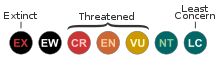
IUCN Red List of Threatened Plants Status : Not available
Growth: S = slow M = medium F = fast. Soil: L = light (sandy) M = medium H = heavy (clay). pH: A = acid N = neutral B = basic (alkaline). Shade: F = full shade S = semi-shade N = no shade. Moisture: D = dry M = Moist We = wet Wa = water.
Now available:
Food Forest Plants for Mediterranean Conditions
350+ Perennial Plants For Mediterranean and Drier Food Forests and Permaculture Gardens.
[Paperback and eBook]
This is the third in Plants For A Future's series of plant guides for food forests tailored to
specific climate zones. Following volumes on temperate and tropical ecosystems, this book focuses
on species suited to Mediterranean conditions—regions with hot, dry summers and cool, wet winters,
often facing the added challenge of climate change.
Read More
Expert comment
Author
(Fisch. & C.A.Mey.) ined.
Botanical References
Links / References
For a list of references used on this page please go here
Readers comment
| Add a comment |
|
If you have important information about this plant that may help other users please add a comment or link below. Only comments or links that are felt to be directly relevant to a plant will be included. If you think a comment/link or information contained on this page is inaccurate or misleading we would welcome your feedback at [email protected]. If you have questions about a plant please use the Forum on this website as we do not have the resources to answer questions ourselves.
* Please note: the comments by website users are not necessarily those held by PFAF and may give misleading or inaccurate information.
|
Subject : Amsinckia menziesii var. intermedia
|
|
|
|