 |
|
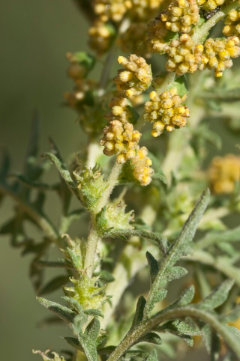
Richard Spellenberg Creative Commons Attribution-Share Alike 3.0 |
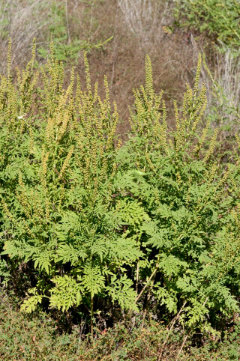 |
| Richard Spellenberg Creative Commons Attribution-Share Alike 3.0 |
Translate this page:
Summary
Ambrosia confertiflora, known as slimleaf bursage or weakleaf bur ragweed, is a desert plant with a controversial history as a food source. Though Native Americans reportedly relied on the roots in times of scarcity, the plant contains bioactive compounds that may cause harm, and its edibility remains questionable. The roots are starchy and palatable, yet their toughness and possible toxicity cast doubt on their value as food. Today, slimleaf bursage is primarily recognized as a weedy, aggressive colonizer of rangelands, not as a foraging resource. While it may once have filled an emergency role in desert diets, it is best approached with caution and not recommended as a modern edible.
Physical Characteristics

 Ambrosia confertiflora is a PERENNIAL growing to 1.5 m (5ft) by 1 m (3ft 3in) at a medium rate.
See above for USDA hardiness. It is hardy to UK zone 9 and is not frost tender. The flowers are pollinated by Wind.
Suitable for: light (sandy) and medium (loamy) soils, prefers well-drained soil and can grow in nutritionally poor soil. Suitable pH: mildly acid, neutral and basic (mildly alkaline) soils. It cannot grow in the shade. It prefers dry or moist soil and can tolerate drought.
UK Hardiness Map
US Hardiness Map
Synonyms
Heterotypic Synonyms: A. caudata (Rydb.) Shinners. Franseria caudata Rydb. Franseria confertiflora Rydb. Franseria hispidissima Rydb. Franseria incana Rydb. Franseria pringlei Rydb. Franseria strigulosa Rydb. Franseria tenuifolia var. tripinnatifida A.Gray.
Plant Habitats
Edible Uses
Reports indicate that the roots of slimleaf bursage were once used as food by Native Americans, particularly the Tohono O’odham, who gathered them in bulk during autumn rains. The roots have a starchy, somewhat resinous flavor, reminiscent of potatoes and sunflower seeds with a faint cardboard-like accent. Boiling does not soften the tough inner cores, but the thin, chewable outer layers provide nourishment. Cooking water takes on the same starchy–resinous flavor and can be used for broths [2-3]. However, serious caution is advised. The plant contains compounds such as confertiflorin, reynosin, and parthenolide, which can cause contact dermatitis, mouth ulcers, and loss of taste. Very little modern research confirms the safety of consuming these roots, and their near disappearance as a food source may indicate either health risks or impracticality [2-3]..
References More on Edible Uses
Medicinal Uses
Plants For A Future can not take any responsibility for any adverse effects from the use of plants. Always seek advice from a professional before using a plant medicinally.
None Known
References More on Medicinal Uses
The Bookshop: Edible Plant Books
Our Latest books on Perennial Plants For Food Forests and Permaculture Gardens in paperback or digital formats.
Edible Tropical Plants
Food Forest Plants for Hotter Conditions: 250+ Plants For Tropical Food Forests & Permaculture Gardens.
More
Edible Temperate Plants
Plants for Your Food Forest: 500 Plants for Temperate Food Forests & Permaculture Gardens.
More
More Books
PFAF have eight books available in paperback and digital formats. Browse the shop for more information.
Shop Now
Other Uses
References More on Other Uses
Cultivation details
Ambrosia confertiflora (weakleaf / denseflower ragweed) is a coarse perennial to subshrub, commonly 0.5–1.5 m tall and in good sites up to about 2 m, often forming broad clumps 0.5–1 m across or more in dense stands. Like other ragweeds, it is a classic anemophilous (wind-pollinated): separate male heads release copious pollen into the air; the small, hidden female flowers are adapted to catch airborne pollen rather than attract insects. A perennial that grows primarily in the subtropical biome. An Annual to short-lived perennial, adapted to zones 8–11. Thrives in desert and semi-arid climates. Sun: Requires full sun. Soil: Tolerates poor, sandy, rocky, or disturbed soils. Moisture: Drought-tolerant; responds to seasonal rainfall, especially late summer–autumn rains. Growth Habit: Upright to sprawling herb/shrub, often forming dense colonies. Habitat: Native to southern Arizona, New Mexico, Texas, and northern Mexico. Found on floodplains, desert washes, roadsides, pastures, and disturbed ground. Often occurs in large stands, resulting in abundant roots that are considered usable.
References Carbon Farming Information and Carbon Sequestration Information
Temperature Converter
Type a value in the Celsius field to convert the value to Fahrenheit:
Fahrenheit:
The PFAF Bookshop
Plants For A Future have a number of books available in paperback and digital form. Book titles include Edible Plants, Edible Perennials, Edible Trees,Edible Shrubs, Woodland Gardening, and Temperate Food Forest Plants. Our new book is Food Forest Plants For Hotter Conditions (Tropical and Sub-Tropical).
Shop Now
Plant Propagation
Seed.
Other Names
If available other names are mentioned here
Ambrosia confertiflora (Slimleaf Bursage / Weakleaf Bur Ragweed)
Native Range
Arizona, California, Colorado, Kansas, Mexico Central, Mexico Gulf, Mexico Northeast, Mexico Northwest, Mexico Southwest, New Mexico, Oklahoma, Texas, Utah
Weed Potential
Right plant wrong place. We are currently updating this section.
Please note that a plant may be invasive in one area but may not in your area so it's worth checking.
High weed potential. Slimleaf bursage is a native species but behaves aggressively, forming vast colonies that dominate disturbed or overgrazed landscapes. Considered a weedy native and often undesirable in rangelands.
Conservation Status
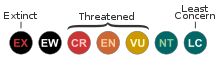
IUCN Red List of Threatened Plants Status : Not available
| Related Plants
|
| Latin Name | Common Name | Habit | Height | Hardiness | Growth | Soil | Shade | Moisture | Edible | Medicinal | Other |
| Ambrosia artemesiifolia | Roman Wormwood, Bitterweed, Blackweed, Carrot Weed, Hay Fever Weed, Stickeweed, Tassel Weed, Wild Ta | Annual | 0.9 |
4-8
| M | LMH | SN | M | 2 | 3 | 1 |
| Ambrosia trifida | Giant Ragweed, Great ragweed, Texan great ragweed, Bitterweed, Bloodweed, Buffalo Weed, Horse Cane | Annual | 2.0 |
1-11
| M | LMH | SN | M | 1 | 3 | 1 |
|
Growth: S = slow M = medium F = fast. Soil: L = light (sandy) M = medium H = heavy (clay). pH: A = acid N = neutral B = basic (alkaline). Shade: F = full shade S = semi-shade N = no shade. Moisture: D = dry M = Moist We = wet Wa = water.
Now available:
Food Forest Plants for Mediterranean Conditions
350+ Perennial Plants For Mediterranean and Drier Food Forests and Permaculture Gardens.
[Paperback and eBook]
This is the third in Plants For A Future's series of plant guides for food forests tailored to
specific climate zones. Following volumes on temperate and tropical ecosystems, this book focuses
on species suited to Mediterranean conditions—regions with hot, dry summers and cool, wet winters,
often facing the added challenge of climate change.
Read More
Expert comment
Author
DC.
Botanical References
Links / References
For a list of references used on this page please go here
Readers comment
| Add a comment |
|
If you have important information about this plant that may help other users please add a comment or link below. Only comments or links that are felt to be directly relevant to a plant will be included. If you think a comment/link or information contained on this page is inaccurate or misleading we would welcome your feedback at [email protected]. If you have questions about a plant please use the Forum on this website as we do not have the resources to answer questions ourselves.
* Please note: the comments by website users are not necessarily those held by PFAF and may give misleading or inaccurate information.
|
Subject : Ambrosia confertiflora
|
|
|
|