 |
|
http://www.flickr.com/photos/aspidoscelis/2232127282 |
 |
|
Translate this page:
Summary
Taxonomic Note: This genus was formerly classified in the family Chenopodiaceae. Modern classifications include it within the Amaranthaceae.
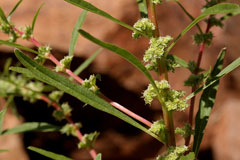
Amaranthus torreyi, or Torrey’s amaranth, is a native desert species with traditional use as a leafy vegetable and seed crop. It is less widespread than redroot or Palmer’s amaranth but still provides excellent nutrition where it grows. The young leaves can be cooked as greens, and the seeds offer a concentrated, protein-rich food source. Although not considered a major agricultural weed, Torrey’s amaranth is opportunistic in sandy or rocky desert habitats. For foragers in the American Southwest, it represents a dependable seasonal food source tied closely to summer rainfall and autumn harvests.
Physical Characteristics

 Amaranthus_torreyi is a ANNUAL growing to 0.8 m (2ft 7in) at a fast rate.
See above for USDA hardiness. It is hardy to UK zone 7 and is frost tender. The species is monoecious (individual flowers are either male or female, but both sexes can be found on the same plant) and is pollinated by Wind. The plant is self-fertile.
It is noted for attracting wildlife.
Suitable for: light (sandy), medium (loamy) and heavy (clay) soils, prefers well-drained soil and can grow in nutritionally poor soil. Suitable pH: mildly acid, neutral and basic (mildly alkaline) soils. It cannot grow in the shade. It prefers moist soil and can tolerate drought.
UK Hardiness Map
US Hardiness Map
Synonyms
Homotypic Synonyms: A. bigelowii var. emarginatus (Torr.) Uline & W.L.Bray. Amblogyna torreyi A.Gray.
Plant Habitats
Edible Uses
Torrey’s amaranth provides edible leaves and seeds, as with most species in the genus. The young leaves are tender and nutritious, suitable for cooking like spinach or used in mixed salads when fresh. Their flavor is typical of amaranths—mild and green, sometimes slightly bitter if older. Boiling improves texture and reduces any harshness [2-3]. The seeds are the real value, as they are abundant and nutrient-dense. Small, shiny, and typically black, they can be toasted, boiled into porridge, ground into flour, or pressed into seed cakes. Like other amaranths, they are a complete protein source, making them especially valuable as a wild grain [2-3]. Edibility Rating: 4/5 – A good wild edible, though less abundant than other weedy species like A. retroflexus or A. palmeri [2-3]. Leaves - cooked[46, 85, 105, 161]. Used as a spinach. Seed - cooked[46, 85, 105, 161]. Very small and fiddly, but the seed is very nutritious. The seed can be cooked whole, and becomes very gelatinous like this, but it is rather difficult to crush all of the small seeds in the mouth and thus some of the seed will pass right through the digestive system without being assimilated[K].
References More on Edible Uses
Medicinal Uses
Plants For A Future can not take any responsibility for any adverse effects from the use of plants. Always seek advice from a professional before using a plant medicinally.
None known
References More on Medicinal Uses
Other Uses
Yellow and green dyes can be obtained from the whole plant[168].
Special Uses
References More on Other Uses
Cultivation details
We have very little information on this species but it should succeed as a spring-sown annual in Britain. The following notes are based on the general needs of the genus. Prefers a well-drained fertile soil in a sunny position[200]. Requires a hot sheltered position if it is to do well[K]. Plants should not be given inorganic fertilizers, see notes above on toxicity. Most if not all members of this genus photosynthesize by a more efficient method than most plants. Called the 'C4 carbon-fixation pathway', this process is particularly efficient at high temperatures, in bright sunlight and under dry conditions[196].
References Carbon Farming Information and Carbon Sequestration Information
Temperature Converter
Type a value in the Celsius field to convert the value to Fahrenheit:
Fahrenheit:
The PFAF Bookshop
Plants For A Future have a number of books available in paperback and digital form. Book titles include Edible Plants, Edible Perennials, Edible Trees,Edible Shrubs, Woodland Gardening, and Temperate Food Forest Plants. Our new book is Food Forest Plants For Hotter Conditions (Tropical and Sub-Tropical).
Shop Now
Plant Propagation
Seed - sow late spring in situ. An earlier sowing can be made in a greenhouse and the plants put out after the last expected frosts. Germination is usually rapid and good if the soil is warm[133]. A drop in temperature overnight aids germination[133]. Cuttings of growing plants root easily[206].
Other Names
If available other names are mentioned here
Torrey’s Amaranth (Amaranthus torreyi)
Native Range
NORTHERN AMERICA: United States (New Mexico, Texas, Arizona (west), California (southeast)), Mexico (Chihuahua, Coahuila de Zaragoza, Durango, San Luis Potosí, Sonora, Baja California (Norte), Baja California Sur, Guanajuato, Jalisco, Michoacán de Ocampo)
Weed Potential
Right plant wrong place. We are currently updating this section.
Please note that a plant may be invasive in one area but may not
in your area so it's worth checking.
Moderate weed potential. Unlike redroot or Palmer’s amaranth, Torrey’s amaranth is more localized and not globally invasive. Found naturally in sandy, rocky, or disturbed soils of the southwestern U.S. and northern Mexico. It self-seeds readily and can spread in disturbed desert soils, but it does not rank among the world’s major invasive weeds.
Conservation Status
IUCN Red List of Threatened Plants Status :
IUCN Red List
Growth: S = slow M = medium F = fast. Soil: L = light (sandy) M = medium H = heavy (clay). pH: A = acid N = neutral B = basic (alkaline). Shade: F = full shade S = semi-shade N = no shade. Moisture: D = dry M = Moist We = wet Wa = water.
Now available:
Food Forest Plants for Mediterranean Conditions
350+ Perennial Plants For Mediterranean and Drier Food Forests and Permaculture Gardens.
[Paperback and eBook]
This is the third in Plants For A Future's series of plant guides for food forests tailored to
specific climate zones. Following volumes on temperate and tropical ecosystems, this book focuses
on species suited to Mediterranean conditions—regions with hot, dry summers and cool, wet winters,
often facing the added challenge of climate change.
Read More
Expert comment
Author
(A.Gray.)Benth. ex Watson.
Botanical References
43235
Links / References
For a list of references used on this page please go here
Readers comment
| Add a comment |
|
If you have important information about this plant that may help other users please add a comment or link below. Only comments or links that are felt to be directly relevant to a plant will be included. If you think a comment/link or information contained on this page is inaccurate or misleading we would welcome your feedback at [email protected]. If you have questions about a plant please use the Forum on this website as we do not have the resources to answer questions ourselves.
* Please note: the comments by website users are not necessarily those held by PFAF and may give misleading or inaccurate information.
|
Subject : Amaranthus_torreyi
|
|
|
|