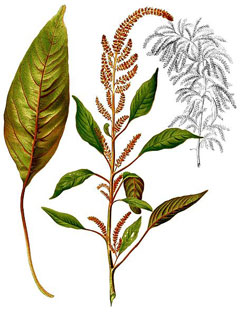
 |
|
http://commons.wikimedia.org/wiki/File:Amaranthus_cruentus_Blanco2.430-cropped.jpg |
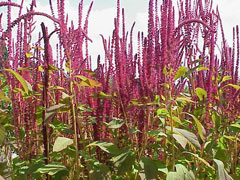 |
| http://www.biolib.de/ |
Translate this page:
Summary
Taxonomic Note: This genus was formerly classified in the family Chenopodiaceae. Modern classifications include it within the Amaranthaceae.
Red amaranth (Amaranthus cruentus) is one of the most important cultivated amaranths, revered since ancient times as both a grain and leafy vegetable. Its seeds are among the most nutritious of any pseudo-grain, with high protein, abundant minerals, and excellent storage qualities. The leaves can be eaten like spinach, though they play a secondary role to the seeds. While not a significant wild foraging plant, it remains a cornerstone of traditional diets in Central and South America and is increasingly valued worldwide as a climate-resilient crop. Its towering red flower spikes also give it ornamental appeal.
Physical Characteristics

 Amaranthus cruentus is a ANNUAL growing to 2 m (6ft 7in).
See above for USDA hardiness. It is hardy to UK zone 4 and is frost tender. It is in flower from July to September, and the seeds ripen from August to September. The species is monoecious (individual flowers are either male or female, but both sexes can be found on the same plant) and is pollinated by Wind. The plant is self-fertile.
Suitable for: light (sandy), medium (loamy) and heavy (clay) soils and prefers well-drained soil. Suitable pH: mildly acid, neutral and basic (mildly alkaline) soils and can grow in very acid soils.
It cannot grow in the shade. It prefers moist soil.
UK Hardiness Map
US Hardiness Map
Synonyms
A. hybridus cruentus. Thell.
Plant Habitats
Cultivated Beds;
Edible Uses
Edible Parts: Leaves Seed
Edible Uses: Colouring
Amaranthus cruentus has a long history of cultivation, especially in South and Central America, where it was grown as a staple seed crop by the Aztec and Maya civilizations. It remains a traditional and important crop in Mexico, Guatemala, and the Andes. Unlike Amaranthus blitoides or A. albus, red amaranth is primarily a cultivated species rather than a common wild plant, and thus less likely to be encountered by casual foragers [2-3]. The seeds are highly nutritious and versatile, ranking among the best of all amaranths. They can be popped like popcorn, toasted, boiled into porridge, or ground into flour for breads and cakes. Seeds are usually lighter-colored than those of wild amaranths, often cream to golden, and are much easier to process. Their protein content is complete, rich in lysine, which is rare for grains [2-3]. The leaves are also edible, though they are less commonly used than the seeds. They can be eaten fresh, cooked, or boiled, with a flavor similar to spinach but often milder [2-3]. Culturally, A. cruentus was used by the Hopi people of Arizona to color traditional “piki bread.” The deep red flower spikes imparted a pink hue to this iconic ceremonial food [2-3]. Edibility Rating: 5/5 – Excellent seed crop, with additional value in leaves.Leaves - cooked as spinach[183]. The mild-flavoured leaves are rich in vitamins and minerals[183]. Seed - very small but easy to harvest and very nutritious. They are eaten cooked or ground into a powder and used for making cakes etc[183, 257]. They can also be sprouted and used in salads[183]. The seed can be cooked whole, and becomes very gelatinous like this, but it is rather difficult to crush all of the small seeds in the mouth, and thus some of the seed will pass right through the digestive system without being assimilated[K]. The flowers are used as a food colouring in ceremonial maize bread[183].
References More on Edible Uses
| Composition
|
| Figures in grams (g) or miligrams (mg) per 100g of food.
|
|
|
Seed (Fresh weight)
|
|
- 0 Calories per 100g
- Water : 0%
- Protein: 15g; Fat: 0g; Carbohydrate: 0g; Fibre: 0g; Ash: 0g;
- Minerals - Calcium: 0mg; Phosphorus: 0mg; Iron: 0mg; Magnesium: 0mg; Sodium: 0mg; Potassium: 0mg; Zinc: 0mg;
- Vitamins - A: 0mg; Thiamine (B1): 0mg; Riboflavin (B2): 0mg; Niacin: 0mg; B6: 0mg; C: 0mg;
- Reference: [ ]
- Notes:
|
|
Medicinal Uses
Plants For A Future can not take any responsibility for any adverse effects from the use of plants. Always seek advice from a professional before using a plant medicinally.
The plant can be cultivated from the tropics to the temperate zone. It grows best in areas where annual daytime temperatures are within the range 22 - 28°c, but can tolerate 10 - 45°c[418 ]. It can be killed by temperatures of 4°c or lower[418 ]. It prefers a mean annual rainfall in the range 2,000 - 2,400mm, but tolerates 500 - 4,000mm[418 ]. Prefers a well-drained fertile soil in a sunny position[200 ]. Requires a hot sheltered position if it is to do well[K ]. Prefers a pH in the range 5.5 - 7, tolerating 4.3 - 7.5[418 ]. Often cultivated as a food crop and ornamental plant, it has escaped from cultivation in many areas and become naturalised as a weed of cultivated and disturbed ground[305 ]. A fast-growing plant, the first crop of leaves can be harvested in 30 - 50 days from sowing the seed, and the plant can carry on being harvested for up to another 250 days[418 ]. Grain yields usually range from 800-1200 kg/ha but with the use of fertilizers the yield can be raised up to 3 t/ha. This species is cultivated for its edible seed in many parts of S. America and in Japan[58 , 97 , 183 ]. There is at least one named variety, 'Oeschberg' is a very productive plant, growing 1 metre tall and can yield up to 2.5 tonnes per hectare[183 ]. This species is the most adaptable of the grain amaranths, it also flowers under a wider range of daylength hours than the other species[183 ]. Plants are particularly susceptible to attacks by leaf-chewing insects[298 ]. Plants should not be given inorganic fertilizers, see notes above on toxicity. Most if not all members of this genus photosynthesize by a more efficient method than most plants. Called the 'C4 carbon-fixation pathway', this process is particularly efficient at high temperatures, in bright sunlight and under dry conditions[196 ].
References More on Medicinal Uses
The Bookshop: Edible Plant Books
Our Latest books on Perennial Plants For Food Forests and Permaculture Gardens in paperback or digital formats.

Edible Tropical Plants
Food Forest Plants for Hotter Conditions: 250+ Plants For Tropical Food Forests & Permaculture Gardens.
More

Edible Temperate Plants
Plants for Your Food Forest: 500 Plants for Temperate Food Forests & Permaculture Gardens.
More

More Books
PFAF have eight books available in paperback and digital formats. Browse the shop for more information.
Shop Now
Other Uses
References More on Other Uses
Cultivation details
Prefers a well-drained fertile soil in a sunny position[200]. Requires a hot sheltered position if it is to do well[K]. Tolerates a pH in the range 4 to 7.5. Plants should not be given inorganic fertilizers, see notes above on toxicity. This species is cultivated for its edible seed in many parts of S. America and in Japan[58, 97, 183]. There is at least one named variety, 'Oeschberg' is a very productive plant, growing 1 metre tall and can yield up to 2.5 tonnes per hectare[183]. This species is the most adaptable of the grain amaranths, it also flowers under a wider range of daylength hours than the other species[183]. Most if not all members of this genus photosynthesize by a more efficient method than most plants. Called the 'C4 carbon-fixation pathway', this process is particularly efficient at high temperatures, in bright sunlight and under dry conditions[196]. In garden design, as well as the above-ground architecture of a plant, root structure considerations help in choosing plants that work together for their optimal soil requirements including nutrients and water. The root pattern is clumping, giving the plant a clumping habit. The predictable growth behaviour makes it easier to maintain without having to apply containment methods[2-1].
References Carbon Farming Information and Carbon Sequestration Information
Temperature Converter
Type a value in the Celsius field to convert the value to Fahrenheit:
Fahrenheit:
The PFAF Bookshop
Plants For A Future have a number of books available in paperback and digital form. Book titles include Edible Plants, Edible Perennials, Edible Trees,Edible Shrubs, Woodland Gardening, and Temperate Food Forest Plants. Our new book is Food Forest Plants For Hotter Conditions (Tropical and Sub-Tropical).
Shop Now
Plant Propagation
Seed - sow late spring in situ. An earlier sowing can be made in a greenhouse and the plants put out after the last expected frosts. Germination is usually rapid and good if the soil is warm[133]. A drop in temperature overnight aids germination[133]. Cuttings of growing plants root easily[206].
Other Names
If available other names are mentioned here
Amaranthus cruentus (Red Amaranth)
Native Range
El Salvador, Guatemala, Honduras, Mexico Central, Mexico Gulf, Mexico Southeast, Mexico Southwest, Nicaragua
Weed Potential
Right plant wrong place. We are currently updating this section.
Please note that a plant may be invasive in one area but may not in your area so it's worth checking.
Low weediness in the wild. Primarily a cultivated crop; rarely invasive outside of farming contexts. Not considered a major agricultural weed compared to other amaranths (e.g., A. retroflexus, A. palmeri).
Conservation Status
IUCN Red List of Threatened Plants Status : Not available
| Related Plants
|
| Latin Name | Common Name | Habit | Height | Hardiness | Growth | Soil | Shade | Moisture | Edible | Medicinal | Other |
| Amaranthus acanthochiton | Greenstripe Amaranth | Annual | 0.5 |
7-10
| F | LM | N | DM | 2 | 0 | 0 |
| Amaranthus albus | Prostrate Pigweed | Annual | 0.7 |
4-10
| | LMH | N | M | 4 | 0 | 1 |
| Amaranthus bidentata | | Annual | 0.9 |
-
| | LMH | N | M | 2 | 1 | 1 |
| Amaranthus blitoides | Mat Amaranth | Annual | 0.2 |
4-10
| | LMH | N | M | 3 | 0 | 1 |
| Amaranthus blitum | Slender Amaranth, Purple amaranth | Annual | 1.0 |
4-8
| | LMH | N | M | 4 | 2 | 2 |
| Amaranthus campestris | | Annual | 0.0 |
-
| | LMH | N | M | 2 | 1 | 1 |
| Amaranthus caudatus | Love Lies Bleeding | Annual | 2.0 |
4-8
| | LMH | N | DM | 4 | 1 | 2 |
| Amaranthus diacanthus | | Annual | 0.0 |
-
| | LMH | N | M | 2 | 0 | 1 |
| Amaranthus dubius | Spleen Amaranth | Annual | 1.0 |
-
| | LMH | N | M | 2 | 0 | 1 |
| Amaranthus fimbriatus | Fringed Amaranth | Annual | 0.6 |
5-10
| F | LM | N | DM | 5 | 0 | 0 |
| Amaranthus frumentaceus | | Annual | 0.0 |
-
| | LMH | N | M | 2 | 0 | 1 |
| Amaranthus graecizans | Spreading Pigweed, Mediterranean amaranth | Annual | 0.5 |
0-0
| | LMH | N | M | 2 | 0 | 1 |
| Amaranthus hybridus | Rough Pigweed, Slim amaranth | Annual | 2.0 |
5-12
| | LMH | N | M | 5 | 1 | 1 |
| Amaranthus hypochondriacus | Prince's Feather, Prince-of-wales feather | Annual/Perennial | 1.2 |
3-10
| | LMH | N | M | 4 | 3 | 2 |
| Amaranthus mangostanus | | Annual | 1.5 |
-
| | LMH | N | M | 2 | 0 | 1 |
| Amaranthus mitchellii | Boggabri Weed | Annual | 0.5 |
-
| | LMH | N | M | 2 | 0 | 1 |
| Amaranthus pallidiflorus | | Annual | 1.0 |
-
| | LMH | N | M | 2 | 0 | 1 |
| Amaranthus palmeri | Careless Weed | Annual | 0.9 |
6-12
| F | LMH | N | M | 5 | 0 | 1 |
| Amaranthus polygamus | | Annual | 0.0 |
-
| | LMH | N | M | 2 | 1 | 1 |
| Amaranthus polystachyus | | Annual | 0.0 |
-
| | LMH | N | M | 2 | 0 | 1 |
| Amaranthus powellii | Powell's Amaranth | Annual | 1.5 |
5-11
| F | LMH | N | M | 5 | 0 | 1 |
| Amaranthus quitensis | Ataco | Annual | 1.0 |
-
| | LMH | N | M | 2 | 0 | 1 |
| Amaranthus retroflexus | Pigweed, Redroot amaranth, Wild Beet | Annual | 0.9 |
5-11
| | LMH | N | M | 5 | 2 | 2 |
| Amaranthus spinosus | Spiny Amaranth | Annual | 0.6 |
4-11
| | LMH | N | M | 2 | 3 | 1 |
| Amaranthus standleyanus | Indehiscent Pigweed | Annual | 0.7 |
-
| | LMH | N | M | 2 | 0 | 1 |
| Amaranthus tenuifolius | | Annual | 0.0 |
-
| | LMH | N | M | 2 | 0 | 1 |
| Amaranthus thunbergii | Thunberg's Pigweed, Thunberg's amaranthus | Annual | 0.5 |
0-0
| | LMH | N | M | 2 | 0 | 1 |
| Amaranthus torreyi | Torrey's amaranthus | Annual | 0.8 |
6-10
| F | LMH | N | M | 4 | 0 | 1 |
| Amaranthus tricolor | Chinese Spinach, Joseph's-coat, Fountain Plant, Tampala , Summer Poinsettia | Annual | 1.0 |
3-11
| M | LMH | N | M | 3 | 1 | 2 |
|
|
Growth: S = slow M = medium F = fast. Soil: L = light (sandy) M = medium H = heavy (clay). pH: A = acid N = neutral B = basic (alkaline). Shade: F = full shade S = semi-shade N = no shade. Moisture: D = dry M = Moist We = wet Wa = water.
Now available:
Food Forest Plants for Mediterranean Conditions
350+ Perennial Plants For Mediterranean and Drier Food Forests and Permaculture Gardens.
[Paperback and eBook]
This is the third in Plants For A Future's series of plant guides for food forests tailored to
specific climate zones. Following volumes on temperate and tropical ecosystems, this book focuses
on species suited to Mediterranean conditions—regions with hot, dry summers and cool, wet winters,
often facing the added challenge of climate change.
Read More
Expert comment
Author
L.
Botanical References
200
Links / References
For a list of references used on this page please go here
Readers comment
© 2010, Plants For A Future. Plants For A Future is a charitable company limited by guarantee, registered in England and Wales. Charity No. 1057719, Company No. 3204567.