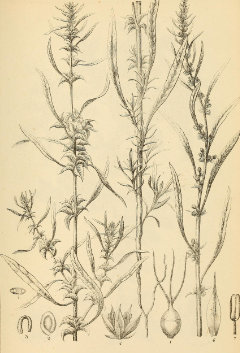
 |
|
Creative Commons Zero, Public Domain Dedication |
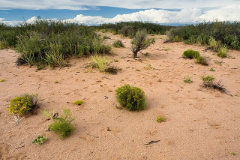 |
| Patrick Alexander from Las Cruces, NM Creative Commons Zero, Public Domain Dedication |
Translate this page:
Summary
Taxonomic Note: This genus was formerly classified in the family Chenopodiaceae. Modern classifications include it within the Amaranthaceae.
Amaranthus acanthochiton (greenstripe amaranth) is a little-known species of amaranth native to the deserts of the American Southwest and northern Mexico. Unlike many of its relatives that were cultivated widely for both leaves and seeds, this plant is primarily valued for its edible leaves. Traditionally, the Hopi gathered the leaves, tied them into bundles, and boiled them as a leafy vegetable. In times of hardship, greenstripe amaranth played an important role in helping communities survive food shortages and was remembered as a famine-averting plant. The seeds are not reported to have been used as food, which makes this species unusual within a genus otherwise famous for its highly nutritious grain. The leaves are nutritious and comparable to spinach in food value, although like other amaranths they may accumulate oxalates and nitrates. These compounds are not normally a problem in a balanced diet, and they can be reduced by boiling. Even so, the rarity of the plant means it was never a staple resource. Foragers today would find it more of an ethnobotanical curiosity than a dependable food source. In its natural habitat, greenstripe amaranth grows in sandy washes, arid grasslands, and disturbed soils, often appearing after summer rains. It thrives in hot, sunny environments, particularly in USDA hardiness zones 7 to 10, and requires well-drained soils to prosper. Although it is part of a genus that contains some of the most notorious agricultural weeds, greenstripe amaranth itself is not aggressive or invasive. Its populations remain scattered and localized, and it does not have significant weed potential.
Physical Characteristics

 Amaranthus acanthochiton is a ANNUAL growing to 0.5 m (1ft 8in) by 0.5 m (1ft 8in) at a fast rate.
See above for USDA hardiness. It is hardy to UK zone 8 and is not frost tender. The flowers are pollinated by Wind.
It is noted for attracting wildlife.
Suitable for: light (sandy) and medium (loamy) soils, prefers well-drained soil and can grow in nutritionally poor soil. Suitable pH: mildly acid, neutral and basic (mildly alkaline) soils. It cannot grow in the shade. It prefers dry or moist soil and can tolerate drought.
UK Hardiness Map
US Hardiness Map
Synonyms
Homotypic Synonyms: Acanthochiton wrightii Torr.
Plant Habitats
Edible Uses
Leaves – edible when cooked as a leafy vegetable. Traditionally gathered by the Hopi, tied in bundles, and boiled. Leaves are nutritious but may contain oxalates and nitrates, as in other amaranths [2-3]. Seeds – not reported as used for food, unlike most other amaranth species [2-3]. Notes: Castetter (1935) recorded its historical use as a famine-averting food among the Hopi. Because it is a rare plant, its caloric contribution is minimal compared to more abundant amaranths [2-3]. Edibility Rating: 2/5 – Leaves edible and nutritious, but availability is limited and seeds were not a documented food.
References More on Edible Uses
Medicinal Uses
Plants For A Future can not take any responsibility for any adverse effects from the use of plants. Always seek advice from a professional before using a plant medicinally.
None Known
References More on Medicinal Uses
The Bookshop: Edible Plant Books
Our Latest books on Perennial Plants For Food Forests and Permaculture Gardens in paperback or digital formats.

Edible Tropical Plants
Food Forest Plants for Hotter Conditions: 250+ Plants For Tropical Food Forests & Permaculture Gardens.
More

Edible Temperate Plants
Plants for Your Food Forest: 500 Plants for Temperate Food Forests & Permaculture Gardens.
More

More Books
PFAF have eight books available in paperback and digital formats. Browse the shop for more information.
Shop Now
Other Uses
References More on Other Uses
Cultivation details
Amaranthus acanthochiton (greenstripe / spiny amaranth, etc.) is typically 10–60 cm tall, occasionally a bit more in good conditions, with a similar lateral spread if branched; plants are often narrow/upright in dry sites. Like most pigweeds, it is functionally wind-pollinated: the tiny, inconspicuous flowers shed abundant pollen that’s carried by air, though small insects may visit and move some pollen incidentally. Growing Conditions: Sun: Full sun required for healthy growth. Soil: Adapted to sandy, gravelly, or disturbed soils. Moisture: Responds to seasonal summer rains; drought-tolerant once established but not as persistent as other amaranths. Cultivation: Rarely cultivated, but behaves similarly to other amaranths – fast-growing once rains arrive.
References Carbon Farming Information and Carbon Sequestration Information
Temperature Converter
Type a value in the Celsius field to convert the value to Fahrenheit:
Fahrenheit:
The PFAF Bookshop
Plants For A Future have a number of books available in paperback and digital form. Book titles include Edible Plants, Edible Perennials, Edible Trees,Edible Shrubs, Woodland Gardening, and Temperate Food Forest Plants. Our new book is Food Forest Plants For Hotter Conditions (Tropical and Sub-Tropical).
Shop Now
Plant Propagation
Seed.
Other Names
If available other names are mentioned here
Native Range
Arizona, Mexico Northeast, New Mexico, Texas, Utah
Weed Potential
Right plant wrong place. We are currently updating this section.
Please note that a plant may be invasive in one area but may not in your area so it's worth checking.
Low weed potential. Unlike A. retroflexus or A. palmeri, greenstripe amaranth is rare and not considered invasive. Occurs in small, localized populations; unlikely to spread aggressively.
Conservation Status
IUCN Red List of Threatened Plants Status : Not available
| Related Plants
|
| Latin Name | Common Name | Habit | Height | Hardiness | Growth | Soil | Shade | Moisture | Edible | Medicinal | Other |
| Amaranthus albus | Prostrate Pigweed | Annual | 0.7 |
4-10
| | LMH | N | M | 4 | 0 | 1 |
| Amaranthus bidentata | | Annual | 0.9 |
-
| | LMH | N | M | 2 | 1 | 1 |
| Amaranthus blitoides | Mat Amaranth | Annual | 0.2 |
4-10
| | LMH | N | M | 3 | 0 | 1 |
| Amaranthus blitum | Slender Amaranth, Purple amaranth | Annual | 1.0 |
4-8
| | LMH | N | M | 4 | 2 | 2 |
| Amaranthus campestris | | Annual | 0.0 |
-
| | LMH | N | M | 2 | 1 | 1 |
| Amaranthus caudatus | Love Lies Bleeding | Annual | 2.0 |
4-8
| | LMH | N | DM | 4 | 1 | 2 |
| Amaranthus cruentus | Purple Amaranth, Red amaranth | Annual | 2.0 |
4-10
| | LMH | N | M | 5 | 2 | 2 |
| Amaranthus diacanthus | | Annual | 0.0 |
-
| | LMH | N | M | 2 | 0 | 1 |
| Amaranthus dubius | Spleen Amaranth | Annual | 1.0 |
-
| | LMH | N | M | 2 | 0 | 1 |
| Amaranthus fimbriatus | Fringed Amaranth | Annual | 0.6 |
5-10
| F | LM | N | DM | 5 | 0 | 0 |
| Amaranthus frumentaceus | | Annual | 0.0 |
-
| | LMH | N | M | 2 | 0 | 1 |
| Amaranthus graecizans | Spreading Pigweed, Mediterranean amaranth | Annual | 0.5 |
0-0
| | LMH | N | M | 2 | 0 | 1 |
| Amaranthus hybridus | Rough Pigweed, Slim amaranth | Annual | 2.0 |
5-12
| | LMH | N | M | 5 | 1 | 1 |
| Amaranthus hypochondriacus | Prince's Feather, Prince-of-wales feather | Annual/Perennial | 1.2 |
3-10
| | LMH | N | M | 4 | 3 | 2 |
| Amaranthus mangostanus | | Annual | 1.5 |
-
| | LMH | N | M | 2 | 0 | 1 |
| Amaranthus mitchellii | Boggabri Weed | Annual | 0.5 |
-
| | LMH | N | M | 2 | 0 | 1 |
| Amaranthus pallidiflorus | | Annual | 1.0 |
-
| | LMH | N | M | 2 | 0 | 1 |
| Amaranthus palmeri | Careless Weed | Annual | 0.9 |
6-12
| F | LMH | N | M | 5 | 0 | 1 |
| Amaranthus polygamus | | Annual | 0.0 |
-
| | LMH | N | M | 2 | 1 | 1 |
| Amaranthus polystachyus | | Annual | 0.0 |
-
| | LMH | N | M | 2 | 0 | 1 |
| Amaranthus powellii | Powell's Amaranth | Annual | 1.5 |
5-11
| F | LMH | N | M | 5 | 0 | 1 |
| Amaranthus quitensis | Ataco | Annual | 1.0 |
-
| | LMH | N | M | 2 | 0 | 1 |
| Amaranthus retroflexus | Pigweed, Redroot amaranth, Wild Beet | Annual | 0.9 |
5-11
| | LMH | N | M | 5 | 2 | 2 |
| Amaranthus spinosus | Spiny Amaranth | Annual | 0.6 |
4-11
| | LMH | N | M | 2 | 3 | 1 |
| Amaranthus standleyanus | Indehiscent Pigweed | Annual | 0.7 |
-
| | LMH | N | M | 2 | 0 | 1 |
| Amaranthus tenuifolius | | Annual | 0.0 |
-
| | LMH | N | M | 2 | 0 | 1 |
| Amaranthus thunbergii | Thunberg's Pigweed, Thunberg's amaranthus | Annual | 0.5 |
0-0
| | LMH | N | M | 2 | 0 | 1 |
| Amaranthus torreyi | Torrey's amaranthus | Annual | 0.8 |
6-10
| F | LMH | N | M | 4 | 0 | 1 |
| Amaranthus tricolor | Chinese Spinach, Joseph's-coat, Fountain Plant, Tampala , Summer Poinsettia | Annual | 1.0 |
3-11
| M | LMH | N | M | 3 | 1 | 2 |
|
|
Growth: S = slow M = medium F = fast. Soil: L = light (sandy) M = medium H = heavy (clay). pH: A = acid N = neutral B = basic (alkaline). Shade: F = full shade S = semi-shade N = no shade. Moisture: D = dry M = Moist We = wet Wa = water.
Now available:
Food Forest Plants for Mediterranean Conditions
350+ Perennial Plants For Mediterranean and Drier Food Forests and Permaculture Gardens.
[Paperback and eBook]
This is the third in Plants For A Future's series of plant guides for food forests tailored to
specific climate zones. Following volumes on temperate and tropical ecosystems, this book focuses
on species suited to Mediterranean conditions—regions with hot, dry summers and cool, wet winters,
often facing the added challenge of climate change.
Read More
Expert comment
Author
J.D.Sauer
Botanical References
Links / References
For a list of references used on this page please go here
Readers comment
| Add a comment |
|
If you have important information about this plant that may help other users please add a comment or link below. Only comments or links that are felt to be directly relevant to a plant will be included. If you think a comment/link or information contained on this page is inaccurate or misleading we would welcome your feedback at [email protected]. If you have questions about a plant please use the Forum on this website as we do not have the resources to answer questions ourselves.
* Please note: the comments by website users are not necessarily those held by PFAF and may give misleading or inaccurate information.
|
Subject : Amaranthus acanthochiton
|
|
|
|