 |
|
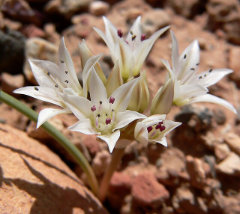
Stan Shebs Creative Commons Attribution-Share Alike 3.0 |
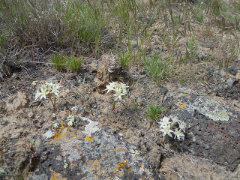 |
| Matt Lavin from Bozeman, Montana, USA Creative Commons Attribution-Share Alike 2.0 |
Translate this page:
Summary
Taxonomic Note: This genus was formerly classified in the family Alliaceae. Modern classifications include it within the Amaryllidaceae.
Allium nevadense, Nevada onion, is a delicate native wild onion of arid and semi-arid western mountains and basins. Like most true Alliums, it is edible throughout (bulbs, leaves, flowers) with a pleasant onion flavor and relatively low risk when properly identified. It’s a modest but high-quality wild seasoning and vegetable in its range. USDA Zones about 4–8, height 10–30 cm. Good multipurpose wild onion, with edible leaves and flowers in addition to bulbs. Nevada onion is a versatile species with edible bulbs, leaves, and flowers. Like most wild onions, its small bulbs limit its use as a staple food.
Physical Characteristics

 Allium nevadense is a BULB growing to 0.2 m (0ft 8in) by 0.1 m (0ft 4in) at a medium rate.
See above for USDA hardiness. It is hardy to UK zone 5 and is not frost tender. The flowers are pollinated by Bees, Insects.
It is noted for attracting wildlife.
Suitable for: light (sandy) and medium (loamy) soils and prefers well-drained soil. Suitable pH: neutral and basic (mildly alkaline) soils and can grow in very alkaline soils.
It cannot grow in the shade. It prefers dry or moist soil.
UK Hardiness Map
US Hardiness Map
Synonyms
Heterotypic Synonyms: Allium nevadense var. macropetalum M. Peck
Plant Habitats
Edible Uses
A fine, regionally important wild onion: subtle, tough, and excellent for seasoning, deserving protection from overharvest. The bulbs are edible raw or cooked, with a strong onion flavor. Leaves are also edible and can be used as a chive substitute. Flowers may be eaten raw in salads or cooked as a garnish [2-3]. Bulbs, leaves, and flowers are edible and used like chives or small green onions. The plant is flavorful but small, so it is best as a seasoning and trail nibble rather than a bulk caloric resource. Edibility rating: 4/5 given good flavor, typical Allium safety, and clarity of use. Taste, Processing & Kitchen Notes: All parts have a clear onion/garlic aroma and flavor, often milder than commercial onions but satisfying. Leaves and scapes can be finely chopped into eggs, soups, stews, or breads. Bulbs can be eaten raw, roasted, or sautéed; drying concentrates flavor. Because the plant is small and slow, ethical harvest is important: take only a small fraction of bulbs from any stand. Seasonality (Phenology): Bulbs break dormancy in spring, leaves and flowers appear as soils warm; flowering typically late spring to early summer, with senescence as drought and heat increase. Bulbs remain dormant underground through dry seasons and winter. Safety & Cautions (Food Use): As with all wild onions, proper ID is crucial. Alliums smell distinctly onion/garlic when crushed; deadly lilies and death camas do not and must never be confused. Within confirmed A. nevadense, typical Allium cautions apply: avoid overconsumption by pets (especially dogs) and use moderate amounts in sensitive individuals. Harvest & Processing Workflow: Clip leaves and flower stalks selectively in spring without uprooting bulbs. If bulbs are harvested, choose more abundant populations, take sparingly, and use as you would small green onions—fresh, sautéed, or dried. Look-Alikes & Confusion Risks: Critical to distinguish from death camas (Toxicoscordion/Zigadenus spp.), which share some habitats. Death camas lacks onion smell, has different flower structure, and bulbs smell/taste wrong. Always confirm both morphology and strong onion odor. Traditional/Indigenous Use Summary: Wild onions, including closely related species, were widely used by Indigenous peoples across the West as flavorings, vegetables, and trade items. Allium nevadense fits within that broader cultural pattern as a local wild onion.
References More on Edible Uses
Medicinal Uses
Plants For A Future can not take any responsibility for any adverse effects from the use of plants. Always seek advice from a professional before using a plant medicinally.
None Known
References More on Medicinal Uses
The Bookshop: Edible Plant Books
Our Latest books on Perennial Plants For Food Forests and Permaculture Gardens in paperback or digital formats.

Edible Tropical Plants
Food Forest Plants for Hotter Conditions: 250+ Plants For Tropical Food Forests & Permaculture Gardens.
More

Edible Temperate Plants
Plants for Your Food Forest: 500 Plants for Temperate Food Forests & Permaculture Gardens.
More

More Books
PFAF have eight books available in paperback and digital formats. Browse the shop for more information.
Shop Now
Other Uses
Compact and ornamental, suitable for rock gardens or native xeric plantings. Ecology & Wildlife: Flowers are attractive to native bees, small wasps, flies, and butterflies, which act as primary pollinators. Rodents and other small mammals occasionally eat bulbs. As an early-season nectar source, it supports pollinator networks.
Special Uses
References More on Other Uses
Cultivation details
Identification & Habit: A small geophyte arising from a tunicate bulb, producing slender, grass-like leaves and a leafless flowering scape topped by a loose umbel of white to pinkish flowers, often with darker midveins. The flowers have six tepals, six stamens, and the classic onion scent when crushed. Leaves are usually few, basal, and cylindrical to slightly flattened. Plants occur in scattered clumps or colonies on open, well-drained sites. Growing Conditions: Prefers full sun, well-drained sandy or gravelly soils, often calcareous or rocky, with cool moist springs and dry summers. It is well adapted to open pinyon-juniper, sagebrush, and steppe environments. Habitat & Range: Native to parts of the Great Basin and adjacent regions, at low to mid elevations on open slopes, benches, and ridges. Size & Landscape Performance: Compact and ornamental, suitable for rock gardens or native xeric plantings. Slow increase; best in undisturbed locations. Cultivation (Horticulture): Similar to other wild onions: plant bulbs or seed in gritty soil with good drainage, full sun, and minimal summer water once established. Avoid heavy competition. Pests & Problems: Generally trouble-free in dry, open conditions; prone to rot in heavy, waterlogged soils. Cultivar/Selection Notes: No named cultivars; it is a wild species occasionally grown by native plant enthusiasts.
References Carbon Farming Information and Carbon Sequestration Information
Temperature Converter
Type a value in the Celsius field to convert the value to Fahrenheit:
Fahrenheit:
The PFAF Bookshop
Plants For A Future have a number of books available in paperback and digital form. Book titles include Edible Plants, Edible Perennials, Edible Trees,Edible Shrubs, Woodland Gardening, and Temperate Food Forest Plants. Our new book is Food Forest Plants For Hotter Conditions (Tropical and Sub-Tropical).
Shop Now
Plant Propagation
By seed sown in fall or early spring (often benefits from cold stratification) and by slow division of bulbs after dormancy.
Other Names
If available other names are mentioned here
Allium nevadense (Nevada Onion)
Native Range
Arizona, California, Colorado, Idaho, Nevada, Oregon, Utah
Weed Potential
Right plant wrong place. We are currently updating this section.
Please note that a plant may be invasive in one area but may not in your area so it's worth checking.
Low. This is a delicate native, not an invasive threat.
Conservation Status
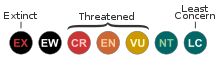
IUCN Red List of Threatened Plants Status : Predicted extinction risk: not threatened. Confidence: confident
| Related Plants
|
| Latin Name | Common Name | Habit | Height | Hardiness | Growth | Soil | Shade | Moisture | Edible | Medicinal | Other |
| Allium acuminatum | Hooker's Onion, Tapertip onion | Bulb | 0.3 |
5-9
| | LM | N | DM | 3 | 2 | 2 |
| Allium aflatunense | Persian Onion, Ornamental Onion | Bulb | 1.0 |
4-8
| M | LM | N | M | 2 | 2 | 1 |
| Allium akaka | | Bulb | 0.2 |
7-10
| | LM | N | DM | 3 | 2 | 1 |
| Allium altaicum | | Bulb | 0.3 |
-
| | LM | N | M | 3 | 2 | 1 |
| Allium ampeloprasum | Wild Leek, Broadleaf wild leek | Bulb | 1.8 |
5-9
| | LMH | N | DM | 5 | 3 | 2 |
| Allium ampeloprasum babingtonii | Babington's Leek | Bulb | 1.8 |
0-0
| | LMH | N | DM | 3 | 3 | 2 |
| Allium angulare | | Bulb | 0.0 |
-
| | LM | N | M | 3 | 2 | 1 |
| Allium angulosum | Mouse Garlic | Bulb | 0.5 |
4-8
| | LMH | SN | M | 3 | 2 | 1 |
| Allium atropurpureum | | Bulb | 1.0 |
7-10
| | LM | SN | M | 3 | 2 | 1 |
| Allium bisceptrum | Aspen Onion, Twincrest onion | Bulb | 0.3 |
7-10
| | LM | N | M | 3 | 2 | 1 |
| Allium bodeanum | | Bulb | 0.2 |
-
| | LM | N | DM | 3 | 2 | 1 |
| Allium bolanderi | Bolander's Onion | Bulb | 0.2 |
6-9
| | LM | N | M | 3 | 2 | 1 |
| Allium brevistylum | Shortstyle Onion | Bulb | 0.5 |
-
| | LM | N | MWe | 3 | 2 | 1 |
| Allium canadense | Canadian Garlic, Meadow garlic, Fraser meadow garlic, Hyacinth meadow garlic | Bulb | 0.5 |
4-8
| | LM | SN | MWe | 4 | 2 | 2 |
| Allium canadense mobilense | Canadian Garlic | Bulb | 0.5 |
4-8
| | LM | SN | MWe | 5 | 2 | 1 |
| Allium carinatum | Keeled Garlic | Bulb | 0.6 |
6-9
| | LMH | SN | M | 3 | 2 | 1 |
| Allium carolinianum | | Bulb | 0.4 |
-
| | LM | N | DM | 3 | 2 | 1 |
| Allium cepa | Onion, Garden onion | Bulb | 0.6 |
4-10
| M | LM | N | M | 5 | 3 | 3 |
| Allium cepa aggregatum | Potato Onion | Bulb | 1.2 |
4-8
| M | LM | N | M | 4 | 3 | 3 |
| Allium cepa ascalonicum | Shallot | Bulb | 0.3 |
4-8
| | LM | N | M | 5 | 3 | 2 |
| Allium cepa proliferum | Tree Onion, Walking Onion | Bulb | 1.2 |
4-8
| M | LM | N | M | 5 | 3 | 3 |
| Allium cernuum | Nodding Onion, New Mexican nodding onion | Bulb | 0.5 |
5-9
| F | LMH | N | M | 5 | 2 | 2 |
| Allium chinense | Rakkyo | Bulb | 0.3 |
6-9
| | LM | N | M | 4 | 2 | 1 |
| Allium condensatum | | Bulb | 0.6 |
4-8
| | LM | N | M | 3 | 2 | 1 |
| Allium cupanii | | Bulb | 0.3 |
7-10
| | LM | N | DM | 3 | 2 | 1 |
| Allium douglasii | Douglas' Onion | Bulb | 0.3 |
0-0
| | LM | N | DM | 3 | 2 | 1 |
| Allium dregeanum | Wild Onion | Bulb | 0.6 |
-
| | LM | N | DM | 3 | 2 | 1 |
| Allium drummondii | Prairie Onion, Drummond's onion | Bulb | 0.3 |
6-9
| | LM | N | M | 3 | 2 | 1 |
| Allium fistulosum | Welsh Onion | Bulb | 0.6 |
5-9
| F | LMH | N | M | 5 | 2 | 2 |
| Allium flavum | Small Yellow Onion, Ornamental Onion | Bulb | 0.5 |
4-7
| M | LMH | SN | M | 2 | 2 | 1 |
|
|
Growth: S = slow M = medium F = fast. Soil: L = light (sandy) M = medium H = heavy (clay). pH: A = acid N = neutral B = basic (alkaline). Shade: F = full shade S = semi-shade N = no shade. Moisture: D = dry M = Moist We = wet Wa = water.
Now available:
Food Forest Plants for Mediterranean Conditions
350+ Perennial Plants For Mediterranean and Drier Food Forests and Permaculture Gardens.
[Paperback and eBook]
This is the third in Plants For A Future's series of plant guides for food forests tailored to
specific climate zones. Following volumes on temperate and tropical ecosystems, this book focuses
on species suited to Mediterranean conditions—regions with hot, dry summers and cool, wet winters,
often facing the added challenge of climate change.
Read More
Expert comment
Author
S.Watson
Botanical References
Links / References
For a list of references used on this page please go here
Readers comment
| Add a comment |
|
If you have important information about this plant that may help other users please add a comment or link below. Only comments or links that are felt to be directly relevant to a plant will be included. If you think a comment/link or information contained on this page is inaccurate or misleading we would welcome your feedback at [email protected]. If you have questions about a plant please use the Forum on this website as we do not have the resources to answer questions ourselves.
* Please note: the comments by website users are not necessarily those held by PFAF and may give misleading or inaccurate information.
|
Subject : Allium nevadense
|
|
|
|