 |
|
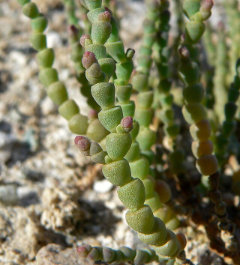
Stan Shebs Creative Commons Attribution-Share Alike 3.0 |
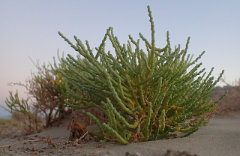 |
| Krzysztof Ziarnek, Kenraiz Creative Commons Attribution-Share Alike 4.0 |
Translate this page:
Summary
Taxonomic Note: This genus was formerly classified in the family Chenopodiaceae. Modern classifications include it within the Amaranthaceae.
Allenrolfea occidentalis is a low, shrubby halophyte of alkali flats and desert playas in the western U.S. Its succulent, jointed stems are intensely salty and sometimes bitter, forming a structural and ecological keystone in high-salinity habitats. As a human food, it is marginal: parts can be nibbled or used as a mineral-rich, salty accent, but high salt and other compounds limit safe intake. USDA Zones roughly 6–9, height usually 0.3–1 m. Picklebush was a significant staple of early Great Basin cultures, with seeds that are highly nutritious, abundant, and relatively easy to process. They can be eaten boiled, toasted, or ground into flour. Young stem tips are technically edible but very salty, so they should be consumed sparingly.
Physical Characteristics

 Allenrolfea occidentalis is a SHRUB growing to 0.5 m (1ft 8in) by 0.4 m (1ft 4in) at a medium rate.
See above for USDA hardiness. It is hardy to UK zone 7 and is not frost tender. The flowers are pollinated by Wind.
It is noted for attracting wildlife.
Suitable for: light (sandy), medium (loamy) and heavy (clay) soils, prefers well-drained soil and can grow in nutritionally poor soil. Suitable pH: neutral and basic (mildly alkaline) soils and can grow in very alkaline and saline soils.
It cannot grow in the shade. It prefers dry or moist soil and can tolerate drought.
UK Hardiness Map
US Hardiness Map
Synonyms
Homotypic Synonyms: Halostachys occidentalis S.Watson. Salicornia occidentalis (S.Watson) Greene. Spirostachys occidentalis (S.Watson) S.Watson. Heterotypic Synonyms: Allenrolfea mexicana Lundell. Arthrocnemum fruticosum Torr. Arthrocnemum fruticosum var. californicum Moq. Arthrocnemum macrostachyum Torr. Salicornia californica Nutt. ex Moq.
Plant Habitats
Edible Uses
The seeds are the primary edible part and were once a staple food for Native Americans in the Great Basin. They are small, brown, and nutritious, with a mild whole-grain flavor lacking the musty character of many goosefoot relatives. Seeds mature from August to December and can be collected in large quantities by gently tapping the brittle, dried stem tips. Processing is relatively straightforward: the papery capsules crumble away and the seeds can be winnowed free. Seeds can be toasted, boiled, or ground into flour, and were traditionally made into porridges, flatbreads, or seed cakes. They remain one of the most important ancient desert grains [2-3]. The young stem tips are also edible raw or cooked, but they are extremely salty and contain oxalic acid. They should be eaten only in moderation and preferably boiled to reduce saltiness and potential irritation. Older stems become woody and unsuitable. In addition to food use, dried stem tips can be chopped and used as a salty seasoning substitute[2-3]. Seasonality (Phenology): Evergreen to semi-evergreen; fleshy growth most active in warm seasons. Flowering and seed set typically occur late summer to autumn. Harvest & Processing Workflow: If used, pinch young green tips only, blanch in fresh water, taste-test cautiously, and use strictly as a garnish/condiment, never a bulk vegetable. Look-Alikes & Confusion Risks: May be confused with glassworts/samphires (Salicornia, Sarcocornia), which are more commonly eaten but share similar salt issues. Accurate ID helps track ecological vs culinary expectations. Traditional/Indigenous Use Summary: Better documented as a fuel, habitat, and landscape plant; any consumption was likely minor and situational.
References More on Edible Uses
Medicinal Uses
Plants For A Future can not take any responsibility for any adverse effects from the use of plants. Always seek advice from a professional before using a plant medicinally.
None Known
References More on Medicinal Uses
The Bookshop: Edible Plant Books
Our Latest books on Perennial Plants For Food Forests and Permaculture Gardens in paperback or digital formats.
Edible Tropical Plants
Food Forest Plants for Hotter Conditions: 250+ Plants For Tropical Food Forests & Permaculture Gardens.
More
Edible Temperate Plants
Plants for Your Food Forest: 500 Plants for Temperate Food Forests & Permaculture Gardens.
More
More Books
PFAF have eight books available in paperback and digital formats. Browse the shop for more information.
Shop Now
Other Uses
An ecological specialist and restoration asset. Forms compact, durable shrubs, excellent for extreme-salinity reclamation. Traditional/Indigenous Use Summary: Better documented as a fuel, habitat, and landscape plant; any consumption was likely minor and situational. Ecology & Wildlife: Provides cover and structure for small mammals and birds on otherwise barren flats. Its seeds and associated invertebrates offer food resources. It contributes to salt and water table dynamics. Pollination is likely largely wind-mediated, with minor insect visitation.
Special Uses
References More on Other Uses
Cultivation details
Identification & Habit: Iodinebush forms rounded, intricately branched shrubs with fleshy, jointed, cylindrical green stems that become woody and gray with age. Leaves are minute and scale-like, quickly shed; photosynthesis is mainly via stems. The overall look is of a dense, coral-like mound on alkali soils. Flowers are tiny, inconspicuous, borne in the joints or spike-like arrangements along stems. The plant often forms nearly pure stands on saline bottoms. Growing Conditions: Obligate halophyte thriving on saline-alkaline flats, playas, and desert basins with high pH, salt crusts, periodic flooding, and intense sun. It is highly drought-tolerant once established. Habitat & Range: Widespread in arid western North America, especially the Great Basin, Mojave, and Sonoran regions, on strongly saline/alkaline soils where few other shrubs thrive. Size & Landscape Performance: Forms compact, durable shrubs, excellent for extreme-salinity reclamation. In ordinary garden soils without salt it may perform poorly or be outcompeted. Cultivation (Horticulture): Rarely cultivated except for restoration or research. Requires saline, well-drained soils and full sun. Overly benign soils reduce its competitive advantage. Pests & Problems: Extremely hardy against drought, salt, and herbivory; main threats are hydrological alteration and disturbance of alkali habitats. Cultivar/Selection Notes: None.
References Carbon Farming Information and Carbon Sequestration Information
Temperature Converter
Type a value in the Celsius field to convert the value to Fahrenheit:
Fahrenheit:
The PFAF Bookshop
Plants For A Future have a number of books available in paperback and digital form. Book titles include Edible Plants, Edible Perennials, Edible Trees,Edible Shrubs, Woodland Gardening, and Temperate Food Forest Plants. Our new book is Food Forest Plants For Hotter Conditions (Tropical and Sub-Tropical).
Shop Now
Plant Propagation
By seed or semi-woody cuttings; seed germination improves with saline conditions.
Other Names
If available other names are mentioned here
Allenrolfea occidentalis (Picklebush, Pickleweed, Iodinebush)
Native Range
Arizona, California, Idaho, Mexico Northeast, Mexico Northwest, Nevada, New Mexico, Oregon, Texas, Utah
Weed Potential
Right plant wrong place. We are currently updating this section.
Please note that a plant may be invasive in one area but may not
in your area so it's worth checking.
Low beyond its specialized niche. Where conditions suit it, it is a dominant native halophyte, not typically an invasive exotic.
Conservation Status
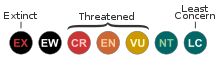
IUCN Red List of Threatened Plants Status : Not available
IUCN Red List
Growth: S = slow M = medium F = fast. Soil: L = light (sandy) M = medium H = heavy (clay). pH: A = acid N = neutral B = basic (alkaline). Shade: F = full shade S = semi-shade N = no shade. Moisture: D = dry M = Moist We = wet Wa = water.
Now available:
Food Forest Plants for Mediterranean Conditions
350+ Perennial Plants For Mediterranean and Drier Food Forests and Permaculture Gardens.
[Paperback and eBook]
This is the third in Plants For A Future's series of plant guides for food forests tailored to
specific climate zones. Following volumes on temperate and tropical ecosystems, this book focuses
on species suited to Mediterranean conditions—regions with hot, dry summers and cool, wet winters,
often facing the added challenge of climate change.
Read More
Expert comment
Author
(S.Watson) Kuntze
Botanical References
Links / References
For a list of references used on this page please go here
Readers comment
| Add a comment |
|
If you have important information about this plant that may help other users please add a comment or link below. Only comments or links that are felt to be directly relevant to a plant will be included. If you think a comment/link or information contained on this page is inaccurate or misleading we would welcome your feedback at [email protected]. If you have questions about a plant please use the Forum on this website as we do not have the resources to answer questions ourselves.
* Please note: the comments by website users are not necessarily those held by PFAF and may give misleading or inaccurate information.
|
Subject : Allenrolfea occidentalis
|
|
|
|