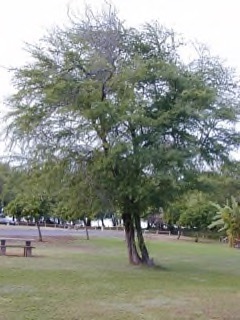
 |
|
Wikimedia.org - Forest & Kim Starr |
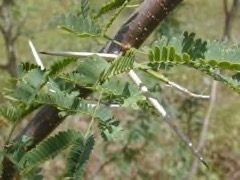 |
| Wikimedia.org - Eric Guinther |
Translate this page:
Summary
Algaroba (P. pallida) are also worth considering because of their natural habitats on dry coastlines, often dominating arid, saline soils. Prosopis species,
Prosopis are nitrogen fixers in the legume family (Fabaceae) that often thrive in arid soil and are drought-resistant. Their fruits are pods that can contain large amounts of sugar and are a balanced staple carbohydrate.
Physical Characteristics

 Acacia pallida is a deciduous Tree growing to 12 m (39ft) by 10 m (32ft) at a fast rate.
See above for USDA hardiness. It is hardy to UK zone 10. The flowers are pollinated by Bees. The plant is not self-fertile.
It can fix Nitrogen.
It is noted for attracting wildlife.
Suitable for: light (sandy), medium (loamy) and heavy (clay) soils and prefers well-drained soil. Suitable pH: mildly acid and neutral soils and can grow in very acid and saline soils.
It cannot grow in the shade. It prefers dry or moist soil and can tolerate drought. The plant can tolerates strong winds but not maritime exposure.
UK Hardiness Map
US Hardiness Map
Synonyms
Acacia pallida Humb. & Bonpl. ex Willd. Mimosa pallida (Humb. & Bonpl. ex Willd.) Poir. Prosopis limensis Benth.
Plant Habitats
Edible Uses
The seedpods can be added to soups and corn meal; or made into a sweet syrup and used to prepare various drinks[418 ]. Staple Crop: balanced Carb.
References More on Edible Uses
Medicinal Uses
Plants For A Future can not take any responsibility for any adverse effects from the use of plants. Always seek advice from a professional before using a plant medicinally.
The seedpods are used in the treatment of dysentery[414 ].
References More on Medicinal Uses
The Bookshop: Edible Plant Books
Our Latest books on Perennial Plants For Food Forests and Permaculture Gardens in paperback or digital formats.
Edible Tropical Plants
Food Forest Plants for Hotter Conditions: 250+ Plants For Tropical Food Forests & Permaculture Gardens.
More
Edible Temperate Plants
Plants for Your Food Forest: 500 Plants for Temperate Food Forests & Permaculture Gardens.
More
More Books
PFAF have eight books available in paperback and digital formats. Browse the shop for more information.
Shop Now
Other Uses
Agroforestry Uses: The tree is suitable for reforestation of hot dry areas where the soil is highly saline[418 ]. The tree is grown as a cover for the soil and shifting sand dunes in order to prevent erosion[414 ]. Other Uses: The bark is a source of tannins[414 , 418 ]. A gum exuding from the trunk can be used in glue and vanish[414 , 418 ]. The heartwood is dark reddish-brown, the sapwood light yellow[414 ]. The wood is dense, strong, relatively easy to work, durable but susceptible to termite attack[414 ]. It is used for crossties, piling, rural carpentry, vehicle parts, furniture, fence posts etc[418 ]. The wood can be used for fuel and for making charcoal[418 ]. Industrial Crop: Biomass. Fodder: Pod. 1. Nectary - Flowers rich in nectar and pollen:
Yes – Mesquite flowers produce nectar and pollen that attract bees and other pollinators, including beneficial insects.
2. Wildlife - Food (Fruit, Seeds, Leaf litter, Shelter, Nesting, Roosting):
Yes – Mesquite pods are consumed by animals, including birds and mammals. The tree provides dense foliage that can serve as shelter and nesting sites for wildlife. The seeds also offer a food source for various species.
3. Invertebrate Shelter (Overwintering sites, Leaf litter, Groundcover):
Yes – The rough bark, fallen pods, and leaf litter provide shelter and overwintering sites for invertebrates, while the groundcover helps maintain beneficial insect populations.
4. Pest Confuser (Smell):
No – Mesquite does not have a strong scent that would act as a pest confuser.
Special Uses
References More on Other Uses
Cultivation details
A plant of drier areas in the tropics and subtropics, where it can be found at elevations up to 300 metres[418 ]. It grows best in areas where annual daytime temperatures are within the range 22 - 28°c, but can tolerate 19 - 32°c[418 ]. Mature plants can be killed by temperatures of -2°c or lower, but new growth can be killed at -1°c [418 ]. It prefers a mean annual rainfall in the range 500 - 1,000mm, but tolerates 250 - 1,250mm[418 ]. Requires a sunny position. Succeeds in a range of well-drained soils, including saline soils[418 ]. Prefers a pH in the range 5.5 - 6, tolerating 5 - 6.7[418 ]. Established plants have deep tap roots and are very drought tolerant[305 , 418 ]. The tree can form dense thickets. It is a prolific producer of seed, which can be dispersed by water, in mud adhering to animals, boots etc, and by being eaten and defecated[305 ]. It has escaped from cultivation in many areas and can become an invasive and troublesome weed[305 , 418 ]. Plants grow quite slowly when young, to around 1 metre annually[414 ]. Plants are very fast to mature, able to flower and fruit within two years of sowing the seed[418 ]. Trees can be coppiced[414 ]. This species has a symbiotic relationship with certain soil bacteria, these bacteria form nodules on the roots and fix atmospheric nitrogen. Some of this nitrogen is utilized by the growing plant but some can also be used by other plants growing nearby[755 ]. Mesquite pods are typically harvested in late Summer to Autumn, depending on the species and environmental conditions.
Mesquite trees flower in Spring, usually from April to June (Northern Hemisphere). Mesquite trees are fast growers, often reaching heights of 4-10 meters (12-35 feet) in just a few years, depending on the species and environmental conditions.
References Carbon Farming Information and Carbon Sequestration Information
Temperature Converter
Type a value in the Celsius field to convert the value to Fahrenheit:
Fahrenheit:
The PFAF Bookshop
Plants For A Future have a number of books available in paperback and digital form. Book titles include Edible Plants, Edible Perennials, Edible Trees,Edible Shrubs, Woodland Gardening, and Temperate Food Forest Plants. Our new book is Food Forest Plants For Hotter Conditions (Tropical and Sub-Tropical).
Shop Now
Plant Propagation
Seed - it has a hard seedcoat and may benefit from scarification before sowing to speed up germination. This can usually be done by pouring a small amount of nearly boiling water on the seeds (being careful not to cook them!) and then soaking them for 12 - 24 hours in warm water. By this time they should have imbibed moisture and swollen - if they have not, then carefully make a nick in the seedcoat (being careful not to damage the embryo) and soak for a further 12 hours before sowing. Suckers Layering
Other Names
If available other names are mentioned here
English: mesquite; prosopis. Spanish: algarrobo. Local Common Names: Brazil: algarobeira. Cape Verde: espinheiro; spinho. Colombia: algarrobo; algarrobo forragero; anchipia guaiva; aroma; cuji; cuji negro; cuji yaque; manca-caballo; mesquite; trupi; trupillo. Djibouti: garawa. Ecuador: algarrobo. French Polynesia: carobier. Peru: guarango; huarango; taco; thacco. USA/Hawaii: algaroba; kiawe; mesquite.
Native Range
SOUTHERN AMERICA: Bolivia, Chuquisaca, Colombia, Ecuador, Peru,
Weed Potential
Right plant wrong place. We are currently updating this section.
Please note that a plant may be invasive in one area but may not in your area so it's worth checking.
It has escaped from cultivation in many areas and can become an invasive and troublesome weed[305 , 418 ]. Algaroba (Prosopis pallida) is regarded as a significant environmental weed in Queensland, the Northern Territory and Western Australia, and as apotential environmental weed or "sleeper weed" in other parts of Australia. This species is actively managed by community groups in Queensland and the mesquites (Prosopis spp.), as a group, are also one of the 20 Weeds of National Significance (WoNS) in Australia.
Conservation Status
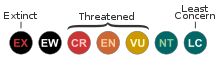
IUCN Red List of Threatened Plants Status : This taxon has not yet been assessed
| Related Plants
|
| Latin Name | Common Name | Habit | Height | Hardiness | Growth | Soil | Shade | Moisture | Edible | Medicinal | Other |
| Acacia aneura | Mulga Acacia | Tree | 15.0 |
8-11
| S | LM | N | DM | 3 | 0 | 3 |
| Acacia angustissima | Prairie acacia. Timbre. Fernleaf Acacia | Tree | 5.0 |
7-10
| F | LMH | N | DM | 2 | 3 | 4 |
| Acacia auriculiformis | Ear-Pod Wattle, Black Acacia, Earleaf, Black wattle | Tree | 25.0 |
10-12
| F | LMH | N | DM | 1 | 0 | 4 |
| Acacia catechu | Cutch tree, Catechu acacia | Tree | 15.0 |
10-12
| F | LMH | N | DM | 1 | 2 | 3 |
| Acacia colei | Cole's wattle, Candelabra Wattle, Soap wattle, | Shrub | 4.0 |
10-12
| F | LMH | N | DM | 3 | 2 | 3 |
| Acacia concinna | Shikakai, Soap-Pod | Tree | 10.0 |
10-11
| M | LM | N | D | 2 | 1 | 4 |
| Acacia coriacea | Wiry Wattle, Acacia, Leather Leaf | Tree | 5.0 |
9-11
| M | LMH | SN | DM | 3 | 0 | 3 |
| Acacia cowleana | Hall’s Creek wattle | Tree | 5.0 |
10-12
| F | LM | N | DM | 3 | 2 | 3 |
| Acacia cultriformis | Knife-Leaf Wattle, Knife acacia | Shrub | 4.0 |
9-11
| S | LMH | N | DM | 2 | 0 | 3 |
| Acacia dealbata | Mimosa, Silver wattle | Tree | 25.0 |
7-10
| F | LM | N | DM | 2 | 0 | 3 |
| Acacia decurrens | Green Wattle | Tree | 12.0 |
6-9
| F | LM | N | DM | 2 | 1 | 3 |
| Acacia farnesiana | Sweet Acacia, Perfume Acacia, Huisache | Shrub | 9.0 |
9-11
| F | LMH | N | DM | 2 | 2 | 4 |
| Acacia holosericea | Strap wattle, Candelabra wattle | Shrub | 3.0 |
10-12
| F | LMH | N | M | 1 | 2 | 3 |
| Acacia koa | Koa Acacia | Tree | 20.0 |
10-12
| F | LMH | N | DM | 0 | 2 | 3 |
| Acacia koaia | Koai'a | Tree | 5.0 |
10-12
| F | LMH | N | DM | 0 | 1 | 4 |
| Acacia leucophloea | Kuteera-Gum, White-barked acacia. | Tree | 25.0 |
10-12
| M | LMH | N | DM | 2 | 1 | 3 |
| Acacia longifolia | Sydney Golden Wattle, Acacia | Tree | 9.0 |
10-11
| M | L | N | DM | 3 | 0 | 3 |
| Acacia mearnsii | Black Wattle, Late black wattle | Tree | 10.0 |
8-11
| F | LM | N | M | 1 | 3 | 4 |
| Acacia melanoxylon | Blackwood, Australia Acacia, Black Acacia, Blackwood Acacia | Tree | 30.0 |
9-11
| F | LM | N | DM | 2 | 1 | 4 |
| Acacia mucronata | Narrow-Leaf Wattle | Tree | 9.0 |
7-10
| | L | N | DM | 2 | 0 | 3 |
| Acacia murrayana | Murray’s wattle, Colony wattle | Tree | 5.0 |
10-12
| F | LMH | N | DM | 3 | 2 | 3 |
| Acacia paradoxa | Kangaroo Thorn, Paradox acacia | Shrub | 5.0 |
7-10
| | LMH | N | DM | 1 | 0 | 2 |
| Acacia podalyriifolia | Queensland Silver Wattle, Pearl wattle | Tree | 3.0 |
7-10
| | LM | N | DM | 1 | 0 | 3 |
| Acacia pycnantha | Golden Wattle | Tree | 8.0 |
7-10
| F | L | N | DM | 2 | 0 | 3 |
| Acacia retinodes | Swamp Wattle, Water wattle | Tree | 6.0 |
7-10
| | LM | N | DM | 2 | 0 | 3 |
| Acacia saligna | Blue-Leaved Wattle, Orange wattle | Shrub | 6.0 |
7-10
| F | LMH | N | DM | 1 | 0 | 5 |
| Acacia sophorae | Coastal Wattle, Acacia | Shrub | 0.0 |
0-0
| | LMH | N | DM | 2 | 0 | 3 |
| Acacia verticillata | Prickly Moses | Shrub | 6.0 |
7-10
| | LMH | N | DM | 1 | 0 | 3 |
| Acacia victoriae | Bramble wattle. Gundabluey, Bardi bush | Shrub | 10.0 |
8-11
| F | LMH | N | DM | 4 | 2 | 3 |
| Arracacia xanthorrhiza | Peruvian Parsnip, Arracacha | Perennial | 1.0 |
8-11
| | M | SN | M | 4 | 0 | 0 |
|
|
Growth: S = slow M = medium F = fast. Soil: L = light (sandy) M = medium H = heavy (clay). pH: A = acid N = neutral B = basic (alkaline). Shade: F = full shade S = semi-shade N = no shade. Moisture: D = dry M = Moist We = wet Wa = water.
Now available:
Food Forest Plants for Mediterranean Conditions
350+ Perennial Plants For Mediterranean and Drier Food Forests and Permaculture Gardens.
[Paperback and eBook]
This is the third in Plants For A Future's series of plant guides for food forests tailored to
specific climate zones. Following volumes on temperate and tropical ecosystems, this book focuses
on species suited to Mediterranean conditions—regions with hot, dry summers and cool, wet winters,
often facing the added challenge of climate change.
Read More
Expert comment
Author
(Humb. & Bonpl. ex Willd.) Kunth
Botanical References
Links / References
For a list of references used on this page please go here
A special thanks to Ken Fern for some of the information used on this page.
Readers comment
| Add a comment |
|
If you have important information about this plant that may help other users please add a comment or link below. Only comments or links that are felt to be directly relevant to a plant will be included. If you think a comment/link or information contained on this page is inaccurate or misleading we would welcome your feedback at [email protected]. If you have questions about a plant please use the Forum on this website as we do not have the resources to answer questions ourselves.
* Please note: the comments by website users are not necessarily those held by PFAF and may give misleading or inaccurate information.
|
|