 |
|
http://commons.wikimedia.org/wiki/File:Narrow-leaved_Indian_Paintbrush_(NGM_XXXI_p515).jpg |
 |
|
Translate this page:
Summary
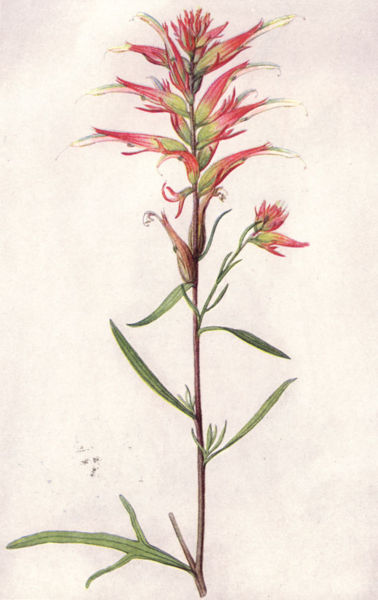
This plant is incorrectly spelt in the database and should be Castilleja linariifolia Benth. Wyoming paintbrush is one of the tallest and showiest paintbrush species in western North America, notable for its red-orange bracts and semi-parasitic physiology. Although the flowers (corollas) are technically edible, the plant’s tendency to accumulate selenium from soils makes it a cautionary-use species. Its primary ecological role is as a nectar source for hummingbirds and bees. It grows in open, dry habitats across the intermountain West and is the state flower of Wyoming.
Physical Characteristics

 Castilleja linariaefolia is a PERENNIAL growing to 0.6 m (2ft).
See above for USDA hardiness. It is hardy to UK zone 5. The species is hermaphrodite (has both male and female organs) and is pollinated by Hummingbirds (e, g, broad-tailed, rufous), bees, and butterflies.
It is noted for attracting wildlife.
Suitable for: light (sandy), medium (loamy) and heavy (clay) soils and can grow in nutritionally poor soil. Suitable pH: mildly acid, neutral and basic (mildly alkaline) soils. It can grow in semi-shade (light woodland) or no shade. It prefers moist soil and can tolerate drought.
UK Hardiness Map
US Hardiness Map
Synonyms
Castilleja linariifolia Benth.
Plant Habitats
Cultivated Beds;
Edible Uses
Flowers[257]. Edible Uses & Rating: Only the corollas, and sometimes the nectar, are safely edible—in moderation only, due to the risk of selenium accumulation. Bracts and calyces are fibrous, sometimes resinous, and not recommended. As a wild food, Wyoming paintbrush earns a low edible rating, used mainly for novelty or emergency use rather than routine consumption [2-3]. Taste, Processing & Kitchen Notes: Corollas taste mild to sweet due to nectar stores at the tube base. Their flavour is delicate but can include faint resinous or medicinal overtones. They may be used as a garnish or eaten raw, but only sparingly. Avoid bracts, which can taste bitter or resinous and add fibrous texture [2-3]. Seasonality (Phenology): Plants bloom May–August, depending on elevation. Corollas should be harvested when fully expanded but before drying. Flowering peaks early to mid-summer. Safety & Cautions (Food Use): Because Castilleja species can hyperaccumulate selenium, corollas should be consumed sparingly, and only from soils known to be low in selenium. Never eat leaves, stems, or roots. Harvest & Processing Workflow: Harvest by gently pulling tubular corollas free of the bracts. Flowers may be rinsed and used fresh, or soaked in water to release nectar for a mild, sweet infusion. Look-Alikes & Confusion Risks May be confused with other red paintbrushes; positive ID requires noting the long, linear leaves and regional distribution. Traditional / Indigenous Use Summary: Some tribes occasionally used the flowers as a sweet nibble due to their nectar but avoided the vegetative parts. No documented use of roots, leaves, or stems.
References More on Edible Uses
Medicinal Uses
Plants For A Future can not take any responsibility for any adverse effects from the use of plants. Always seek advice from a professional before using a plant medicinally.
Leprosy
Treats skin diseases, kidney disorders and leprosy[155]. A decoction of the plant has been used in the treatment of excessive menstrual discharge and other menstrual difficulties, and also to prevent conception[257]. A decoction of the leaves has been used during pregnancy in order to keep the baby small and thus lead to an easier labour[257]. The root is cathartic[257]. A decoction has been used as a blood purifier[257]. When taken over a long period of time, a decoction of the root is said to be an effective treatment for venereal disease[257]. The plant has been used to treat stomach aches[257].
References More on Medicinal Uses
The Bookshop: Edible Plant Books
Our Latest books on Perennial Plants For Food Forests and Permaculture Gardens in paperback or digital formats.
Edible Tropical Plants
Food Forest Plants for Hotter Conditions: 250+ Plants For Tropical Food Forests & Permaculture Gardens.
More
Edible Temperate Plants
Plants for Your Food Forest: 500 Plants for Temperate Food Forests & Permaculture Gardens.
More
More Books
PFAF have eight books available in paperback and digital formats. Browse the shop for more information.
Shop Now
Other Uses
Ecology & Wildlife: Wyoming paintbrush is an important nectar plant for hummingbirds (e.g., broad-tailed, rufous), native bees, and butterflies. Pollination is primarily hummingbird-mediated, with secondary bee pollination.
Special Uses
References More on Other Uses
Cultivation details
The state flower of Wyoming[60]. Identification & Habit: Wyoming paintbrush is a perennial herb, woody at the base, typically 60–90 cm tall (sometimes over 1 m), forming upright stems with narrow, linear leaves. The colorful red to orange bracts surround the true flowers, which are tubular and greenish. Leaves are long, narrow, and often entire, somewhat resembling those of flax, hence the epithet linariifolia. Flowers occur in elongated, showy spikes from early to mid-summer. Growing Conditions: Wyoming paintbrush prefers dry, open slopes, scrub, sagebrush, and pinyon–juniper woodlands, typically in light, well-drained soils. It is a hemiparasite, commonly tapping into roots of grasses, sagebrush, and other perennials. USDA hardiness is approximately Zone 4–8. Habitat & Range: Occurs across the Rocky Mountains and Intermountain West, especially Wyoming, Colorado, Utah, Nevada, Idaho, and northern Arizona and New Mexico. Elevational range is broad, from foothills to montane regions. Size & Landscape Performance: Typically 60–90 cm tall with a spread of 20–40 cm. Long-lived where established but difficult to cultivate because it requires a host plant for optimal growth. Cultivation (Horticulture): Cultivation requires a host species such as blue grama, Indian ricegrass, sagebrush, or other native perennials. Seeds should be sown in situ and allowed to establish naturally. Over-watering and rich soils discourage parasitic behaviour and weaken the plant. Pests & Problems: Few issues in wild settings. In cultivation, failure to locate a host or soils that are too rich reduces vigor. Rusts and root rots occur in damp conditions. Cultivar/Selection Notes: No cultivars exist; species grown only ornamentally in native gardens.
References Carbon Farming Information and Carbon Sequestration Information
Temperature Converter
Type a value in the Celsius field to convert the value to Fahrenheit:
Fahrenheit:
The PFAF Bookshop
Plants For A Future have a number of books available in paperback and digital form. Book titles include Edible Plants, Edible Perennials, Edible Trees,Edible Shrubs, Woodland Gardening, and Temperate Food Forest Plants. Our new book is Food Forest Plants For Hotter Conditions (Tropical and Sub-Tropical).
Shop Now
Plant Propagation
Propagation is mainly from seed, sown in fall or stratified prior to spring planting. Seeds need contact with compatible host roots. Transplanting adult plants is usually unsuccessful.
Other Names
If available other names are mentioned here
Wyoming Paintbrush (Castilleja linariifolia)
Native Range
US. USA. Arizona, California, Colorado, Idaho, Montana, Nevada, New Mexico, Oregon, Utah, Wyoming
Weed Potential
Right plant wrong place. We are currently updating this section.
Please note that a plant may be invasive in one area but may not in your area so it's worth checking.
Wyoming paintbrush is not weedy, spreads slowly, and has no invasive tendencies.
Conservation Status
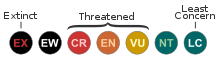
IUCN Red List of Threatened Plants Status : Not available.
Growth: S = slow M = medium F = fast. Soil: L = light (sandy) M = medium H = heavy (clay). pH: A = acid N = neutral B = basic (alkaline). Shade: F = full shade S = semi-shade N = no shade. Moisture: D = dry M = Moist We = wet Wa = water.
Now available:
Food Forest Plants for Mediterranean Conditions
350+ Perennial Plants For Mediterranean and Drier Food Forests and Permaculture Gardens.
[Paperback and eBook]
This is the third in Plants For A Future's series of plant guides for food forests tailored to
specific climate zones. Following volumes on temperate and tropical ecosystems, this book focuses
on species suited to Mediterranean conditions—regions with hot, dry summers and cool, wet winters,
often facing the added challenge of climate change.
Read More
Expert comment
Author
Benth.
Botanical References
60
Links / References
For a list of references used on this page please go here
Readers comment
© 2010, Plants For A Future. Plants For A Future is a charitable company limited by guarantee, registered in England and Wales. Charity No. 1057719, Company No. 3204567.