
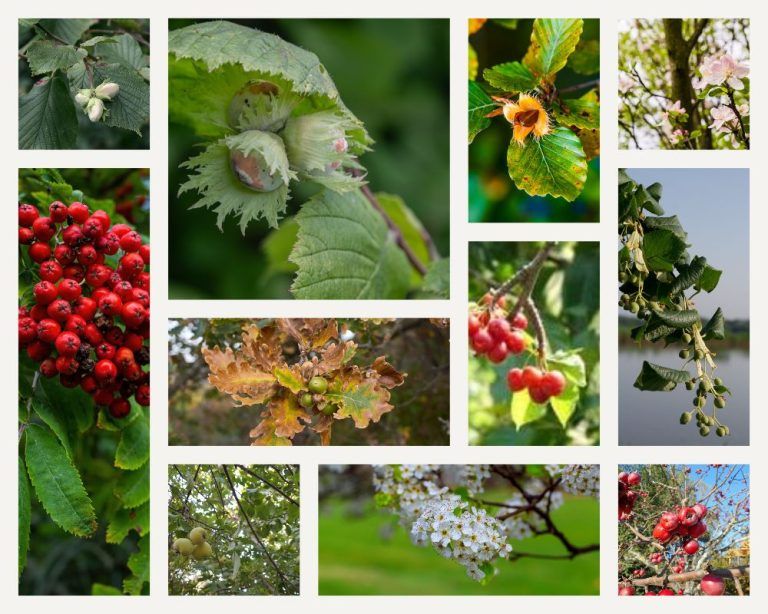
A hazelnut, a handful of young lime leaves and a jar of crab apple jelly have something in common: each comes from a tree native to the UK. Together, they suggest a food garden with a different rhythm. Spring brings leaves and blossom; summer brings cherries; autumn brings nuts and fruit. Between harvests, the trees keep growing.
In the first article in this series, Growing UK-Native Edible Perennials, we explored food plants that return year after year. Here we move into the canopy. Trees can feed us while creating shade, shelter and habitat, but they also ask us to think further ahead. A choice made in a nursery can shape a garden for decades.
The most useful question is therefore more specific than “Is this tree edible?” What can you harvest, how much preparation does it need, and will the mature tree belong in the space you have?
Key takeaways
- Trees are woody perennials. This article covers tree species and tree forms, including hazel grown as a small tree, rather than herbaceous plants or shrub planting schemes.
- Hazel, small-leaved lime and crab apple offer particularly useful starting points for nuts, young leaves and preserves, where space and conditions suit them.
- Native trees can support local food webs, but “native” does not mean edible, drought-proof or suitable for every garden.
- Check the plant part and its preparation, not just its edible rating. Yew is highly poisonous and is not recommended here as a food crop.
What is a tree, and how does it fit into a garden?
A tree is a long-lived woody plant that usually develops a main trunk supporting a crown of branches. A shrub usually has several woody stems arising near the ground. There is no single height threshold that neatly separates every tree from every shrub: growth conditions and management can change the form a plant takes.
“Perennial” describes lifespan rather than shape. Trees and shrubs are perennials because they live for more than two years. Gardeners often use the word more narrowly for herbaceous perennials, whose softer shoots may die back in winter while their roots or other underground parts survive. A tree retains its woody framework from one year to the next.
Hazel shows why these categories overlap. It often grows as a many-stemmed shrub, yet it can become a small tree. It is included here in that tree form, with its usual shrubby habit made explicit. Similarly, a beech clipped into a hedge is managed differently from a beech allowed to develop a full crown. This article considers the latter role.
In a garden, a tree supplies height and permanence. It can frame a view, shade a seat, shelter an exposed edge or form the upper layer of a food garden. Its crown also changes the conditions below it. An area that receives full sun when the tree is planted may become shaded and root-filled as it matures.
Plan for that future garden. A young oak in a pot gives little impression of the space its adult crown may occupy. “Fits today” is a poor test for a plant that could outlive the person planting it.
Why grow edible trees?
Repeated harvests from an established plant
A productive tree can yield food for many seasons without annual resowing. Its roots and woody structure remain in place between crops. That can reduce repeated cultivation around the tree, although establishing it still takes care and some species take many years to bear well.
The harvest may also differ from familiar orchard fruit. Lime offers young leaves, hazel offers oil-rich nuts, and birch has a history of sap use. These foods will not all replace supermarket staples, but they widen what a garden can provide.
A cooler, more sheltered place
Leaves intercept sunlight, and trees release water through transpiration. Together, these processes can cool their surroundings. Crowns and branches can also soften wind. In a garden, that may mean a more comfortable place to sit and better conditions for other plants.
The same effects can be inconvenient in the wrong place. Dense shade may reduce food production nearby, and tree roots compete for moisture. Treat shade and shelter as design choices, not automatic benefits everywhere.
Living structure above and below ground
Woody growth stores carbon while it remains in the tree. Roots help hold soil, and fallen leaves supply organic matter as they decompose. The benefit depends on the tree surviving, growing and being managed sensibly; planting alone does not guarantee a lasting environmental gain.
Older trees develop features that young planting cannot quickly replace: rough bark, cavities, decaying wood and complex crowns. If a healthy mature tree already stands in the garden, recognising its value may matter more than replacing it with a species carrying a higher food rating.
Useful materials as well as food
Tree management can produce stakes, small poles, craft wood and material for mulching. Such uses explain why PFAF rates more than edibility. However, the different harvests can compete. Cutting back a tree for wood or fresh shoots can remove branches that would otherwise flower and fruit. Decide what you want most from each tree.
What makes a plant native?
A native plant occurs in an area through natural processes rather than human introduction. For the UK’s trees, that history often includes natural colonisation after the last Ice Age, when land connections and climates differed from those of today. The Woodland Trust’s explanation of native woods places these long ecological relationships at the centre of their value.
A tree that people brought here can grow freely, reproduce and become familiar without becoming native. Such a plant may be described as naturalised. Familiarity, usefulness and nativeness are different things.
Nor does a UK-native label mean a tree is naturally found throughout the UK. Beech, for example, is native to southern England and south Wales, although it is planted much more widely. The Ancient Tree Inventory’s species guides make that regional distinction. A national list is a starting point, not a map of what belongs naturally in every county.
Two other terms help when buying trees. Provenance refers to the geographical origin of planting material. A cultivar is a cultivated selection maintained for particular characteristics. A native species may be sold as imported nursery stock, a local seed-grown tree or a selected garden form. These are not interchangeable choices when conserving a local wild population is the aim.
How can one tree be native to several countries?
Plant ranges developed before modern political borders. Seeds travelled by wind, water and animals, and populations expanded or contracted as conditions changed. A species whose natural range extends across Europe can be native to many European countries at once.
Hazel illustrates the point: PFAF records its range across Europe, including Britain, and into western Asia. Being native to the UK does not make it uniquely British. Conversely, a plant restricted naturally to one small region may be endemic there. Native and endemic do not mean the same thing.
Scale matters, too. A tree can be native to a particular valley, a country and a continent, while being introduced elsewhere. Botanical databases sometimes use geographical units such as Great Britain and Ireland rather than present-day national borders. Read the distribution details rather than assuming that every regional label has the same meaning.
Why choose native trees for gardens?
Native trees are part of local food webs. Their leaves may feed insects, their flowers may feed pollinators, and their fruit and seeds support birds and mammals. Fungi and other organisms use living roots, fallen leaves and dead wood. Much of this activity happens without attracting a gardener’s attention.
Oak provides a striking example. Research summarised by the Woodland Trust associates Britain’s two native oak species with about 2,300 wildlife species, including 326 that depend on oak. That is a combined ecological association, not a promise that one garden tree will host all of them.
Native trees can therefore help a garden connect with the wider landscape. They also make everyday natural history visible: catkins before spring, insects on leaves, birds searching branches, and the changing timing of fruit.
The case for natives does not require claiming that all non-native plants are worthless. The RHS Plants for Bugs research found value in different plant origins, while recommending a predominance of British natives to support a broad range of plant-dwelling invertebrates. Species choice, the amount of vegetation and garden management all matter.
A native tree planted in unsuitable soil may struggle. A well-chosen one still needs water while establishing. And a tree supporting caterpillars will sometimes have chewed leaves. If wildlife is part of the purpose, a perfectly untouched canopy need not be the measure of success.
Reading the PFAF ratings—and the numbers behind this article
The PFAF total supplied for this series is 28 UK-native edible trees in the database. 25 have an Edible score above zero and four have a score of zero but have other important uses. Seven records score 4 or 5 for edibility.
Ratings are out of five, with higher scores indicating greater assessed usefulness within that category. Edible concerns food use; Medicinal concerns recorded medicinal use; Other covers additional uses, such as wood, fibre and practical materials. The Other column is a rating, not a written list of those uses.
A score is a guide to further reading. It is not a measure of yield in your garden, proof of medicinal effectiveness or a safety certificate. The PFAF search page describes edible ratings from 1, very poor, to 5, excellent.
There are also identification and distribution issues. Sorbus hybrida, is now known as Hedlundia hybrida, and introduced in Great Britain. English elm also requires care: a UK government response treats the familiar English elm as an introduced form of Ulmus minor.
Table: PFAF tree records
Scientific names, common-name strings and numeric scores below are retained from the PFAF database. Common names can include names of cultivated forms, and do not establish that every named form is appropriate for a native planting. This is a source-data table, not a list of plants recommended for eating. Read the qualifications above and the species notes below.
| Scientific name | Common name(s), as supplied | Edible /5 | Medicinal /5 | Other /5 |
|---|---|---|---|---|
| Corylus avellana | Common Hazel, Common filbert, European Filbert, Harry Lauder’s Walking Stick, Corkscrew Hazel, Hazel | 5 | 2 | 5 |
| Tilia cordata | Small Leaved Lime, Littleleaf linden | 5 | 3 | 3 |
| Fagus sylvatica | Beech, European beech, Common Beech | 4 | 2 | 4 |
| Prunus avium | Wild Cherry, Sweet cherry | 4 | 2 | 4 |
| Quercus robur | Pedunculate Oak, English oak | 4 | 3 | 5 |
| Sorbus torminalis | Wild Service Tree, Checkertree | 4 | 0 | 3 |
| Betula pendula | Silver Birch, European white birch, Common Birch, Warty Birch, European White Birch | 3 | 3 | 5 |
| Betula pubescens | White Birch, Downy birch | 3 | 3 | 5 |
| Malus sylvestris | Crab Apple, European crab apple | 3 | 2 | 2 |
| Prunus padus | Bird Cherry, European bird cherry | 3 | 2 | 2 |
| Sorbus aria | Whitebeam, Chess-apple | 3 | 1 | 4 |
| Taxus baccata | Yew, English yew, Common Yew | 3 | 4 | 4 |
| Ulmus glabra | Wych Elm, Table-top Scotch Elm, Scotch Elm | 3 | 2 | 2 |
| Ulmus procera | English Elm | 3 | 2 | 3 |
| Acer campestre | Field Maple, Hedge maple | 2 | 1 | 3 |
| Pinus sylvestris | Scot’s Pine, Scotch Pine | 2 | 3 | 5 |
| Pyrus cordata | Plymouth Pear, Pear | 2 | 0 | 0 |
| Quercus petraea | Sessile Oak, Durmast oak | 2 | 3 | 2 |
| Sorbus aucuparia | Mountain Ash, European mountain ash | 2 | 2 | 3 |
| Populus tremula | Aspen Poplar, European aspen, Aspen | 1 | 2 | 3 |
| Salix caprea | Goat Willow, Kilmarnock Willow, Pink Pussy Willow, Pussy Willow | 1 | 2 | 4 |
| Salix pentandra | Bay Willow, Laurel willow | 1 | 3 | 3 |
| Salix triandra | Almond-Leaved Willow, Almond willow | 1 | 2 | 3 |
| Sorbus hybrida | Swedish Service Tree, Oakleaf mountain ash | 1 | 0 | Not recorded |
| Alnus glutinosa | Alder, European alder , Common Alder, Black Alder | 0 | 3 | 5 |
| Carpinus betulus | Hornbeam, European hornbeam, Common Hornbeam, European Hornbeam | 0 | 2 | 3 |
| Populus x canescens | Grey Poplar | 0 | 1 | 2 |
| Salix atrocinerea | Rusty Sallow, large gray willow | 0 | 3 | 3 |
Important edible native trees: what to grow and why
The following profiles concentrate on useful harvests and realistic garden roles. The ratings table provides the three scores for each species; the linked PFAF records give fuller cultivation and use details. Heights are approximate indications of potential size, not promised limits.
Common hazel (Corylus avellana): a substantial autumn harvest
Hazelnuts bring something valuable to an edible garden: a crop rich in oil that can be eaten fresh, roasted or used in baking. PFAF gives hazel an Edible rating of 5. It can reach roughly 6 metres and is often naturally many-stemmed; for the tree-based garden described here, choose and maintain a small-tree form.
Give it reasonable light and moist soil that suits the species. For dependable nuts, seek advice on compatible pollinating plants rather than relying on a single isolated specimen. Squirrels may take much of the harvest before you do.
Hazel also has a long practical life as material for hurdles and plant supports. Coppicing supplies new stems, but frequent cutting works against the aim of retaining a fruiting crown. Choose between those priorities. The ornamental names “corkscrew hazel” and “Harry Lauder’s walking stick” in the table are not a guarantee of a productive nut tree. Read the PFAF hazel record.
Small-leaved lime (Tilia cordata): food from spring foliage
This lime is unrelated to citrus. Its young leaves can be mild, tender salad ingredients, giving a tree an unexpectedly direct place in the kitchen. Pick only a modest quantity of soft new growth; mature leaves are less appealing. It shares the top Edible rating of 5 with hazel.
Unrestricted, small-leaved lime can reach around 30 metres. It suits a large garden or a carefully planned system of pruning begun while young. Harvestable shoots do not justify repeatedly cutting an established large tree without proper advice.
Its summer flowers attract bees. PFAF also records flower tea, with a caution in its hazards section, so the leaf crop is the simpler focus here. One unusual historical use was a chocolate-like paste made from flowers and immature fruit; its poor keeping quality limited commercial success. Read the PFAF small-leaved lime record.
Crab apple (Malus sylvestris): a good tree for the preserving kitchen
A crab apple’s sharpness becomes an advantage in jelly, sauces and mixed-fruit preserves. Its pectin helps mixtures set. That makes it a useful reminder that a rating of 3 can still describe a very worthwhile garden crop.
Expect a small to medium tree, potentially around 10 metres, rather than assuming that “crab” means dwarf. A sunny position with moist, well-drained soil gives it a useful garden setting. The combination of blossom and autumn fruit adds interest beyond harvest day.
If native identity matters, ask specifically for Malus sylvestris with a reliable origin. “Crab apple” is also used broadly in horticulture for ornamental apples; the common name alone is insufficient. Prepare the fruit using an established recipe and discard the pips and core residues. Read the PFAF crab apple record.
Wild cherry (Prunus avium): blossom followed by summer fruit
Wild cherry offers a familiar pleasure: ripe fruit that may be eaten fresh or cooked. Flavour varies between trees, so a seed-grown native cherry is not a promise of supermarket-sized dessert fruit.
It can become a substantial tree, reaching around 18 metres or more under favourable conditions. Give it space, good light and well-drained soil, and check pollination requirements when choosing stock. Birds will be serious competitors for the crop; deciding in advance to share some fruit makes the outcome less frustrating.
Eat the ripe flesh and discard the stones. Do not crush or eat the kernels, or use cherry foliage as a vegetable: these tissues can contain cyanide-releasing compounds. PFAF’s historical seed-use entries should not be treated as a reason to experiment. Read the PFAF wild cherry record.
Beech (Fagus sylvatica): a seasonal bonus beneath a large crown
Beech’s young leaves are edible while very tender, but that opportunity is brief. The small nuts, known as beechmast, have food uses too. Gathering and shelling them takes work, and PFAF warns against eating large quantities. They should not be presented as an unrestricted snack or staple.
At around 30 metres at maturity, beech belongs in a generous space with well-drained ground. Its dense canopy will strongly affect nearby planting. For most people, the sensible food opportunity is an existing, correctly identified tree rather than planting a giant solely for its nuts.
Heavy seed production can be followed by lean years. That uneven rhythm is part of the appeal of woodland foods, but it is a poor basis for a fixed annual harvest target. Read the PFAF beech record.
Pedunculate oak (Quercus robur): food that demands preparation
Oak earns its place first as a long-lived habitat tree. Its acorns also have food potential, but their tannins must be removed by thorough leaching before appropriate cooking. Roasting alone is not a substitute for that preparation.
Processed acorns can contribute to flour mixtures and other cooked foods. The work involved explains why an Edible rating of 4 does not automatically make oak a convenient kitchen crop. Use a reliable, species-appropriate preparation method rather than improvising from a short description.
A mature pedunculate oak can have a crown roughly as broad as its considerable height. It is a choice for substantial land, a community site or a large garden. Where there is room, leaving most acorns to wildlife and taking a modest experimental harvest may be the most rewarding approach. Read the PFAF pedunculate oak record.
Wild service tree (Sorbus torminalis): a fruit worth rediscovering
Wild service produces small brown fruits whose eating quality improves as they soften through bletting. This is controlled softening after ripening, not permission to eat mouldy or spoiled fruit. It offers a different experience from a crisp apple or a juicy cherry.
The tree may reach around 20 metres. It deserves room and a suitable, well-drained site, with pollination considered if fruit is the aim. The Woodland Trust’s tree species handbook describes its association with particular ancient wooded landscapes and the value of respecting its local native range.
Names can complicate the search: Kew treats Sorbus torminalis as a synonym of Torminalis glaberrima. The older name remains useful for finding its PFAF entry. Read the PFAF wild service tree record.
Silver birch (Betula pendula): a light canopy and a history of sap use
Birch sap brings an early-season harvest into the story. PFAF records its use as a drink and its concentration into syrup, but this should not obscure the cost to the tree of careless tapping. Concentrating a dilute sap also takes considerable evaporation.
Silver birch needs light and generally suits better-drained ground. Its pale bark and relatively airy crown can be attractive in a garden, although a potential height around 20 metres still demands planning.
Choose birch for its overall garden and habitat value, with sap as an optional specialist use. Do not tap a newly planted, small or stressed tree. Seek current practical guidance before making any wound, and avoid stripping bark: recorded famine foods are not sensible reasons to damage a living tree. Read the PFAF silver birch record.
Downy birch (Betula pubescens): a better fit for damp ground
Downy birch has similar recorded sap uses, but site suitability distinguishes it from silver birch. It tolerates wetter ground and can be the more appropriate choice in a damp, open setting. It also becomes a substantial tree, potentially around 20 metres.
That difference is a useful lesson in native gardening. Two closely related native trees do not necessarily want the same conditions. Choose the one suited to the place before considering the harvest.
The same restraint applies to sap collection: a healthy tree and a sound method matter more than extracting the maximum volume. In many gardens, simply enjoying the tree’s seasonal growth is the better choice. Read the PFAF downy birch record.
Bird cherry (Prunus padus): more wildlife tree than dessert crop
Bird cherry carries small fruits with a high proportion of stone to flesh. The flesh is often bitter or astringent, and its main kitchen interest lies in carefully prepared preserves rather than eating handfuls straight from the tree.
It can reach around 15 metres and suits moist ground with adequate drainage. Its flowers and fruit help give it a place in a wildlife-minded garden even when the human harvest is small.
Keep food use to properly prepared ripe flesh, with the stones removed intact. Do not grind the stones or use leaves and bark in home preparations. Like other cherries, it contains cyanide-releasing compounds in parts of the plant. A database record of traditional use is not a complete food-safety method. Read the PFAF bird cherry record.
Whitebeam (Sorbus aria): autumn fruit with a different texture
Whitebeam offers small fruits with a mealy texture. PFAF records their use in preserves and after bletting. They are an occasional food to explore carefully, rather than an obvious replacement for orchard apples. Discard the seeds when preparing the flesh.
A potential height around 12 metres makes it smaller than oak or beech but still a meaningful presence. Its pale leaf undersides give the crown a shifting appearance in a breeze. PFAF records tolerance of alkaline ground and maritime exposure, useful traits when matching a tree to a difficult site.
The whitebeam group includes closely related plants, so buy correctly named stock and avoid assuming that every whitebeam has identical status or uses. Read the PFAF whitebeam record.
One entry that need a different kind of attention
Yew (Taxus baccata): an edible rating is not a recommendation
Yew illustrates the sharpest limit of a numerical score. The fleshy red covering around its seed, called an aril, is the exception to the plant’s toxicity. The seed within it, the foliage and other parts are highly poisonous; ingestion can be fatal.
For that reason, this article does not recommend yew as a food crop or give harvesting instructions. Its rating of 3 records a particular edible part, not general safety. Grow and value yew for its landscape, cultural and habitat roles where appropriate, while keeping its toxic material out of food preparation. Read the PFAF yew record and hazards.
Choosing, planting and managing your tree
Begin with the space, then choose the harvest
Measure the available ground and consider the eventual crown, nearby buildings, boundaries and overhead services. Think about access for gathering fruit as well as room for roots. A tree whose crop is mainly beyond reach may be excellent for birds but disappointing if your main aim is filling the kitchen.
For a relatively modest space, investigate a true crab apple or a tree-form hazel, while checking their eventual spread. Where you have room for a large tree, lime offers leaves, and wild cherry offers summer fruit. Oak and beech make most sense when their long-term landscape value is part of the purpose. Even the smaller options here can outgrow a tiny courtyard.
Match soil, light and pollination
Observe winter wetness and summer dryness before buying. Most fruiting trees crop better with good light, even if they tolerate partial shade. Birch needs an open position. A damp patch suited to downy birch may be wrong for a tree requiring freely drained ground.
Ask the nursery whether a second compatible tree is needed, whether nearby trees can supply pollen, and whether flowering times overlap. “Two trees” is not enough if they are incompatible or are identical clones requiring a different pollinator. Also ask whether the plant is seed-grown, grafted or a named selection, and what that means for size and fruiting.
Give establishment the attention it needs
Plant bare-root deciduous trees during their dormant season when soil is workable, avoiding frozen or waterlogged ground. Keep the original root flare at soil level, water well and maintain a clear area around the young tree. Apply mulch without piling it against the trunk, and check soil moisture through dry spells while roots establish.
Use stakes and protection where needed, inspect ties and guards as the tree grows, and remove them when they have served their purpose. The RHS tree-growing guide provides fuller planting and aftercare advice. Native origin does not remove these practical needs.
Harvest in a way the tree can sustain
Take modest leaf harvests from established trees, leave enough foliage to support growth, and share fruit and nuts with wildlife. Avoid damaging branches to reach a crop. Let tree health, rather than a fixed target, determine how much you take.
Do not use one pruning rule for every species. Timing and technique depend on the tree and the intended result. A plan for accessible lime shoots differs from a plan for a cherry crown. For large trees or major cuts, obtain qualified arboricultural advice.
Food use: identify the tree, the part and the method
Before eating anything, confirm identification with more than a common name or a single photograph. Then check which part is edible, when it is harvested and how it must be prepared. A fruit’s flesh and the seed inside it can have very different properties.
The main distinctions in this article are clear: cherries are not permission to eat kernels; acorns require tannin removal; beechmast is not an unlimited food; and yew is excluded from practical food recommendations. Bletting should produce softened fruit, not visible mould or decay.
Use clean produce from places where contamination and chemical treatment are known, and recognise that familiar foods such as hazelnuts can cause allergies. The Medicinal column is included to reproduce the dataset, not to recommend home treatment. Consult the full species records, including their hazards, and use reliable food-preparation guidance for unfamiliar crops.
Finding more trees with PFAF and Kew
PFAF’s Native Plant Search is designed to help users find useful plants associated with a selected native region and refine their exploration through use and property criteria. It is a practical route into the database when the question is “What useful plants are native where I live?” rather than “What is this one species?”
Open each resulting plant record to check habit, size, edible parts, known hazards and cultivation needs. For this project, retain trees and appropriate tree forms rather than expanding the list into shrubs or herbaceous plants.
Then check the scientific name at Plants of the World Online, maintained by the Royal Botanic Gardens, Kew. POWO helps establish whether a name is accepted or a synonym, and distinguishes native from introduced distributions. It is a taxonomic and distribution resource, not a substitute for food-safety guidance.
Using both resources is valuable precisely because records do not always agree. Keep a note of the name and date checked, and investigate conflicts before ordering plants. For a conservation planting, add local botanical advice: a national database cannot resolve every local provenance question.
Glossary
- Aril
- A fleshy structure surrounding or partly surrounding a seed. In yew, it is the red flesh around the poisonous seed.
- Bletting
- Softening of certain ripe fruits after harvest or on the tree, making them more palatable. It is distinct from mouldy spoilage.
- Canopy
- The layer formed by a tree’s branches and leaves, or the combined crowns of several trees.
- Coppicing
- Cutting a suitable woody plant near ground level so that it produces new stems.
- Cultivar
- A cultivated plant selection maintained for particular features, such as fruit quality or growth habit.
- Endemic
- Native to, and naturally restricted to, a particular geographical area.
- Leaching
- Removing soluble substances with water; in acorn preparation, this reduces tannins.
- Mast
- The fruits or seeds of woodland trees, especially nuts and acorns. A mast year is one of unusually abundant production.
- Native
- Present in an area through natural processes rather than human introduction.
- Naturalised
- Introduced by people but able to maintain wild populations without continued planting.
- Perennial
- A plant that lives for more than two years, including trees, shrubs and herbaceous perennials.
- Provenance
- The geographical origin of seed or other planting material.
- Synonym
- A scientific name treated as another name for a taxon with a different accepted name.
- Tannins
- Plant compounds that can give food a bitter or astringent character; they are a key preparation issue in acorns.
Frequently asked questions
Which native edible tree should I start with?
Begin with the food you actually want and the space you can provide. A true crab apple is useful for preserves; hazel is useful for nuts where pollination and space can be arranged. Small-leaved lime offers young leaves but needs much more room unless managed from a young age.
Does a rating of 5 mean a tree is safe to eat?
No. The rating concerns edible usefulness, not the safety of every part. Always read the plant’s hazards and preparation details. The same caution applies to lower scores: an edible part can coexist with poisonous tissues.
Why include hazel in an article about trees?
Hazel crosses the usual tree – shrub boundary. It often grows as a multi-stemmed shrub but can be grown as a small tree. It is included here explicitly in that form; the article does not propose a shrub layer.
Will native trees need less watering?
Not necessarily. A tree suited to the site may perform well once established, but young trees need help during dry periods. Native status does not tell you how a plant will cope with a paved courtyard, compacted ground or an unusually dry summer.
Are all crab apples native?
No. The name covers a range of ornamental apples as well as the native Malus sylvestris. Check the scientific identity and the origin of the stock if native planting is your aim.
Can I eat acorns straight from the tree?
No. The oak discussed here requires thorough tannin removal and appropriate cooking. Its inclusion in the table is not an invitation to eat raw acorns.
Can a tree be native to Britain and other countries?
Yes. A natural range can cross many borders. Native means it occurs naturally in a place; it does not mean that place is its only home.
A harvest that changes with the years
An edible tree asks for patience, but it also changes what we notice. The first catkins become a seasonal event. A good nut year becomes memorable. Fallen fruit brings birds into view, and a spreading crown makes a once-open corner feel enclosed.
The best choice is a tree whose adult size, growing needs and harvest you can live with. Plant it well, give it time, and let some of its production remain part of the food web around it. A native food tree can then become both something you harvest and something you keep watching.