
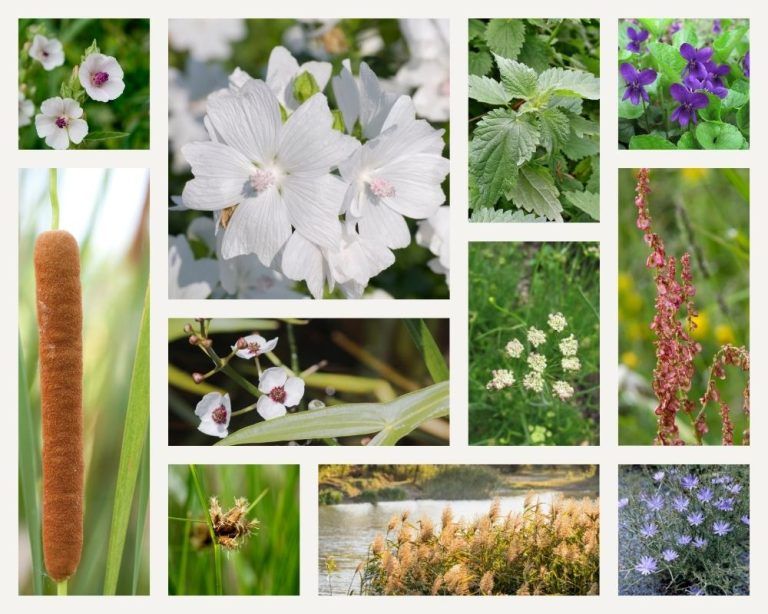
Britain’s perennial food plants include sharp spring greens, fragrant flowers, starchy wetland crops and fibres for making useful objects. They can feed people while keeping living roots in the ground—but choosing the right plant for the right place is essential.
Key takeaways
- A herbaceous perennial lives for more than two years and regrows from roots or other underground structures; it is not a tree or shrub.
- PFAF lists 285 edible perennials native to the United Kingdom. The table below presents the 27 plants in the PFAF dataset with an edibility rating of 4 or 5.
- Perennial foods can reduce repeated sowing and soil disturbance, extend harvest seasons and provide lasting habitat.
- “Native” means that a plant reached an area naturally. One species can be native to many countries because plant ranges cross modern borders.
- A native label does not guarantee that a plant is edible, harmless, rare, or suitable for every garden.
- Several highly rated plants are vigorous wetland species. Grow common reed, reedmaces and bulrushes only where their spread can be controlled.
- Check identification, hazards, preparation and accepted scientific names before eating any plant.
Most vegetable gardens begin with bare soil. Gardeners sow, weed, water and harvest. Then winter arrives, the plants die, and much of the work begins again.
An edible perennial garden follows a different rhythm. Sorrel pushes up lemony leaves in spring. Sweet violets flower beneath taller plants. Nettles return in a controlled patch. At the pond’s edge, arrowhead and reedmace store food underground.
These plants do not remove work from gardening. They change its character. Instead of rebuilding the garden every year, the gardener manages a living community that is already established.
What is a perennial?
A perennial is a plant that lives for more than two years. The visible growth of a herbaceous perennial may die back during winter, but the plant remains alive in its roots, rhizomes, corms, bulbs or other underground structures. It grows again when conditions improve.
This distinguishes perennials from annuals, which normally complete their lives in one growing season, and biennials, which usually flower and die in their second year. This article covers herbaceous perennials only. It excludes trees, shrubs and other woody plants.
“Perennial” does not mean quiet or compact. Some form restrained clumps; others travel through the soil. A few are short-lived but maintain a garden population by self-seeding.
Why grow perennial food plants?
Less repeated disturbance
Annual beds are often dug or cleared every year. Perennial plantings can remain largely undisturbed, protecting soil structure and providing a more stable home for fungi, worms and other organisms. Permanent roots and longer soil cover can also reduce erosion.
Established roots
A mature perennial does not rebuild its whole root system each spring. Established roots can reach water and nutrients beyond the shallow zone occupied by seedlings. This does not make every perennial drought-proof: wetland plants still need wet ground.
Earlier and longer harvests
Sorrel, nettles and sweet violet can offer food around the spring “hungry gap”, when stored winter crops are running low and many annual vegetables are not ready.
Habitat as well as food
Perennial patches are not cleared to bare earth at the end of every season. Leaves feed herbivores, flowers feed visiting insects, standing stems offer shelter and roots hold the soil. A garden can harvest some growth while leaving some for other species.
Several uses from one plant
Nettles yield food, fibre, dye and liquid feed. Reedmace leaves can be woven. Common reed supplies thatching material. Sorrel has recorded uses in dyes and cleaning. Sweet violet can cover the ground.
Less sowing, not no work
Perennials need suitable sites, water while establishing and control when they spread. The most productive wetland plants in the table can dominate a small pond. Perennial gardening replaces some annual sowing with long-term observation and management.
What is a native plant?
A native plant reached and established itself in an area through natural processes rather than human introduction. In Britain, this usually includes plants that survived here through the last Ice Age or colonised naturally afterwards.
The Royal Horticultural Society describes native plants as species that originated in a place or arrived without human involvement. Kew’s Plants of the World Online methodology similarly separates native distributions from places where plants were introduced deliberately or accidentally by people.
Native describes geographical history. It does not mean rare, harmless, edible or suitable for every garden. A native plant can be poisonous or highly vigorous.
How can a plant be native to many countries?
Nature does not follow modern borders. A species may have occupied a continuous area of marsh, grassland or woodland long before today’s countries existed. If that natural range crosses several national boundaries, it can be native to every country concerned.
Common reed is a striking example. It has a vast natural distribution. Wind, water, animals and changing coastlines moved plants long before passports or political boundaries appeared.
Scale also changes the answer. A plant may be native to Britain, western Europe, temperate Eurasia and more than one continent at the same time. It may even be native in one part of a country and introduced in another.
Common names can confuse the picture. “English violet” does not mean sweet violet occurs naturally only in England. Scientific names are a better starting point, although botanists revise them as evidence improves.
Why use native plants in gardens?
Native plants have shared a long history with local fungi, insects and other organisms. Their leaves, roots and flowers can fit into existing food webs. Nettles, for example, are human food and habitat for numerous insects, including the caterpillars of several butterflies and moths.
Plants placed in habitats resembling their natural ones may also cope well with local winters, rainfall and day length. They connect a garden with the surrounding landscape and help recover local food knowledge.
Native planting should not become a purity test. RHS research found that both native and non-native garden plants support invertebrates. A diverse mixture, abundant flowers across the seasons and good management all matter. A native reed that fills a small pond can reduce diversity rather than improve it.
Understanding the PFAF ratings and codes
PFAF ratings run from 1 to 5. In the table, Edible describes the quality and usefulness of edible parts, Medicinal summarises recorded medicinal importance, and Other covers practical, ecological or material uses. Five is the highest rating.
A medicinal rating is not clinical proof and does not make self-treatment safe. Plants and herbal preparations can cause side effects or interact with medicines.
- N = no shade/full sun; S = semi-shade; F = full shade.
- D = dry soil; M = moist soil; We = wet soil; Wa = water plant.
- Codes combine: SN means sun or semi-shade; MWeWa means moist soil, wet soil or water.
These codes are filters, not complete growing instructions. Always open the full plant record before choosing a species.
Table: UK-native edible perennials rated 4 or 5
The following table contains all 27 records in the supplied PFAF dataset. Names, common names, ratings and codes are reproduced from that dataset. Taxonomy and distribution can change, so confirm the accepted name and native range through Kew’s Plants of the World Online.
| Scientific name | Common name(s) | Edible | Medicinal | Other | Shade | Moisture |
|---|---|---|---|---|---|---|
| Althaea officinalis | Marsh mallow, common marshmallow | 5 | 5 | 3 | N | DM |
| Bolboschoenus maritimus | Cosmopolitan bulrush | 5 | 1 | 3 | N | WeWa |
| Malva moschata | Musk mallow | 5 | 2 | 2 | SN | M |
| Phragmites australis | Common reed, American common reed, hybrid common reed, European common reed, subtropical common reed | 5 | 2 | 4 | SN | MWeWa |
| Rumex acetosa | Sorrel, garden sorrel | 5 | 3 | 4 | SN | M |
| Sagittaria sagittifolia | Arrowhead, Hawaii arrowhead | 5 | 1 | 0 | N | WeWa |
| Typha angustifolia | Small reedmace, narrowleaf cattail | 5 | 3 | 3 | N | WeWa |
| Typha latifolia | Reedmace, broadleaf cattail, bullrush, nailrod | 5 | 3 | 4 | N | WeWa |
| Urtica dioica | Stinging nettle, California nettle | 5 | 5 | 4 | SN | M |
| Viola odorata | Sweet violet, English violet, garden violet, florist’s violet | 5 | 3 | 3 | SN | M |
| Brassica oleracea botrytis aparagoides | Nine Star perennial broccoli | 4 | 0 | 2 | SN | M |
| Bunium bulbocastanum | Pignut, earth-nut | 4 | 1 | 0 | N | M |
| Campanula glomerata | Clustered bellflower, Dane’s blood | 4 | 0 | 0 | SN | M |
| Cichorium intybus | Chicory, radicchio, succory, witloof | 4 | 3 | 3 | N | M |
| Crambe maritima | Sea kale | 4 | 0 | 3 | SN | DM |
| Hippuris vulgaris | Common mare’s-tail | 4 | 1 | 3 | N | WeWa |
| Medicago sativa | Alfalfa, yellow alfalfa | 4 | 3 | 4 | N | DM |
| Nasturtium officinale | Watercress | 4 | 3 | 2 | N | WeWa |
| Nasturtium × sterile | Brown watercress | 4 | 3 | 1 | N | WeWa |
| Origanum vulgare | Oregano, pot marjoram | 4 | 3 | 5 | SN | DM |
| Origanum vulgare hirtum | Greek oregano | 4 | 3 | 3 | SN | DM |
| Rubus chamaemorus | Cloudberry | 4 | 1 | 2 | N | MWe |
| Rumex acetosella | Sheep’s sorrel, common sheep sorrel | 4 | 3 | 1 | SN | M |
| Sanguisorba minor | Salad burnet, small burnet | 4 | 2 | 3 | N | M |
| Schoenoplectus tabernaemontani | Softstem bulrush | 4 | 2 | 3 | N | WeWa |
| Taraxacum officinale | Dandelion | 4 | 3 | 3 | SN | M |
| Wolffia arrhiza | Least duckweed, spotless watermeal | 4 | 0 | 0 | N | Wa |
Ten important edible perennials
The ten plants rated 5 for edibility in the table show how varied a native perennial food garden can be.
1. Marsh mallow (Althaea officinalis)
Ratings: edible 5, medicinal 5, other 3. Site: sun; dry or moist soil.
Marsh mallow links a modern sweet with a real marsh plant. Its mucilaginous roots were used in early confectionery. PFAF records cooked roots, leaves for salads or soup, flower tea and cooking liquid used as an egg-white substitute. It prefers rich, moist soil in sun but tolerates drier ground once established. Marsh mallow at PFAF.
2. Cosmopolitan bulrush (Bolboschoenus maritimus)
Ratings: edible 5, medicinal 1, other 3. Site: sun; wet soil or water.
This sedge stores starch in underground corms, which can be cooked, roasted or dried for flour. Seeds and pollen also have food uses. Its leaves have been used in weaving. Because carbohydrates are less common than leafy greens among wild foods, this wetland crop occupies an interesting nutritional niche. Cosmopolitan bulrush at PFAF.
3. Musk mallow (Malva moschata)
Ratings: edible 5, medicinal 2, other 2. Site: sun or semi-shade; moist soil.
Musk mallow produces mild, mucilaginous leaves, edible pink or white flowers and small, nutty immature seeds. Its leaves can provide a perennial alternative to lettuce. Cutting back at flowering may encourage fresh late-summer growth. Although individual plants can be short-lived, they often maintain themselves by self-seeding. Musk mallow at PFAF.
4. Common reed (Phragmites australis)
Ratings: edible 5, medicinal 2, other 4. Site: sun or semi-shade; moist soil, wet soil or water.
Young shoots, rhizomes, seeds and sugary material from the stems have recorded food uses. The plant also supplies thatch, screens, mats, paper and biomass. However, powerful rhizomes can travel many metres. Common reed is generally unsuitable for a small garden pond unless securely contained. Common reed at PFAF.
5. Sorrel (Rumex acetosa)
Ratings: edible 5, medicinal 3, other 4. Site: sun or semi-shade; moist soil.
Sorrel is an excellent entry plant. Its lemony leaves brighten salads, sauces and soups. Cutting flower stems encourages fresh leaves. Because sorrel contains oxalic acid, it is best used in moderate quantities, particularly by anyone advised to limit oxalates. Its roots and leaves have also supplied dyes, and sorrels feed several butterfly and moth caterpillars. Sorrel at PFAF.
6. Arrowhead (Sagittaria sagittifolia)
Ratings: edible 5, medicinal 1, other 0. Site: sun; wet soil or water.
Arrowhead produces starchy tubers in the mud. PFAF describes them as potato-like when roasted. They should be cooked, and their bitter skins are best removed afterwards. Cultivated forms have a long food history in China. A large container inside a pond makes the wandering tubers easier to manage and harvest. Arrowhead at PFAF.
7. Narrowleaf reedmace (Typha angustifolia)
Ratings: edible 5, medicinal 3, other 3. Site: sun; wet soil or water.
The underground parts provide starch, while spring shoots, young flower stems, immature flower heads and pollen have recorded food uses. Leaves and stems can be used for thatching, paper and weaving. Its bank-stabilising roots spread strongly, so it requires firm control. Narrowleaf reedmace at PFAF.
8. Broadleaf reedmace (Typha latifolia)
Ratings: edible 5, medicinal 3, other 4. Site: sun; wet soil or water.
Broadleaf reedmace offers rhizomes, spring shoots, stem bases, immature flower spikes, seeds and pollen. It has also supplied thatch, mats, paper, insulation, stuffing and tinder. Reedmaces can accumulate pollutants, so never harvest them from road drains, sewage-affected water or sites with an uncertain history. Broadleaf reedmace at PFAF.
9. Stinging nettle (Urtica dioica)
Ratings: edible 5, medicinal 5, other 4. Site: sun or semi-shade; moist soil.
Young nettles can be cooked for soups, used like spinach or made into pesto. Cooking or thorough drying neutralises the sting. Use young growth; PFAF warns that older leaves develop gritty particles that may irritate the urinary system. Nettles also provide fibre, dye, liquid feed and important caterpillar habitat. Keep a managed patch and harvest with gloves. Stinging nettle at PFAF.
10. Sweet violet (Viola odorata)
Ratings: edible 5, medicinal 3, other 3. Site: sun or semi-shade; moist soil.
Young leaves are mild and can thicken soup, while fragrant flowers decorate desserts and salads. Runners allow the plant to form a low ground cover. Use only correctly identified edible violets. The root is not routine food and can cause vomiting in high doses. Sweet violet at PFAF.
Designing a practical native perennial food garden
A sunny or partly shaded border
A manageable border could combine sorrel, musk mallow, marsh mallow and sweet violet, with nettles confined to a separate patch. Put violet along a cool edge or beneath taller plants. Give sorrel and musk mallow enough light for strong leaf growth. Place marsh mallow towards the back. Harvest lightly in the first year while roots establish.
A contained bog or pond garden
The table identifies arrowhead, cosmopolitan bulrush, common reed and the two reedmaces as wetland choices. They are not interchangeable ornaments. Several become large and dominant. A small garden should choose one, use a robust container and inspect it regularly.
Do not introduce these plants into natural ponds, streams or ditches, and do not let garden fragments escape. Aquatic plants can spread from surprisingly small pieces of rhizome.
Identification and harvesting safety
Edibility in a database is not a substitute for correct identification. Common names such as “bulrush” can refer to different plants, and edible wetland species may grow beside dangerous ones.
- Confirm the species from several reliable identification features.
- Check its accepted name and distribution at Plants of the World Online.
- Read the complete PFAF record, including hazards and preparation.
- Use only the edible part and growth stage specified.
- Try a small amount of a correctly prepared food the first time.
- Avoid plants exposed to herbicide, animal waste, road runoff or polluted water.
- Seek qualified advice before medicinal use, especially during pregnancy or while taking medicine.
Garden-grown material from a known source is safer than casual wild collection. Do not uproot wild plants without the landowner’s permission, collect protected species or take so much that the plant and dependent wildlife cannot recover.
Finding more native edible perennials
PFAF’s Native Plant Search helps users find plants native to a country or region, then filter them by ratings, habitat, shade, moisture and special uses. Enter United Kingdom rather than “UK” for a more accurate search.
PFAF has 285 edible perennials native to the United Kingdom in its database. This is a starting point, not a promise that every species is a good vegetable. Some offer only minor edible parts, require difficult preparation, carry safety warnings or behave poorly in small gardens.
After finding a plant, use Kew’s Plants of the World Online to check the accepted scientific name and whether the species is recorded as native or introduced in the region.
Glossary
- Annual
- A plant that normally completes its life cycle within one growing season.
- Biennial
- A plant that normally grows during its first year, then flowers and dies in its second.
- Corm
- A swollen underground plant base that stores energy.
- Cultivar
- A selected cultivated form maintained for particular characteristics.
- Herbaceous
- Having non-woody stems, often with above-ground growth that dies back seasonally.
- Introduced
- Brought to a place through human activity, deliberately or accidentally.
- Mucilage
- A slippery, water-binding plant substance that can thicken foods.
- Native
- Present in an area through natural origin or colonisation rather than human introduction.
- Perennial
- A plant that lives for more than two years.
- Rhizome
- A usually horizontal underground stem that stores energy and produces roots and shoots.
- Taxonomy
- The naming and scientific classification of organisms.
- Tuber
- A swollen underground structure that stores food and can produce new growth.
Frequently asked questions
Are all native plants good for wildlife?
Native plants can support long-established ecological relationships, but their value depends on species, form and management. A diverse garden with abundant flowers, shelter and undisturbed areas is usually better than relying on origin alone.
Are native plants always easier to grow?
No. A native marsh plant will struggle in a dry border, and a chalk-loving native may fail in acidic soil. Match the plant to light, moisture, soil and available space.
Does a rating of 5 mean the whole plant is edible?
No. The rating concerns overall edible usefulness. Only certain parts or growth stages may be edible, and preparation may be essential. Read the full plant record.
Does a high medicinal rating prove that a remedy works?
No. It summarises recorded medicinal uses; it is not a guarantee of clinical effectiveness or safety.
Which plant is easiest for a beginner?
Sorrel is a strong starting choice. It is familiar, compact, easy to harvest and useful in small quantities. Sweet violet and a controlled nettle patch are also practical.
Can I grow reedmace or common reed in a small pond?
Usually only with strong containment and regular control. Both can spread vigorously and displace other pond plants. Arrowhead in a large submerged container may be easier to manage.
Can wetland plants be harvested from the wild?
Wild harvesting carries identification, legal and pollution risks. Reedmaces can accumulate contaminants. Garden-grown plants in known clean water are a safer choice.
Why does the same plant have several common names?
Common names develop in different regions and languages. They may also be applied to unrelated plants. Use the scientific name when checking identity, safety and distribution.
How can I check whether a plant is truly native to the UK?
Begin with the PFAF Native Plant Search, then confirm the accepted name and distribution at Plants of the World Online.