 |
|
http://commons.wikimedia.org/wiki/File:Cleaned-Illustration_Euphorbia_helioscopia.jpg |
 |
|
Translate this page:
Summary
Physical Characteristics

 Euphorbia helioscopia is a ANNUAL growing to 0.4 m (1ft 4in). It is in flower from May to October. The species is hermaphrodite (has both male and female organs) and is pollinated by Flies.
Suitable for: light (sandy) and medium (loamy) soils and prefers well-drained soil. Suitable pH: mildly acid, neutral and basic (mildly alkaline) soils. It cannot grow in the shade. It prefers dry or moist soil.
UK Hardiness Map
US Hardiness Map
Synonyms
E. lunulata.
Plant Habitats
Cultivated Beds;
Edible Uses
Edible Parts: Stem
Edible Uses: Tea
Young stems - cooked[177, 179, 183]. Caution is advised, see the notes above on toxicity. Young leaves are used as a tea substitute[177, 183].
References More on Edible Uses
Medicinal Uses
Plants For A Future can not take any responsibility for any adverse effects from the use of plants. Always seek advice from a professional before using a plant medicinally.
Anthelmintic Antiperiodic Cancer Febrifuge Cholera
Antiperiodic[178]. The leaves and stems are febrifuge and vermifuge[218]. The root is anthelmintic[240]. The plant is cathartic[240]. It has anticancer properties[218]. The milky sap is applied externally to skin eruptions[240]. The seeds, mixed with roasted pepper, have been used in the treatment of cholera[240]. The oil from the seeds has purgative properties[240].
References More on Medicinal Uses
Other Uses
References More on Other Uses
Cultivation details
Prefers a light well-drained moderately rich loam in an open position[200]. Succeeds in dry soils. Hybridizes with other members of this genus[200]. The ripe seed is released explosively from the seed capsules[200]. Members of this genus are rarely if ever troubled by browsing deer or rabbits[233]. This genus has been singled out as a potential source of latex (for making rubber) for the temperate zone, although no individual species has been singled out[141].
References Carbon Farming Information and Carbon Sequestration Information
Temperature Converter
Type a value in the Celsius field to convert the value to Fahrenheit:
Fahrenheit:
Plant Propagation
Seed - sow spring or late summer in situ. Germination usually takes place within 2 - 3 weeks at 20°c.
Other Names
If available other names are mentioned here
Native Range
TEMPERATE ASIA: Oman, Saudi Arabia, Yemen, Cyprus, Iran, Iraq, Israel, Jordan, Lebanon, Syria, Turkey, Russian Federation-Ciscaucasia (Ciscaucasia), Armenia, Azerbaijan, Georgia, Russian Federation (Dagestan), Tajikistan, Turkmenistan, Uzbekistan, China (Anhui Sheng, Gansu Sheng, Guangdong Sheng, Guizhou Sheng, Hubei Sheng, Jiangsu Sheng, Ningxia Huizi Zizhiqu, Shaanxi Sheng, Sichuan Sheng, Yunnan Sheng), Korea, Japan (Honshu, Kyushu, Shikoku), Taiwan TROPICAL ASIA: India (Bihar, Haryana, Himachal Pradesh, Jammu and Kashmir (north), Punjab, Tamil Nadu, Uttar Pradesh), Pakistan (west), Vietnam EUROPE: Denmark, Finland, United Kingdom, Ireland, Norway, Sweden, Czechoslovakia, Austria, Belgium, Switzerland, Germany, Hungary, Netherlands, Poland, Russian Federation (European part), Belarus, Estonia, Lithuania, Latvia, Moldova, Ukraine (incl. Krym), Former Yugoslavia, Albania, Bulgaria, Greece (incl. Crete), Italy (incl. Sardinia, Sicily), Romania, Spain (incl. Baleares), France (incl. Corsica), Portugal AFRICA: Spain (Canarias), Portugal (Madeira Islands), Algeria, Egypt, Libya, Morocco, Tunisia
Weed Potential
Right plant wrong place. We are currently updating this section.
Please note that a plant may be invasive in one area but may not
in your area so it's worth checking.
Conservation Status
IUCN Red List of Threatened Plants Status :
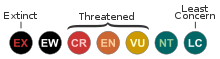
IUCN Red List
| Related Plants
|
| Latin Name | Common Name | Habit | Height | Hardiness | Growth | Soil | Shade | Moisture | Edible | Medicinal | Other |
| Acalypha australis | Asian copperleaf | Annual | 0.5 |
0-0
| | LMH | SN | M | 0 | 1 | |
| Alchornea castaneifolia | Iporuru | Tree | 8.0 |
10-12
| F | LMH | SN | MWe | 0 | 4 | 2 |
| Alchornea cordifolia | Christmas Bush | Shrub | 8.0 |
10-12
| M | LMH | N | DMWe | 2 | 4 | 3 |
| Aleurites cordata | Japan Wood-Oil Tree | Tree | 7.0 |
9-11
| | LM | SN | M | 0 | 0 | 2 |
| Aleurites fordii | Tung Tree, Tung Oil Tree, Wood Oil Tree China | Tree | 7.0 |
8-10
| F | LM | SN | M | 1 | 3 | 3 |
| Aleurites moluccanus | Candle Nut, Country Walnut | Tree | 20.0 |
10-12
| F | LMH | N | DM | 3 | 3 | 4 |
| Caryodendron orinocense | Taccy Nut, Nuez de Barinas | Tree | 25.0 |
10-12
| F | LMH | N | M | 3 | 1 | 2 |
| Chrozophora obliqua | Dyer's croton | Perennial | 0.0 |
0-0
| | LMH | SN | M | 1 | 1 | 0 |
| Chrozophora tinctoria | Dyer's Croton, Giradol | Perennial | 0.0 |
0-0
| | LMH | SN | M | 1 | 0 | 2 |
| Cnidoscolus aconitifolius | Tree Spinach, Tread Softly, Cabbage Star, Chaya | Shrub | 5.0 |
9-11
| F | LMH | SN | M | 4 | 3 | 3 |
| Cnidoscolus elasticus | Highland chilte | Shrub | 1.0 |
9-11
| F | LMH | N | DM | 0 | 0 | 4 |
| Croton lechleri | Sangre De Grado, Dragon's blood | Tree | 12.0 |
10-12
| F | LMH | N | M | 0 | 4 | 1 |
| Croton megalocarpus | Croton tree | Tree | 25.0 |
10-12
| F | LM | N | M | 0 | 2 | 4 |
| Croton palanostigma | Sangre De Grado, Dragon's blood | Tree | 12.0 |
10-12
| F | LM | N | M | 0 | 4 | 2 |
| Croton salutaris | Sangre De Grado, Dragon's blood | Tree | 12.0 |
10-12
| F | LM | N | M | 0 | 4 | 0 |
| Croton tiglium | Croton Oil Plant. Croton, Purging croton. | Tree | 7.0 |
10-12
| M | LMH | N | DM | 0 | 3 | 2 |
| Euphorbia abyssinica | Candelabra Spurge | Tree | 7.5 |
10-12
| M | LM | SN | D | 0 | 2 | 3 |
| Euphorbia antisyphilitica | Candelilla | Shrub | 1.0 |
7-10
| | LM | N | DM | 2 | 0 | 4 |
| Euphorbia corollata | Wild Spurge, Flowering spurge | Perennial | 1.0 |
4-8
| | LM | SN | DM | 0 | 2 | 2 |
| Euphorbia drummondii | Caustic Weed | Annual | 0.2 |
-
| | LM | N | DM | 0 | 1 | |
| Euphorbia esula | Leafy Spurge. Green spurge | Perennial | 1.0 |
3-9
| F | LMH | SN | DM | 0 | 0 | 4 |
| Euphorbia hirta | Asthma Weed, Pill-Bearing Spurge | Annual | 0.3 |
-
| | LM | N | DM | 1 | 3 | |
| Euphorbia humifusa | | Annual | 0.2 |
-
| | LM | N | DM | 1 | 2 | |
| Euphorbia intisy | Intisy, Pencil Plant | Shrub | 5.0 |
10-12
| F | LM | SN | D | 0 | 0 | 3 |
| Euphorbia ipecacuanhae | American Ipec | | 0.0 |
-
| | LMH | SN | M | 0 | 1 | |
| Euphorbia lactea | Mottled Spurge | Shrub | 5.0 |
10-11
| M | LMH | SN | DM | 0 | 0 | 4 |
| Euphorbia lathyris | Caper Spurge, Moleplant | Annual/Biennial | 1.0 |
5-9
| | LMH | SN | DM | 1 | 2 | 3 |
| Euphorbia marginata | Mountain Snow, Ghost Spurge, Ghost Weed | Annual | 0.6 |
4-8
| F | LM | N | DM | 1 | 1 | 3 |
| Euphorbia neriifolia | Fleshy spurge, Hedge Euphorbia, Oleander spurge | Shrub | 4.0 |
10-12
| F | LM | SN | D | 2 | 2 | 2 |
|
|
Growth: S = slow M = medium F = fast. Soil: L = light (sandy) M = medium H = heavy (clay). pH: A = acid N = neutral B = basic (alkaline). Shade: F = full shade S = semi-shade N = no shade. Moisture: D = dry M = Moist We = wet Wa = water.
Support Plants For A Future
Plants For A Future relies on regular donations to keep our free database and search facilities going, to pay for ongoing research, improvements and enhancements, and to develop and publish new books.
Read more
Choose Currency
Donate in £ GBP
Donate in $ USD
Donate in € EUR
Securely pay via PayPal or Credit/Debit Card without an account.
Expert comment
Author
L.
Botanical References
17
Links / References
For a list of references used on this page please go here
Readers comment