 |
|
|
 |
| USDA-NRCS PLANTS Database |
Translate this page:
Summary
Green rabbitbrush is a widespread shrub of arid and semi-arid landscapes in the American Southwest. Although it has been reported as a minor survival resource in extreme circumstances, it is best regarded as essentially inedible. Strong resins, latex-like compounds, and potentially harmful secondary metabolites dominate the plant’s chemistry. While roots were occasionally chewed as gum by some Indigenous groups and may yield a starchy-tasting broth when simmered, the safety of such uses is uncertain. Leaves and flowers are intensely acrid and unsuitable for food. Overall, green rabbitbrush is abundant but nutritionally and culinarily poor, and it should not be considered a meaningful food resource.
Physical Characteristics

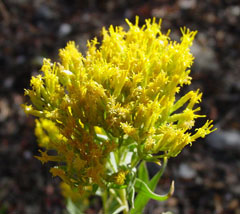
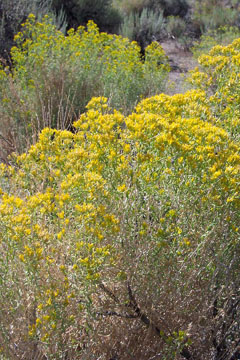
 Chrysothamnus viscidiflorus is a deciduous Shrub growing to 1 m (3ft 3in).
See above for USDA hardiness. It is hardy to UK zone 5. It is in flower from July to September. The species is hermaphrodite (has both male and female organs) and is pollinated by Insects.
Suitable for: light (sandy) and medium (loamy) soils, prefers well-drained soil and can grow in nutritionally poor soil. Suitable pH: mildly acid, neutral and basic (mildly alkaline) soils and can grow in very alkaline soils.
It cannot grow in the shade. It prefers dry or moist soil and can tolerate drought.
UK Hardiness Map
US Hardiness Map
Synonyms
Bigelovia douglasii.
Plant Habitats
Woodland Garden Sunny Edge;
Edible Uses
Edible Parts:
Edible Uses: Condiment Gum
A latex obtained from the root is used as a chewing gum[46, 61, 105, 257]. The plant has been used as a spice[257]. Edible Uses & Rating: Edible use is extremely limited. Roots have been chewed as gum or simmered into broth in rare historical contexts, but this use carries uncertainty and risk. Leaves and flowers are not edible. As a food plant, green rabbitbrush ranks very low and should be considered a last-resort survival resource only [2-3]. Taste, Processing & Kitchen Notes: Roots are woody at all stages of growth and splinter into sharp fibers when chewed. Simmered roots produce a broth with a faintly starchy, resinous flavor that is not unpleasant, but potential toxicity remains unknown. Flowers and leaves are intensely acrid and resinous, producing a burning sensation in the mouth and throat that boiling does not eliminate. These parts are not suitable for culinary use [2-3]. Seasonality (Phenology): Green rabbitbrush flowers primarily in late summer to early autumn, though vegetative growth persists year-round in many regions. Roots are accessible at any time of year, though this does not imply suitability for consumption. Safety & Cautions (Food Use): Rabbitbrush contains resins, latexes, and sesquiterpene lactones that may cause circulatory, respiratory, or digestive distress. These compounds are not reliably removed by cooking. Consumption is not recommended [2-3]. Traditional / Indigenous Use Summary: Roots were occasionally chewed as gum by Paiute and Goshiute groups. Use as food was rare and limited. The plant was never a dietary staple [2-3].
References More on Edible Uses
Medicinal Uses
Plants For A Future can not take any responsibility for any adverse effects from the use of plants. Always seek advice from a professional before using a plant medicinally.
Antirheumatic Odontalgic Poultice
A poultice made from the chewed plant tips has been applied to boils and rheumatic joints[257]. An infusion of the leaves has been used to treat colds[257]. The finely mashed leaves have been inserted in tooth cavities to treat toothache[257].
References More on Medicinal Uses
The Bookshop: Edible Plant Books
Our Latest books on Perennial Plants For Food Forests and Permaculture Gardens in paperback or digital formats.
Edible Tropical Plants
Food Forest Plants for Hotter Conditions: 250+ Plants For Tropical Food Forests & Permaculture Gardens.
More
Edible Temperate Plants
Plants for Your Food Forest: 500 Plants for Temperate Food Forests & Permaculture Gardens.
More
More Books
PFAF have eight books available in paperback and digital formats. Browse the shop for more information.
Shop Now
Other Uses
Dye Gum Latex
The latex obtained from the roots could be used in making rubber[46, 61, 161, 177]. Unfortunately it is not produced in sufficient quantity to make commercial extraction worthwhile[K]. A green dye is obtained from the bark[168]. A yellow-gold dye is obtained from the flowers[168, 257]. It is orange when alum is used as a mordant[257]. It rapidly establishes in disturbed habitat, including burns, flooded washes, and rockslides, so it is a valuable shrub for revegetating damaged land such as overgrazed rangeland and abandoned mining areas. Ecology & Wildlife: Rabbitbrush species provide important late-season nectar for insects, especially bees and flies, when few other plants are flowering. Despite the name, they are not a preferred food of rabbits and are used more often as cover than forage.
Special Uses
Scented Plants
References More on Other Uses
Cultivation details
Green rabbitbrush is an ecologically important shrub but a poor and potentially unsafe food plant. Its abundance does not translate into usefulness for foragers, and it should generally be avoided as a food source. Requires a sunny position and prefers a well-drained sandy soil[1, 11]. Plants do not require a rich soil[11]. They tolerate alkaline soils[200]. A very hardy plant but it prefers a drier climate than it finds in Britain though it succeeds in this country if given the protection of a dry sunny wall[200]. A very variable and ornamental species[60]. The leaves and stems are pleasantly aromatic[219]. Growing Conditions: This species thrives in dry, open environments with full sun and well-drained soils. It tolerates alkaline, sandy, gravelly, and disturbed soils and is commonly found in sagebrush steppe, desert margins, and post-disturbance landscapes. Habitat & Range: Green rabbitbrush occurs throughout much of the western United States, including the Great Basin, Colorado Plateau, and desert regions of the Southwest. It is particularly common in open rangelands and disturbed sites.
References Carbon Farming Information and Carbon Sequestration Information
Temperature Converter
Type a value in the Celsius field to convert the value to Fahrenheit:
Fahrenheit:
The PFAF Bookshop
Plants For A Future have a number of books available in paperback and digital form. Book titles include Edible Plants, Edible Perennials, Edible Trees,Edible Shrubs, Woodland Gardening, and Temperate Food Forest Plants. Our new book is Food Forest Plants For Hotter Conditions (Tropical and Sub-Tropical).
Shop Now
Plant Propagation
Seed - we have no information for this species but suggest sowing the seed in spring in a greenhouse and only just covering the seed. When they are large enough to handle, prick the seedlings out into individual pots and grow them on in a greenhouse for at least their first winter. Plant them out into their permanent positions in late spring or early summer, after the last expected frosts. Cuttings of half-ripe wood, July/August in sand in a frame[200].
Other Names
If available other names are mentioned here
Douglas rabbitbrush,
green rabbitbrush,
yellow rabbitbrush, Sticky-leafed rabbit brush,
Native Range
NORTHERN AMERICA: Canada (British Columbia), United States (Nebraska, South Dakota, Colorado, Idaho, Montana, Oregon, Washington, Wyoming, New Mexico, Arizona, California, Nevada, Utah)
Weed Potential
Right plant wrong place. We are currently updating this section.
Please note that a plant may be invasive in one area but may not in your area so it's worth checking.
This plant can be weedy or invasive. Noted in western USA as weedy.
Conservation Status
IUCN Red List of Threatened Plants Status : This taxon has not yet been assessed.

Growth: S = slow M = medium F = fast. Soil: L = light (sandy) M = medium H = heavy (clay). pH: A = acid N = neutral B = basic (alkaline). Shade: F = full shade S = semi-shade N = no shade. Moisture: D = dry M = Moist We = wet Wa = water.
Now available:
Food Forest Plants for Mediterranean Conditions
350+ Perennial Plants For Mediterranean and Drier Food Forests and Permaculture Gardens.
[Paperback and eBook]
This is the third in Plants For A Future's series of plant guides for food forests tailored to
specific climate zones. Following volumes on temperate and tropical ecosystems, this book focuses
on species suited to Mediterranean conditions—regions with hot, dry summers and cool, wet winters,
often facing the added challenge of climate change.
Read More
Expert comment
Author
(Hook.)Nutt.
Botanical References
60200
Links / References
For a list of references used on this page please go here
Readers comment
| Add a comment |
|
If you have important information about this plant that may help other users please add a comment or link below. Only comments or links that are felt to be directly relevant to a plant will be included. If you think a comment/link or information contained on this page is inaccurate or misleading we would welcome your feedback at [email protected]. If you have questions about a plant please use the Forum on this website as we do not have the resources to answer questions ourselves.
* Please note: the comments by website users are not necessarily those held by PFAF and may give misleading or inaccurate information.
|
Subject : Chrysothamnus viscidiflorus
|
|
|
|