 |
|
|
 |
| http://commons.wikimedia.org/wiki/User:Gidip |
Translate this page:
Summary
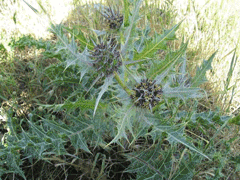
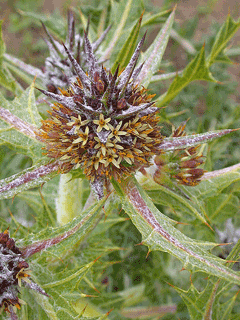
Gundelia tournefortii,
Tournefort’s gundelia thick flowering stem, and its young, undeveloped flower buds are sold in local markets like Jerusalem. The immature flowering heads are cooked and used similarly to globe artichokes. The plant’s leaves, seed and roots are also edible when cooked.
Gundelia tournefortii thrives in well-drained, sandy, or peaty soils and requires a sunny location. It naturally occurs in diverse vegetation types such as Mediterranean woodlands, shrublands, semi-steppe shrublands, and montane vegetation.
Tournefort’s gundelia is native to parts of temperate Asia, including regions like Afghanistan, Cyprus, Egypt (Sinai), Iran, Iraq, Israel, Jordan, Lebanon, Syria, Turkey, Armenia, Azerbaijan, and Turkmenistan.
Harvesting: Young shoots and immature flower heads in spring.
Physical Characteristics

 Gundelia tournefortii is a PERENNIAL growing to 0.6 m (2ft) by 0.2 m (0ft 8in) at a medium rate. The species is hermaphrodite (has both male and female organs) and is pollinated by Insects. The plant is self-fertile.
It is noted for attracting wildlife.
Suitable for: light (sandy) and medium (loamy) soils and prefers well-drained soil. Suitable pH: mildly acid, neutral and basic (mildly alkaline) soils. It cannot grow in the shade. It prefers dry or moist soil.
UK Hardiness Map
US Hardiness Map
Synonyms
Plant Habitats
Cultivated Beds;
Edible Uses
Edible Parts: Flowers Leaves Root Seed Stem
Edible Uses:
The thick flowering stem, with the young and still undeveloped flower buds, is sold in the local markets in Jerusalem[2]. It is a sought after vegetable[2]. Immature flowering heads - cooked. Used like globe artichokes[177]. Leaves - cooked[46, 61, 177]. Root - cooked[114]. Seed - cooked[114].
References More on Edible Uses
Medicinal Uses
Plants For A Future can not take any responsibility for any adverse effects from the use of plants. Always seek advice from a professional before using a plant medicinally.
None known
References More on Medicinal Uses
The Bookshop: Edible Plant Books
Our Latest books on Perennial Plants For Food Forests and Permaculture Gardens in paperback or digital formats.

Edible Tropical Plants
Food Forest Plants for Hotter Conditions: 250+ Plants For Tropical Food Forests & Permaculture Gardens.
More

Edible Temperate Plants
Plants for Your Food Forest: 500 Plants for Temperate Food Forests & Permaculture Gardens.
More

More Books
PFAF have eight books available in paperback and digital formats. Browse the shop for more information.
Shop Now
Other Uses
Agroforestry uses:
It can be used in natural landscaping and restoration projects, particularly in Mediterranean habitats. Its dense foliage can provide cover for wildlife. 1. Nectary - Flowers rich in nectar and pollen:
Yes – Tournefort’s Gundelia produces flowers that are rich in nectar, making them attractive to various pollinators, including bees.
2. Wildlife - Food (Fruit, Seeds, Leaf litter, Shelter, Nesting, Roosting):
Yes – The young flower buds and leaves are edible and can be consumed by wildlife. The plant can provide shelter due to its dense foliage, and its structure may support nesting birds.
3. Invertebrate Shelter (Overwintering sites, Leaf litter, Groundcover):
Yes – The plant’s structure can offer some shelter for invertebrates, and its leaf litter can contribute to the habitat for beneficial insects.
4. Pest Confuser (Smell):
Yes – The aromatic properties of the plant may help in confusing or deterring some pests, making it a beneficial component in pest management.
Special Uses
References More on Other Uses
Cultivation details
Prefers a sandy peaty soil[1]. Requires a sunny position and a well-drained soil[200]. Cultivated in Jerusalem as a vegetable[2]. Dislikes shady conditions. It can grow up to 3000m elevation on plains and mountains. Grows in batha, shrub-steppe, in Mediterranean woodland and shrubland, semi-steppe shrublands, shrub steppe, and montane vegetation. Tournefort’s Gundelia is generally self-fertile. Young shoots and immature flower heads are typically harvested in spring.
Tournefort’s Gundelia flowers in late spring to early summer.
Tournefort’s Gundelia has a moderate growth rate, establishing itself quickly in suitable conditions.
References Carbon Farming Information and Carbon Sequestration Information
Temperature Converter
Type a value in the Celsius field to convert the value to Fahrenheit:
Fahrenheit:
The PFAF Bookshop
Plants For A Future have a number of books available in paperback and digital form. Book titles include Edible Plants, Edible Perennials, Edible Trees,Edible Shrubs, Woodland Gardening, and Temperate Food Forest Plants. Our new book is Food Forest Plants For Hotter Conditions (Tropical and Sub-Tropical).
Shop Now
Plant Propagation
Seed - sow spring in a cold frame. When they are large enough to handle, prick the seedlings out into individual pots and plant them out in the summer. Division.
Other Names
If available other names are mentioned here
Native Range
TEMPERATE ASIA: Afghanistan, Cyprus, Egypt (Sinai), Iran, Iraq, Israel, Jordan, Lebanon, Syria, Turkey, Armenia, Azerbaijan, Turkmenistan
Weed Potential
Right plant wrong place. We are currently updating this section.
Please note that a plant may be invasive in one area but may not in your area so it's worth checking.
Conservation Status
IUCN Red List of Threatened Plants Status :
Growth: S = slow M = medium F = fast. Soil: L = light (sandy) M = medium H = heavy (clay). pH: A = acid N = neutral B = basic (alkaline). Shade: F = full shade S = semi-shade N = no shade. Moisture: D = dry M = Moist We = wet Wa = water.
Now available:
Food Forest Plants for Mediterranean Conditions
350+ Perennial Plants For Mediterranean and Drier Food Forests and Permaculture Gardens.
[Paperback and eBook]
This is the third in Plants For A Future's series of plant guides for food forests tailored to
specific climate zones. Following volumes on temperate and tropical ecosystems, this book focuses
on species suited to Mediterranean conditions—regions with hot, dry summers and cool, wet winters,
often facing the added challenge of climate change.
Read More
Expert comment
Author
L.
Botanical References
200
Links / References
For a list of references used on this page please go here
Readers comment