 |
|
http://commons.wikimedia.org/wiki/User:Dalgial |
 |
| Patrick J. Alexander @ USDA-NRCS PLANTS Database |
Translate this page:
Summary
A widespread annual weed of moist disturbed soils, Bidens bipinnata (Spanish needles) is infamous for its clingy barbed seeds but valued across Asia and the Americas as a leafy vegetable and tea herb. It thrives wherever water and warmth coincide, producing airy, bipinnate foliage and small yellow heads.
Physical Characteristics

 Bidens bipinnata is a ANNUAL growing to 1 m (3ft 3in).
See above for USDA hardiness. It is hardy to UK zone 5. It is in flower from September to October, and the seeds ripen in October. The species is hermaphrodite (has both male and female organs) and is pollinated by Insects.
It is noted for attracting wildlife.
Suitable for: light (sandy), medium (loamy) and heavy (clay) soils. Suitable pH: mildly acid, neutral and basic (mildly alkaline) soils. It cannot grow in the shade. It prefers moist soil.
UK Hardiness Map
US Hardiness Map
Synonyms
Plant Habitats
Cultivated Beds;
Edible Uses
Edible Parts: Leaves Shoots
Edible Uses: Condiment Tea
Leaves and young shoots - cooked or used as a flavouring[177, 207]. Used as a vegetable[218]. A tea is made from the flowering tops[207]. Edible Uses & Rating: Leaves and shoots are edible, cooked or fresh, and flowers are usable for tea. Seeds not recommended for eating due to dangerous barbs [2-3]. Edibility rating: (3/5). Taste, Processing & Kitchen Notes: Fresh leaves taste lettuce-like with a salty, fishy accent; boiling removes this, yielding a mild green comparable to spinach. The tea is reddish-brown, aromatic, and pleasant. Excellent paired with rice or fish dishes. Seeds may be used as a beverage (after toasting, pounding, boiling, and filtering), producing a sweet, mild drink, though collection is hazardous. Seasonality (Phenology): Flowers July–October; seeds adhere in autumn. Leaves best mid-summer to pre-flowering. Harvest & Processing Workflow: Gather leaves before flowering; brief boiling removes resinous flavor. Dry for tea or powder. Look-Alikes & Confusion Risks: Resembles Coreopsis tinctoria before fruiting; Bidens distinguished by barbed fruits. Traditional / Indigenous Use Summary: Used in folk medicine for fever and inflammation; eaten widely as boiled green in Asia, Africa, Mexico.
References More on Edible Uses
Medicinal Uses
Plants For A Future can not take any responsibility for any adverse effects from the use of plants. Always seek advice from a professional before using a plant medicinally.
Antibacterial Emmenagogue Styptic Vermifuge
The root and seeds are popularly used as an emmenagogue and in the treatment of laryngeal and bronchial diseases[207]. A tea made from the leaves is vermifuge[222]. The leaves have been chewed as a treatment for sore throat[222]. The plant juice is styptic and has been used as ear drops[222]. An extract of the plant has bactericidal properties[218].
References More on Medicinal Uses
The Bookshop: Edible Plant Books
Our Latest books on Perennial Plants For Food Forests and Permaculture Gardens in paperback or digital formats.
Edible Tropical Plants
Food Forest Plants for Hotter Conditions: 250+ Plants For Tropical Food Forests & Permaculture Gardens.
More
Edible Temperate Plants
Plants for Your Food Forest: 500 Plants for Temperate Food Forests & Permaculture Gardens.
More
More Books
PFAF have eight books available in paperback and digital formats. Browse the shop for more information.
Shop Now
Other Uses
Ecology & Wildlife: Excellent bee and butterfly nectar source; seed food for small birds. Contributes organic matter in fall dieback. A cosmopolitan “weed” that doubles as an edible and medicinal herb, easy to grow and supportive of pollinators.
Special Uses
Attracts Wildlife
References More on Other Uses
Cultivation details
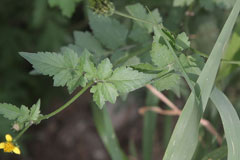
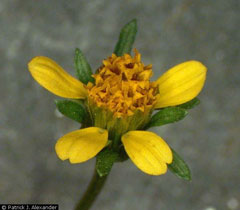
Succeeds in any moderately fertile moisture-retentive soil in full sun[200]. A good bee plant[200]. Identification & Habit: Annual 30–120 cm tall, with angular, ridged stems and finely bipinnate opposite leaves of 3–7 deep lobes. Flower heads 1–2 cm across, yellow disk florets, few or no rays. Fruits black, linear-fusiform, 4-angled, 7–18 mm long, with 2–4 barbed awns. Moist disturbed soils, full sun, tolerates drought once mature. USDA Zones 4–11. Habitat & Range: Native to eastern North America, now cosmopolitan, especially southeastern U.S., Mexico, Asia, and tropics. Size & Landscape Performance: 0.3–1.2 m tall; fast-growing, fine-textured; short life cycle; beneficial for pollinator corridors. Pests & Problems: Minimal; occasional mildew or leaf spot.
References Carbon Farming Information and Carbon Sequestration Information
Temperature Converter
Type a value in the Celsius field to convert the value to Fahrenheit:
Fahrenheit:
The PFAF Bookshop
Plants For A Future have a number of books available in paperback and digital form. Book titles include Edible Plants, Edible Perennials, Edible Trees,Edible Shrubs, Woodland Gardening, and Temperate Food Forest Plants. Our new book is Food Forest Plants For Hotter Conditions (Tropical and Sub-Tropical).
Shop Now
Plant Propagation
Seed - sow mid to late spring in situ and only just cover the seed.
Other Names
If available other names are mentioned here
Spanish needles.
Native Range
NORTHERN AMERICA: Canada (Ontario, New Brunswick), United States (Connecticut, Indiana, New Jersey, New York, Ohio, Pennsylvania, Rhode Island, West Virginia, Illinois, Iowa, Kansas, Missouri, Nebraska, Oklahoma, Alabama, Arkansas, Florida, Georgia, Kentucky, Louisiana, Maryland, Mississippi, North Carolina, South Carolina, Tennessee, Virginia, District of Columbia, New Mexico, Texas, Arizona)
Weed Potential
Right plant wrong place. We are currently updating this section.
Please note that a plant may be invasive in one area but may not in your area so it's worth checking.
High; prolific seed production and adhesion dispersal. Manage by cutting before fruit set. This plant can be weedy or invasive. Possible weedy in Nebraska and the Great Plains, USA.
Conservation Status
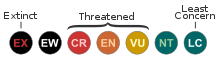
IUCN Red List of Threatened Plants Status : This taxon has not yet been assessed.
Growth: S = slow M = medium F = fast. Soil: L = light (sandy) M = medium H = heavy (clay). pH: A = acid N = neutral B = basic (alkaline). Shade: F = full shade S = semi-shade N = no shade. Moisture: D = dry M = Moist We = wet Wa = water.
Now available:
Food Forest Plants for Mediterranean Conditions
350+ Perennial Plants For Mediterranean and Drier Food Forests and Permaculture Gardens.
[Paperback and eBook]
This is the third in Plants For A Future's series of plant guides for food forests tailored to
specific climate zones. Following volumes on temperate and tropical ecosystems, this book focuses
on species suited to Mediterranean conditions—regions with hot, dry summers and cool, wet winters,
often facing the added challenge of climate change.
Read More
Expert comment
Author
L.
Botanical References
43200
Links / References
For a list of references used on this page please go here
Readers comment