 |
|
Patrick Alexander from Las Cruces, NM Creative Commons Zero, Public Domain Dedication |
 |
| Patrick Alexander from Las Cruces, NM Creative Commons Zero, Public Domain Dedication |
Translate this page:
Summary
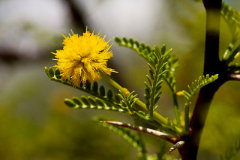
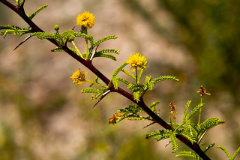
Vachellia vernicosa, commonly called varnish or Sticky acacia, is a small, spiny, drought-adapted legume of the desert foothills of northern Mexico and the far southwestern U.S. It forms dense, glossy green thickets on rocky slopes and arroyos, fixing nitrogen and offering cover and forage for wildlife. As a food plant it is minor and uncertain: like many mimosoid legumes, its seeds and gums have potential but also safety questions (possible cyanogenic and other secondary compounds). It functions far better as an ecological and restoration shrub than as a human staple. It is best approached as “probably useful, but not a primary edible” pending very species-specific confirmation. USDA hardiness is broadly around Zones 8–10; height typically 1–4 m with a similar spread.. Sticky acacia offers edible seeds in theory, but the lack of documentation, possible bitterness, and presence of toxins make it a very minor food source. It was not traditionally important as food and should be approached with caution. Acacia neovernicosa Isely is a synonym of Vachellia vernicosa
Physical Characteristics

 Vachellia vernicosa is a SHRUB growing to 2 m (6ft) by 2 m (6ft) at a medium rate.
See above for USDA hardiness. It is hardy to UK zone 9 and is not frost tender. The flowers are pollinated by Bees, Insects.
It can fix Nitrogen.
It is noted for attracting wildlife.
Suitable for: light (sandy) and medium (loamy) soils, prefers well-drained soil and can grow in nutritionally poor soil. Suitable pH: neutral and basic (mildly alkaline) soils and can grow in very alkaline soils.
It cannot grow in the shade. It prefers dry or moist soil and can tolerate drought.
UK Hardiness Map
US Hardiness Map
Synonyms
Homotypic Synonyms: Acacia constricta var. vernicosa (Standl.) L.D.Benson. Acacia neovernicosa Isely. Acacia vernicosa Standl. Acaciopsis vernicosa Britton & Rose.
Plant Habitats
Edible Uses
The seeds of sticky acacia have been reported as edible after thorough cooking. They are available from July to November. However, the plant has not been well studied, and there are few accounts of its use as food. Based on similarities to related species (such as whitethorn acacia), the seeds are likely to be small, hard, and somewhat bitter. Other parts of the plant are not known to be edible [2-3]. There is scattered, non-specific precedent for use of seeds or gum of related acacias as food or famine food, but robust, species-specific data for V. vernicosa is lacking. Given that many Vachellia/Senegalia species contain potentially problematic compounds, this species should be treated with caution. As a forager’s plant for this project, its human food value is best rated 1/5. Taste, Processing & Kitchen Notes: In practice, any experimental use should be extremely conservative: small quantities of properly cooked seeds, or minor use of gum, only with strong cross-checking against authoritative regional ethnobotanical sources. Pods are generally thin and not especially fleshy; flavor is typically tannic/green rather than inviting. In short, this shrub is better admired than eaten. Seasonality (Phenology): Leaf flush follows warm-season rains; flowering typically occurs in spring or summer depending on rainfall, followed by pod development into late summer or autumn. It may leaf out multiple times in response to episodic moisture. Safety & Cautions (Food Use): Due to limited data on edibility and the known toxicity in some related taxa (tannins, alkaloids, cyanogenic glycosides), any food use should be considered experimental and minimal. Not recommended as a regular food source without stronger evidence. Harvest & Processing Workflow: For practical purposes: harvest is mainly for seed collection, gum, or fuel/structural uses, not routine eating. Pods can be dried, seeds extracted and test-cooked, but this is more academic than advisable. Look-Alikes & Confusion Risks: Can be confused with other Vachellia/Senegalia species, especially in mixed thornscrub. Accurate ID is critical since chemistry and potential toxicity differ among species. Traditional/Indigenous Use Summary: Documented uses focus on fuel, fencing, and potentially minor medicinal or utilitarian roles; detailed, verifiable records of its use as a staple food are thin. It should not be casually equated with better-known edible acacias without explicit sources.
References More on Edible Uses
Medicinal Uses
Plants For A Future can not take any responsibility for any adverse effects from the use of plants. Always seek advice from a professional before using a plant medicinally.
None Known
References More on Medicinal Uses
The Bookshop: Edible Plant Books
Our Latest books on Perennial Plants For Food Forests and Permaculture Gardens in paperback or digital formats.
Edible Tropical Plants
Food Forest Plants for Hotter Conditions: 250+ Plants For Tropical Food Forests & Permaculture Gardens.
More
Edible Temperate Plants
Plants for Your Food Forest: 500 Plants for Temperate Food Forests & Permaculture Gardens.
More
More Books
PFAF have eight books available in paperback and digital formats. Browse the shop for more information.
Shop Now
Other Uses
A tough desert legume that stabilizes slopes, feeds insects, and participates in nitrogen cycling. Documented uses focus on fuel, fencing, and potentially minor medicinal or utilitarian roles. Ecologically valuable, culturally present, but a minor or questionable human food. Ecology & Wildlife: Flowers provide nectar and pollen for bees and other insects; foliage and pods offer browse for some wildlife and livestock, though spines and chemistry can limit use. Dense growth offers cover and nesting habitat. As a nitrogen-fixer, it contributes to soil fertility patches in otherwise poor desert soils. Pollination is primarily by bees and other insects attracted to the puffball inflorescences.
Special Uses
References More on Other Uses
Cultivation details
Identification & Habit: Varnish acacia is a multi-stemmed, thorny shrub with smooth, shiny, often reddish-brown young bark and a distinctly “varnished” look to its foliage. Leaves are bipinnate and small, giving a fine, feathery texture; stipular spines are present at the nodes. Flowers are pale cream to yellow, in globose puffball heads characteristic of acacias. Fruits are narrow, often slightly curved pods with several small seeds. The plant is deciduous to semi-evergreen depending on moisture. Habit is stiffly branched, often forming impenetrable thickets on slopes and washes. Growing Conditions: Varnish acacia thrives in full sun, heat, and drought on rocky or gravelly, often calcareous soils. It tolerates extreme aridity once established, benefits from good drainage, and is adapted to episodic heavy rains followed by long dry spells. Habitat & Range: Native to desert foothills, arroyos, and slopes in northern Mexico; extending locally into the borderlands of the southwestern United States. It occurs in thornscrub, desert scrub, and open woodland ecotones. Size & Landscape Performance: In landscape settings it forms dense, drought-hardy, wildlife-friendly screens. It copes well with reflected heat and minimal irrigation. Spines and density make it unsuitable for tight human spaces but useful as a barrier. Cultivation (Horticulture): Where legal and ecologically appropriate, it is straightforward to grow from seed in hot dry climates. It prefers full sun and minimal supplemental water once established. Root nodulation allows survival in poor soils. Because of invasive or conflict potential with restoration targets, it should only be introduced within its native or naturalized range. Pests & Problems: Generally resilient in arid climates, with occasional insect herbivory or fungal spotting in wetter-than-normal years. Main management issues are thorniness and potential for dense, obstructive growth. Cultivar/Selection Notes: No named food cultivars are in use; interest is largely ecological (erosion control, native shrub).
References Carbon Farming Information and Carbon Sequestration Information
Temperature Converter
Type a value in the Celsius field to convert the value to Fahrenheit:
Fahrenheit:
The PFAF Bookshop
Plants For A Future have a number of books available in paperback and digital form. Book titles include Edible Plants, Edible Perennials, Edible Trees,Edible Shrubs, Woodland Gardening, and Temperate Food Forest Plants. Our new book is Food Forest Plants For Hotter Conditions (Tropical and Sub-Tropical).
Shop Now
Plant Propagation
Primarily by seed. Hard seeds benefit from scarification and warm conditions. Inoculation with appropriate rhizobia enhances vigor. Semi-hardwood cuttings are possible but less common.
Other Names
If available other names are mentioned here
Acacia neovernicosa Isely is a synonym of Vachellia vernicosa. Varnish or Sticky acacia
Native Range
Arizona, Mexico Central, Mexico Northeast, Mexico Northwest, Mexico Southwest, New Mexico, Texas
Weed Potential
Right plant wrong place. We are currently updating this section.
Please note that a plant may be invasive in one area but may not in your area so it's worth checking.
Within its native range it is a natural component of arid scrub. Outside that range, caution is warranted; many acacias naturalize aggressively. It seeds readily and should not be spread into sensitive habitats.
Conservation Status
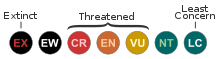
IUCN Red List of Threatened Plants Status : Not available
Growth: S = slow M = medium F = fast. Soil: L = light (sandy) M = medium H = heavy (clay). pH: A = acid N = neutral B = basic (alkaline). Shade: F = full shade S = semi-shade N = no shade. Moisture: D = dry M = Moist We = wet Wa = water.
Now available:
Food Forest Plants for Mediterranean Conditions
350+ Perennial Plants For Mediterranean and Drier Food Forests and Permaculture Gardens.
[Paperback and eBook]
This is the third in Plants For A Future's series of plant guides for food forests tailored to
specific climate zones. Following volumes on temperate and tropical ecosystems, this book focuses
on species suited to Mediterranean conditions—regions with hot, dry summers and cool, wet winters,
often facing the added challenge of climate change.
Read More
Expert comment
Author
(Britton & Rose) Seigler & Ebinger
Botanical References
Links / References
For a list of references used on this page please go here
Readers comment
| Add a comment |
|
If you have important information about this plant that may help other users please add a comment or link below. Only comments or links that are felt to be directly relevant to a plant will be included. If you think a comment/link or information contained on this page is inaccurate or misleading we would welcome your feedback at [email protected]. If you have questions about a plant please use the Forum on this website as we do not have the resources to answer questions ourselves.
* Please note: the comments by website users are not necessarily those held by PFAF and may give misleading or inaccurate information.
|
Subject : Vachellia vernicosa
|
|
|
|