 |
|
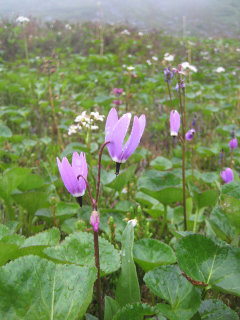
Ebitz. Creative Commons Attribution-Share Alike 3.0 |
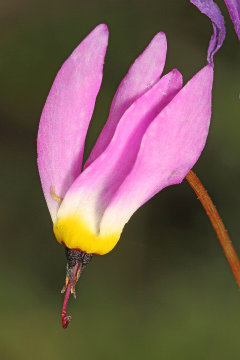 |
| Judy Gallagher. Creative Commons Attribution 2.0 |
Translate this page:
Summary
Alpine shootingstar is a delicate but striking mountain perennial known for its swept-back, star-like flowers held above a basal rosette of smooth leaves. Although it has been listed among edible shootingstars, it is best approached with caution as a food plant. The leaves are tender but often markedly acrid and unpleasant, and the group has long carried a mixed reputation in foraging literature. In practical terms, alpine shootingstar is far more important as a botanical and ecological plant of moist high-country meadows than as a dependable edible. Its beauty and ease of recognition make it memorable, but its culinary value is uncertain and often overstated.
Physical Characteristics

 Primula tetrandra is a PERENNIAL growing to 0.2 m (0ft 8in) by 0.2 m (0ft 8in) at a slow rate.
See above for USDA hardiness. It is hardy to UK zone 5. The flowers are pollinated by Bees.
It is noted for attracting wildlife.
Suitable for: light (sandy) and medium (loamy) soils, prefers well-drained soil and can grow in nutritionally poor soil. Suitable pH: mildly acid, neutral and basic (mildly alkaline) soils. It can grow in semi-shade (light woodland) or no shade. It prefers moist soil.
UK Hardiness Map
US Hardiness Map
Synonyms
Note: Dodecatheon alpinum (A.Gray) Greene is a synonym of Primula tetrandra. Homotypic Synonyms: Dodecatheon jeffreyi var. tetrandrum (Suksd.) Jeps. Dodecatheon tetrandrum Suksd. Heterotypic Synonyms: Dodecatheon alpinum (A.Gray) Greene. Dodecatheon alpinum subsp. majus H.J.Thomps. i Dodecatheon alpinum f. nanum H.M.Hall. Dodecatheon jeffreyi var. alpinum (A.Gray) A.Gray. Dodecatheon meadia var. alpinum A.Gray.
Plant Habitats
Edible Uses
Leaves have sometimes been described as edible fresh or cooked, and the broader shootingstar group has occasionally been credited with edible roots as well. In practice, however, alpine shootingstar is a poor candidate for routine use because the foliage can be strongly acrid and soapy in effect, even after cooking. The plant is better treated as a species of caution rather than a recommended edible [2-3]. Edible Uses & Rating: As a food plant, alpine shootingstar ranks low. It may be technically edible in small amounts, but that is not the same as desirable, safe for regular use, or worth the effort. Its main practical food-use value is educational: it helps illustrate how “reported edible” and “worth eating” can be very different categories [2-3]. Taste, Processing & Kitchen Notes: The leaves are tender in texture, especially when young, but the flavor is often disappointing. They can resemble bitter endive or other chicory-like greens layered with an acrid overtone, and boiling does not reliably solve the problem. Instead, cooking tends to emphasize a soapy quality while leaving enough bitterness or irritation to make the result unattractive. Even repeated changes of water may fail to produce a pleasant vegetable. If someone were determined to evaluate a colony, very small test amounts and cooked preparations would be the most conservative approach, but in most situations, there are far better greens available [2-3]. Seasonality (Phenology): Alpine shootingstar generally flowers from late spring into summer, with timing strongly controlled by snowmelt and elevation. In colder alpine or subalpine sites, it may bloom relatively late compared with valley plants, while lower-elevation populations can flower earlier. The leaf rosette appears before or during bloom and is most obvious during the spring and early summer growth period [2-3]. Safety & Cautions (Food Use): The key caution is the presence of saponins and the plant’s strongly unappealing chemistry. Saponin-rich plants can cause gastrointestinal upset and tissue irritation, especially when consumed in large quantities or repeatedly. Even if some colonies prove milder than others, alpine shootingstar should not be treated as a safe staple or a casual salad green. In addition, because shootingstars often grow in sensitive mountain meadow habitats, careless harvest can damage local populations and wetland edges [2-3]. Harvest & Processing Workflow: In practical, modern terms, there is little reason to harvest this species for food, except perhaps to evaluate its edibility in a highly controlled, minimal-impact way. If leaves are sampled, only a few outer leaves should be taken from a healthy clump, rinsed thoroughly, and tested in tiny amounts, preferably after cooking. Root harvest is generally a poor idea because it damages or kills the plant, and the food value remains uncertain [2-3]. Cultivar/Selection Notes: There are no food cultivars. In horticulture, shootingstars are selected almost entirely for ornamental appeal, bloom quality, adaptation to cool gardens, and botanical interest rather than edible potential. Look-Alikes & Confusion Risks: Within the shootingstars, alpine species are usually identifiable by their distinctive nodding flowers with strongly reflexed petals and exserted anthers clustered into a cone. Confusion with unrelated edible greens is unlikely when the plant is in bloom, but vegetative rosettes could potentially be overlooked or mistaken for other soft-leaved meadow herbs. The safest identification period is the flowering season, when the floral architecture is unmistakable [2-3]. Traditional/Indigenous Use Summary: Some members of the shootingstar group have been used as food in parts of western North America, but alpine shootingstar itself is not one of the best-supported or most reassuring examples. The broader ethnobotanical picture suggests caution and species-level variability rather than enthusiastic use across the group [2-3].
References More on Edible Uses
Medicinal Uses
Plants For A Future can not take any responsibility for any adverse effects from the use of plants. Always seek advice from a professional before using a plant medicinally.
Primula tetrandra is recognized in ethnobotanical studies for its medicinal properties, particularly in the Himalayan region, where local communities use it for its therapeutic potential. It is one of several Primula species containing active constituents of medicinal interest (National Institutes of Health.gov). Medicinal Uses and Pharmacological Potential: Antibacterial Activity: Extracts from Primula species, including P. tetrandra, have demonstrated noteworthy antibacterial activity against pathogenic bacteria, evaluated using disc diffusion and minimum inhibitory concentration assays. Triterpene Saponins: P. tetrandra is noted for containing sakurasosaponin and other saponins. Saponins in Primula species are generally known for their secretolytic and expectorant properties, helping to treat coughs, bronchitis, and bronchial mucus. Other Potential Benefits: While specific, in-depth studies on P. tetrandra are less common than those for P. veris (cowslip), it belongs to a genus used in traditional medicine for respiratory issues, skin problems, and wound healing (National Institutes of Health.gov). Important Distinctions: While P. tetrandra contains high levels of sakurasosaponin, its specific ethnomedicinal applications for cough/bronchitis are not as widely documented as those for the official European pharmacopeia species P. veris or P. elatior. Note on Tetrandrine: Tetrandrine is a well-known calcium channel blocker known for its anti-inflammatory and antifibrogenic properties. This compound is derived from Stephania tetrandra, a different plant, and is not associated with Primula tetrandra.
References More on Medicinal Uses
The Bookshop: Edible Plant Books
Our Latest books on Perennial Plants For Food Forests and Permaculture Gardens in paperback or digital formats.

Edible Tropical Plants
Food Forest Plants for Hotter Conditions: 250+ Plants For Tropical Food Forests & Permaculture Gardens.
More

Edible Temperate Plants
Plants for Your Food Forest: 500 Plants for Temperate Food Forests & Permaculture Gardens.
More

More Books
PFAF have eight books available in paperback and digital formats. Browse the shop for more information.
Shop Now
Other Uses
In gardens, alpine shootingstar is a refined, small-scale perennial suited to rock gardens, alpine beds, and moisture-retentive but sharply drained crevice settings. It is not a bold structural plant; its value lies in the dramatic flowers and compact rosette habit. Garden success usually depends on recreating mountain meadow conditions with excellent drainage. This species is an important component of moist western mountain meadows, where it contributes early to mid-season pollen resources and floral diversity. Its flowers support specialist-style bee behavior, and its presence often signals cool-season moisture and relatively intact meadow habitat.
Special Uses
References More on Other Uses
Cultivation details
Alpine shootingstar is an elegant mountain primrose with notable ornamental and ecological value but weak culinary value. It is one of those plants that should be admired first, identified carefully, and only treated as an edible with great reservation. Growing Conditions: This species prefers cool, moist, well-drained mountain soils, often in alpine or subalpine meadows, seeps, snowmelt zones, and stream-adjacent openings. It generally performs best with spring moisture, bright light, and protection from prolonged summer drought. Good drainage remains important even in moist habitats, since standing water can damage the crown. Habitat & Range: Alpine shootingstar is a western North American mountain plant associated with moist meadows and subalpine habitats. It is especially tied to cooler elevations where spring moisture persists into the growing season. Its range is much more tied to mountain systems than to arid basins or lowland deserts. Size & Landscape Performance: In gardens, alpine shootingstar is a refined, small-scale perennial suited to rock gardens, alpine beds, and moisture-retentive but sharply drained crevice settings. It is not a bold structural plant; its value lies in the dramatic flowers and compact rosette habit. Once flowering ends, it can become visually quiet or partly summer-dormant depending on conditions. Cultivation (Horticulture): It is best grown in cool-summer climates or carefully managed rock gardens with moisture in spring and early summer. The ideal soil is humus-enriched but sharply drained. It resents baking heat and prolonged drought, yet it also dislikes stagnant winter wet. Garden success usually depends on recreating mountain meadow conditions with excellent drainage. Pests & Problems: The biggest problems are climatic mismatch and drainage failure. Hot, dry summers can stress plants badly, while waterlogged soils can rot the crown. Slugs and snails may also feed on the soft leaves in garden settings. In the wild, trampling and habitat disturbance are probably bigger threats than insect pests. Identification & Habit: Alpine shootingstar is a stemless or nearly stemless perennial with a basal rosette of smooth leaves and one or more erect flowering stalks. The flowers are arranged in umbels, with strongly reflexed petals and a projecting cone of stamens that gives the “shooting star” effect. The plant typically arises from fibrous roots or short rhizomatous structures rather than from bulbs or corms. ? Pollinators: Shootingstars are especially associated with buzz-pollinating bees, including bumblebees and other native bees capable of vibrating the anthers to release pollen. This floral mechanism makes them ecologically distinctive among spring and early-summer mountain wildflowers. The same buzz-pollination pattern is well documented in the closely related dark-throated shootingstar and applies to the group generally. Alpine shootingstar, now best referred to as Primula tetrandra (formerly Dodecatheon alpinum), belongs to the primrose family (Primulaceae) and the genus Primula. Common names include alpine shootingstar. It is a small perennial herb of moist western mountain habitats and is best suited to roughly USDA Zones 4–8, depending on snow cover, summer heat, and soil moisture. Mature plants are usually about 8–25 cm tall in flower and often spread 10–25 cm across as a compact basal clump.
References Carbon Farming Information and Carbon Sequestration Information
Temperature Converter
Type a value in the Celsius field to convert the value to Fahrenheit:
Fahrenheit:
The PFAF Bookshop
Plants For A Future have a number of books available in paperback and digital form. Book titles include Edible Plants, Edible Perennials, Edible Trees,Edible Shrubs, Woodland Gardening, and Temperate Food Forest Plants. Our new book is Food Forest Plants For Hotter Conditions (Tropical and Sub-Tropical).
Shop Now
Plant Propagation
Propagation is usually by seed, though established clumps can sometimes be divided carefully. Seed-grown plants often require patience, and germination may benefit from cool, moist stratification conditions that mimic mountain winters. Young plants are typically slower to establish than coarser meadow species.
Other Names
If available other names are mentioned here
Note:Dodecatheon alpinum (A.Gray) Greene is a synonym of Primula tetrandra. Alpine shooting star. Shooting star. Primula Alpine shootingstar.
Native Range
US. USA. Arizona, California, Nevada, Oregon, Utah, Washington.
Weed Potential
Right plant wrong place. We are currently updating this section.
Please note that a plant may be invasive in one area but may not in your area so it's worth checking.
Alpine shootingstar has very low weed potential. It is habitat-specific, relatively slow-growing, and not at all invasive under ordinary garden or wild conditions.
Conservation Status
IUCN Red List of Threatened Plants Status : Not listed.
| Related Plants
|
| Latin Name | Common Name | Habit | Height | Hardiness | Growth | Soil | Shade | Moisture | Edible | Medicinal | Other |
| Anagallis arvensis | Scarlet Pimpernel | Annual | 0.1 |
6-9
| | LMH | N | DM | 2 | 2 | 3 |
| Androsace sarmentosa | Rock Jasmine | Perennial | 0.1 |
3-7
| | LM | SN | DM | 0 | 2 | 3 |
| Ardisia crenata | Coralberry, Hen's eyes, Spiceberry | Shrub | 2.0 |
7-10
| S | LMH | S | M | 0 | 1 | 1 |
| Ardisia crispa | | Shrub | 1.2 |
6-9
| | LMH | S | M | 1 | 1 | 0 |
| Ardisia japonica | Marlberry | Shrub | 0.5 |
8-10
| M | LMH | S | M | 0 | 3 | 2 |
| Ardisia sieboldii | Duo Zhi Zi Jin Niu | Shrub | 6.0 |
0-0
| | LMH | S | M | 1 | 0 | 0 |
| Cyclamen hederifolium | Cyclamen, Alpine Violet, Persian Violet | Perennial | 0.1 |
6-9
| M | LM | FSN | M | 0 | 1 | 3 |
| Dodecatheon hendersonii | Sailor-Caps, Mosquito bills | Perennial | 0.3 |
5-9
| | LMH | FS | M | 1 | 0 | |
| Embelia ribes | False black pepper, White-flowered Embelia | Climber | 15.0 |
10-12
| F | LMH | S | M | 3 | 4 | 2 |
| Glaux maritima | Black Saltwort, Sea milkwort | Perennial | 0.3 |
0-0
| | LMH | N | M | 2 | 1 | |
| Hottonia palustris | Water Violet | Perennial | 0.9 |
5-9
| F | LMH | N | Wa | 0 | 1 | |
| Lysimachia barystachys | Manchurian yellow loosestrife | Perennial | 0.6 |
4-8
| | LMH | SN | M | 1 | 0 | |
| Lysimachia christiniae | Jin Qian Cao | Perennial | 0.3 |
-
| | LMH | SN | M | 0 | 2 | |
| Lysimachia clethroides | Gooseneck Loosestrife, Gooseneck yellow loosestrife, Japanese Loosestrife, Shepherd's Crook | Perennial | 1.0 |
3-8
| F | LMH | SN | M | 1 | 0 | |
| Lysimachia eleutheroides | | Perennial | 0.0 |
-
| | LMH | SN | M | 3 | 0 | |
| Lysimachia foenum-graecum | Ling Xiang Cao | Perennial | 0.5 |
-
| | LMH | SN | M | 0 | 1 | 1 |
| Lysimachia fortunei | | Perennial | 0.5 |
6-9
| | LMH | SN | MWeWa | 1 | 0 | |
| Lysimachia nemorum | Yellow Pimpernel | Perennial | 0.5 |
5-9
| | LMH | SN | MWe | 0 | 1 | |
| Lysimachia nummularia | Creeping Jenny, Moneywort, Creeping Charlie | Perennial | 0.2 |
4-8
| F | LMH | SN | MWeWa | 1 | 2 | 3 |
| Lysimachia paridiformis | | Perennial | 0.3 |
6-9
| | LMH | SN | MWeWa | 0 | 2 | |
| Lysimachia quadrifolia | Whorled Yellow Loosestrife | Perennial | 0.6 |
-
| | LMH | SN | M | 1 | 1 | |
| Lysimachia sikokiana | | Perennial | 0.6 |
-
| | LMH | SN | M | 0 | 1 | |
| Lysimachia vulgaris | Yellow Loosestrife, Garden yellow loosestrife | Perennial | 1.2 |
4-8
| | LMH | SN | MWeWa | 1 | 2 | 2 |
| Primula auricula | | Perennial | 0.2 |
3-7
| | LMH | S | M | 0 | 1 | 2 |
| Primula denticulata | Drumstick Primula | Perennial | 0.3 |
4-8
| | LMH | SN | MWe | 2 | 0 | 2 |
| Primula elatior | Oxlip | Perennial | 0.3 |
3-7
| | MH | FS | M | 2 | 2 | |
| Primula involucrata | | Perennial | 0.3 |
4-8
| | LMH | S | MWe | 0 | 2 | |
| Primula macrophylla | | Perennial | 0.3 |
5-9
| | LMH | N | M | 0 | 2 | |
| Primula parryi | Parry's primrose | Perennial | 0.3 |
4-8
| | LMH | FS | M | 0 | 0 | 1 |
| Primula pauciflora | Dark-Throated Shootingstar | Perennial | 0.5 |
3-8
| S | LM | SN | M | 1 | 1 | 2 |
|
|
Growth: S = slow M = medium F = fast. Soil: L = light (sandy) M = medium H = heavy (clay). pH: A = acid N = neutral B = basic (alkaline). Shade: F = full shade S = semi-shade N = no shade. Moisture: D = dry M = Moist We = wet Wa = water.
Now available:
Food Forest Plants for Mediterranean Conditions
350+ Perennial Plants For Mediterranean and Drier Food Forests and Permaculture Gardens.
[Paperback and eBook]
This is the third in Plants For A Future's series of plant guides for food forests tailored to
specific climate zones. Following volumes on temperate and tropical ecosystems, this book focuses
on species suited to Mediterranean conditions—regions with hot, dry summers and cool, wet winters,
often facing the added challenge of climate change.
Read More
Expert comment
Author
(Suksd.) A.R.Mast & Reveal
Botanical References
Links / References
For a list of references used on this page please go here
Readers comment
| Add a comment |
|
If you have important information about this plant that may help other users please add a comment or link below. Only comments or links that are felt to be directly relevant to a plant will be included. If you think a comment/link or information contained on this page is inaccurate or misleading we would welcome your feedback at [email protected]. If you have questions about a plant please use the Forum on this website as we do not have the resources to answer questions ourselves.
* Please note: the comments by website users are not necessarily those held by PFAF and may give misleading or inaccurate information.
|
Subject : Primula tetrandra
|
|
|
|