 |
|
aspidoscelis. Creative Commons Zero, Public Domain Dedication |
 |
| Agnieszka Kwiecien, Nova. Creative Commons Attribution-Share Alike 4.0 |
Translate this page:
Summary
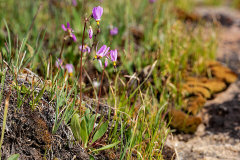
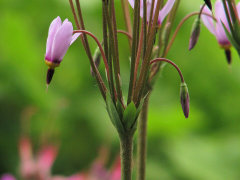
Dark-throated shootingstar is one of the most widespread and variable members of the shootingstar complex and one of the most recognizable spring wildflowers of western North America. Its reflexed pink-to-purple petals, yellow and dark-throated floral center, and nodding umbels make it botanically distinctive and highly attractive in the field. Although some authors have described shootingstar leaves favorably, this species is not a dependable edible and is best approached with caution. Its true strengths are ornamental, ecological, and botanical rather than culinary.
Physical Characteristics

 Primula pauciflora is a PERENNIAL growing to 0.5 m (1ft 8in) by 0.3 m (1ft) at a slow rate.
See above for USDA hardiness. It is hardy to UK zone 4. The flowers are pollinated by Bees.
It is noted for attracting wildlife.
Suitable for: light (sandy) and medium (loamy) soils and prefers well-drained soil. Suitable pH: mildly acid, neutral and basic (mildly alkaline) soils. It can grow in semi-shade (light woodland) or no shade. It prefers moist soil.
UK Hardiness Map
US Hardiness Map
Synonyms
Dodecatheon meadia var. pauciflorum Durand. Dodecatheon pauciflorum (Durand) Greene. Dodecatheon pauciflorum subsp. eupauciflorum R.Knuth. Dodecatheon pulchellum subsp. pauciflorum (Durand) Hultén. Meadia pauciflora (Durand) Kuntze.
Plant Habitats
Edible Uses
Leaves have sometimes been described as edible fresh or cooked, and related members of the shootingstar group have occasionally been credited with edible underground parts. Even so, dark-throated shootingstar is not a plant that should be recommended confidently for regular food use. The foliage can be acrid, soapy, and unpleasant even after repeated boiling, and its saponin content raises further concerns [2-3]. Edible Uses & Rating: As an edible, dark-throated shootingstar ranks low. It may be one of those plants that is “possible” in a narrow technical sense, but it is not one that performs well as a practical green or dependable wild food. In almost any real foraging situation, there are better and less chemically questionable options [2-3]. Taste, Processing & Kitchen Notes: The leaves are often soft and tender when young, which can initially make them seem promising. However, that promise tends to collapse on tasting: they can resemble endive or other bitter salad greens with a pronounced acrid overtone, and cooking often reveals or intensifies a slick, soapy texture rather than improving them. Even with multiple water changes, the result may remain disappointing. That combination of tenderness and poor flavor is one reason the plant can mislead new foragers [2-3]. Seasonality (Phenology): Dark-throated shootingstar typically flowers from spring into early summer, with bloom time strongly shaped by latitude, snowmelt, and elevation. Across its wide range, it may flower as early as April in lower-elevation prairies and as late as July or August in colder mountain settings. Its basal rosette is generally present in the active spring growth period and may fade or become less conspicuous as summer drought or heat advances [2-3]. Safety & Cautions (Food Use): The strongest caution is the plant’s chemistry. Shootingstars contain saponins capable of causing severe digestive upset and cellular irritation, and the foliage often gives practical warning through its soapy, acrid taste. Even if some populations are milder than others, this is not a plant to treat casually as a salad ingredient. Another important caution is conservation: some regional populations have limited distribution, and collection should always be minimal and lawful. Calflora lists Primula pauciflora in California as a plant of limited distribution [2-3]. Harvest & Processing Workflow: In modern practical terms, this species is better studied than harvested for food. If someone were to test the leaves, only a few should be taken from a healthy rosette, carefully cleaned, and sampled in extremely small cooked portions. Root harvest is especially hard to justify because it damages the plant, and the food value remains uncertain. For most users, the best workflow is simply to identify, observe, and leave the colony intact [2-3]. Cultivar/Selection Notes: There are no food cultivars. Horticultural interest focuses on flower color, range, and adaptation to prairie or mountain garden settings. In native-plant circles, it is appreciated far more as a spring ornamental than as an edible. Look-Alikes & Confusion Risks: When in flower, dark-throated shootingstar is one of the easiest western wildflowers to recognize because of its strongly reflexed petals and protruding cone of stamens. Vegetatively, however, the basal rosette can be less distinctive and may be overlooked among meadow herbs. The accepted name has also changed: many floras and gardeners still know it as Dodecatheon pulchellum, while current taxonomic treatments commonly place it in Primula as Primula pauciflora. Calflora explicitly notes Dodecatheon pulchellum as an inactive name and Primula pauciflora as the current one [2-3]. Traditional/Indigenous Use Summary; The broader shootingstar group has a mixed history of human use, but dark-throated shootingstar is not among the strongest or safest edible examples. Ethnobotanical coverage is relatively limited compared with many truly important western food plants, and that lack of a strong use record is itself a reason for caution.
References More on Edible Uses
Medicinal Uses
Plants For A Future can not take any responsibility for any adverse effects from the use of plants. Always seek advice from a professional before using a plant medicinally.
Primula pauciflora (formerly Dodecatheon pauciflorum) has traditional medicinal uses, particularly among Indigenous groups in North America. Traditional Medicinal Uses: Respiratory Ailments: It has been used as an infusion to treat mild respiratory conditions. Anti-inflammatory: The plant has been traditionally used to help reduce inflammation. Important Safety Information: Toxicity: Because specific medical studies on its safety are limited, Primula pauciflora should be treated as potentially poisonous. Allergen Warning: Many Primula species contain primin, a substance that can cause skin irritation, itching, or contact dermatitis upon handling. It should not be confused with Primula veris (cowslip), which is widely recognized in European pharmacopeias for its strong expectorant and secretolytic properties.
References More on Medicinal Uses
The Bookshop: Edible Plant Books
Our Latest books on Perennial Plants For Food Forests and Permaculture Gardens in paperback or digital formats.
Edible Tropical Plants
Food Forest Plants for Hotter Conditions: 250+ Plants For Tropical Food Forests & Permaculture Gardens.
More
Edible Temperate Plants
Plants for Your Food Forest: 500 Plants for Temperate Food Forests & Permaculture Gardens.
More
More Books
PFAF have eight books available in paperback and digital formats. Browse the shop for more information.
Shop Now
Other Uses
In gardens it is a highly effective spring ephemeral or semi-ephemeral perennial, valued for its dramatic nodding flowers and tidy basal foliage. It works especially well in meadow gardens, prairie restorations, and woodland-edge plantings where spring display is important and summer dormancy is acceptable. This species contributes strongly to spring pollinator support in western prairies, meadows, and moist uplands. Its flowers provide a specialized pollen resource for native bees, and its presence often indicates a healthy spring-moist habitat with relatively intact seasonal hydrology.
Special Uses
References More on Other Uses
Cultivation details
Dark-throated shootingstar is an outstanding wildflower and a poor culinary prospect. It is best valued as a pollinator plant, a mountain and prairie indicator, and a striking native ornamental rather than as a food plant. Growing Conditions: This species prefers moist but well-drained soils, often in meadows, seeps, prairies, woodland edges, or open montane habitats. It does best with spring moisture and good drainage, and it generally dislikes hot, stagnant, winter-wet sites. It can tolerate full sun in cooler or wetter climates and part shade in warmer inland settings. Habitat & Range: Dark-throated shootingstar is widespread across western North America, from lowland prairies and coastal openings to montane meadows and moist uplands. It is far more broadly distributed than Alpine shooting star and appears across a range of western habitats where spring soil moisture is dependable. Size & Landscape Performance: In gardens, it is a highly effective spring ephemeral or semi-ephemeral perennial, valued for its dramatic nodding flowers and tidy basal foliage. It works especially well in meadow gardens, prairie restorations, and woodland-edge plantings where spring display is important, and summer dormancy is acceptable. Cultivation (Horticulture): Dark-throated shootingstar can be a rewarding native garden plant if its moisture rhythm is respected. It prefers a cool, moist spring growing period followed by relatively drier summer conditions, though it should not be baked dry while actively growing. Prairie and mountain forms may differ somewhat in their exact preferences, so matching the source population to the garden climate improves success. Pests & Problems: Poor drainage, slug damage, and climatic mismatch are the main challenges. In heavy, poorly drained soils, the crown can rot. In hot, dry gardens without enough spring moisture, plants may remain small or short-lived. Deer and rabbits may occasionally browse foliage in accessible habitats, though the plant is not typically among the most heavily grazed. Identification & Habit: Dark-throated shootingstar is a perennial herb with a basal rosette of smooth, oblanceolate to ovate leaves and one or more erect flowering stalks topped by a few to many nodding flowers. The petals are strongly reflexed, usually pink to purple with a yellow and darker throat, and the exserted stamens form a pointed cone around the style. The capsule is ovoid to cylindrical and many-seeded [2-3]. Pollinators: The flowers are buzz-pollinated, with bumblebees and other native bees vibrating the anthers to release pollen. This is one of the defining ecological features of the species and a major reason it is so valuable in native meadow and prairie systems. The U.S. National Phenology Network explicitly notes buzz pollination for Primula pauciflora. Plant Name. Family. Genus. Common Names. USDA Hardiness Zones and approximate height/spread ranges. Dark-throated shootingstar, now best referred to as Primula pauciflora (formerly Dodecatheon pulchellum), belongs to the primrose family (Primulaceae) and the genus Primula. Common names include dark-throated shootingstar, dark throat shooting star, few-flowered shootingstar, and western shootingstar. It is a perennial herb of meadows, seeps, and moist western habitats and is generally suited to roughly USDA Zones 3–8. Mature plants are typically about 10–50 cm tall in flower, with a basal spread of around 10–30 cm.
References Carbon Farming Information and Carbon Sequestration Information
Temperature Converter
Type a value in the Celsius field to convert the value to Fahrenheit:
Fahrenheit:
The PFAF Bookshop
Plants For A Future have a number of books available in paperback and digital form. Book titles include Edible Plants, Edible Perennials, Edible Trees,Edible Shrubs, Woodland Gardening, and Temperate Food Forest Plants. Our new book is Food Forest Plants For Hotter Conditions (Tropical and Sub-Tropical).
Shop Now
Plant Propagation
Propagation is usually by seed, though large crowns may occasionally be divided in cultivation. Seed may benefit from a cool, moist period before germination, and seed-grown plants typically take time to establish well. Once settled into suitable conditions, clumps can persist for years.
Other Names
If available other names are mentioned here
Dark-Throated Shooting star. (formerly Dodecatheon pulchellum). Dark throat shooting star. Few-flowered shootingstar, Western shootingstar. Saline Shooting Star.
Native Range
US. USA. Alaska, Alberta, Arizona, British Columbia, California, Colorado, Idaho, Manitoba, Mexico Northeast, Montana, Nebraska, Nevada, New Mexico, North Dakota, Northwest Territories, Oregon, Saskatchewan, South Dakota, Utah, Washington, Wyoming, Yukon.
Weed Potential
Right plant wrong place. We are currently updating this section.
Please note that a plant may be invasive in one area but may not in your area so it's worth checking.
Dark-throated shootingstar has very low weed potential. It is not invasive and generally remains where conditions are favorable rather than spreading aggressively.
Conservation Status
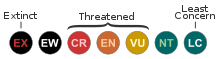
IUCN Red List of Threatened Plants Status : Not listed.
| Related Plants
|
| Latin Name | Common Name | Habit | Height | Hardiness | Growth | Soil | Shade | Moisture | Edible | Medicinal | Other |
| Anagallis arvensis | Scarlet Pimpernel | Annual | 0.1 |
6-9
| | LMH | N | DM | 2 | 2 | 3 |
| Androsace sarmentosa | Rock Jasmine | Perennial | 0.1 |
3-7
| | LM | SN | DM | 0 | 2 | 3 |
| Ardisia crenata | Coralberry, Hen's eyes, Spiceberry | Shrub | 2.0 |
7-10
| S | LMH | S | M | 0 | 1 | 1 |
| Ardisia crispa | | Shrub | 1.2 |
6-9
| | LMH | S | M | 1 | 1 | 0 |
| Ardisia japonica | Marlberry | Shrub | 0.5 |
8-10
| M | LMH | S | M | 0 | 3 | 2 |
| Ardisia sieboldii | Duo Zhi Zi Jin Niu | Shrub | 6.0 |
0-0
| | LMH | S | M | 1 | 0 | 0 |
| Cyclamen hederifolium | Cyclamen, Alpine Violet, Persian Violet | Perennial | 0.1 |
6-9
| M | LM | FSN | M | 0 | 1 | 3 |
| Dodecatheon hendersonii | Sailor-Caps, Mosquito bills | Perennial | 0.3 |
5-9
| | LMH | FS | M | 1 | 0 | |
| Embelia ribes | False black pepper, White-flowered Embelia | Climber | 15.0 |
10-12
| F | LMH | S | M | 3 | 4 | 2 |
| Glaux maritima | Black Saltwort, Sea milkwort | Perennial | 0.3 |
0-0
| | LMH | N | M | 2 | 1 | |
| Hottonia palustris | Water Violet | Perennial | 0.9 |
5-9
| F | LMH | N | Wa | 0 | 1 | |
| Lysimachia barystachys | Manchurian yellow loosestrife | Perennial | 0.6 |
4-8
| | LMH | SN | M | 1 | 0 | |
| Lysimachia christiniae | Jin Qian Cao | Perennial | 0.3 |
-
| | LMH | SN | M | 0 | 2 | |
| Lysimachia clethroides | Gooseneck Loosestrife, Gooseneck yellow loosestrife, Japanese Loosestrife, Shepherd's Crook | Perennial | 1.0 |
3-8
| F | LMH | SN | M | 1 | 0 | |
| Lysimachia eleutheroides | | Perennial | 0.0 |
-
| | LMH | SN | M | 3 | 0 | |
| Lysimachia foenum-graecum | Ling Xiang Cao | Perennial | 0.5 |
-
| | LMH | SN | M | 0 | 1 | 1 |
| Lysimachia fortunei | | Perennial | 0.5 |
6-9
| | LMH | SN | MWeWa | 1 | 0 | |
| Lysimachia nemorum | Yellow Pimpernel | Perennial | 0.5 |
5-9
| | LMH | SN | MWe | 0 | 1 | |
| Lysimachia nummularia | Creeping Jenny, Moneywort, Creeping Charlie | Perennial | 0.2 |
4-8
| F | LMH | SN | MWeWa | 1 | 2 | 3 |
| Lysimachia paridiformis | | Perennial | 0.3 |
6-9
| | LMH | SN | MWeWa | 0 | 2 | |
| Lysimachia quadrifolia | Whorled Yellow Loosestrife | Perennial | 0.6 |
-
| | LMH | SN | M | 1 | 1 | |
| Lysimachia sikokiana | | Perennial | 0.6 |
-
| | LMH | SN | M | 0 | 1 | |
| Lysimachia vulgaris | Yellow Loosestrife, Garden yellow loosestrife | Perennial | 1.2 |
4-8
| | LMH | SN | MWeWa | 1 | 2 | 2 |
| Primula auricula | | Perennial | 0.2 |
3-7
| | LMH | S | M | 0 | 1 | 2 |
| Primula denticulata | Drumstick Primula | Perennial | 0.3 |
4-8
| | LMH | SN | MWe | 2 | 0 | 2 |
| Primula elatior | Oxlip | Perennial | 0.3 |
3-7
| | MH | FS | M | 2 | 2 | |
| Primula involucrata | | Perennial | 0.3 |
4-8
| | LMH | S | MWe | 0 | 2 | |
| Primula macrophylla | | Perennial | 0.3 |
5-9
| | LMH | N | M | 0 | 2 | |
| Primula parryi | Parry's primrose | Perennial | 0.3 |
4-8
| | LMH | FS | M | 0 | 0 | 1 |
|
|
Growth: S = slow M = medium F = fast. Soil: L = light (sandy) M = medium H = heavy (clay). pH: A = acid N = neutral B = basic (alkaline). Shade: F = full shade S = semi-shade N = no shade. Moisture: D = dry M = Moist We = wet Wa = water.
Now available:
Food Forest Plants for Mediterranean Conditions
350+ Perennial Plants For Mediterranean and Drier Food Forests and Permaculture Gardens.
[Paperback and eBook]
This is the third in Plants For A Future's series of plant guides for food forests tailored to
specific climate zones. Following volumes on temperate and tropical ecosystems, this book focuses
on species suited to Mediterranean conditions—regions with hot, dry summers and cool, wet winters,
often facing the added challenge of climate change.
Read More
Expert comment
Author
(Durand) A.R.Mast & Reveal
Botanical References
Links / References
For a list of references used on this page please go here
Readers comment
| Add a comment |
|
If you have important information about this plant that may help other users please add a comment or link below. Only comments or links that are felt to be directly relevant to a plant will be included. If you think a comment/link or information contained on this page is inaccurate or misleading we would welcome your feedback at [email protected]. If you have questions about a plant please use the Forum on this website as we do not have the resources to answer questions ourselves.
* Please note: the comments by website users are not necessarily those held by PFAF and may give misleading or inaccurate information.
|
Subject : Primula pauciflora
|
|
|
|