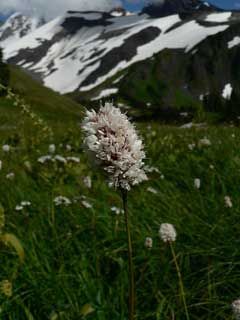
 |
|
http://commons.wikimedia.org/wiki/User:Wsiegmund |
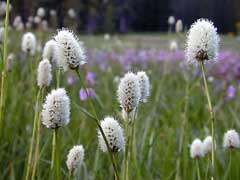 |
| http://www.flickr.com/people/51035743246@N01 |
Translate this page:
Summary
American bistort is a perennial of moist subalpine–montane meadows across the western U.S. prized more for its mild, thick salad-quality leaves and small edible seeds than for its very bitter, tannin-rich “bulbous” roots. It forms tidy clumps topped by white, bottlebrush spikes in summer, provides early forage for wildlife, binds wet soils, and tolerates cold, wet sites. USDA Hardiness Zones 3–7; typical size 20–70 cm tall, 20–45 cm spread.
Physical Characteristics

 Polygonum bistortoides is a PERENNIAL growing to 0.5 m (1ft 8in) by 0.3 m (1ft).
See above for USDA hardiness. It is hardy to UK zone 4. It is in flower from July to August. The species is hermaphrodite (has both male and female organs) and is pollinated by Insects.
Suitable for: light (sandy), medium (loamy) and heavy (clay) soils. Suitable pH: mildly acid, neutral and basic (mildly alkaline) soils. It can grow in semi-shade (light woodland) or no shade. It prefers moist soil.
UK Hardiness Map
US Hardiness Map
Synonyms
Bistorta bistortoides. (Pursh.)Small.
Plant Habitats
Woodland Garden Sunny Edge; Dappled Shade; Bog Garden; Cultivated Beds;
Edible Uses
Edible Parts: Leaves Root Seed
Edible Uses:
Leaves - raw or cooked. A pleasant acid flavour, they are used as a potherb[183]. Root - raw or cooked[106]. Starchy and rather pleasant[85], the root can be baked or added to soups, stews etc[105, 161, 183, 257]. It was often dried before being used[207]. The raw root is slightly astringent, it becomes sweeter when boiled but is best when baked[212]. Seed - raw or cooked. It is rather small and fiddly to utilize. Edible Uses & Rating (foraging): Leaves are the standout—mild, slightly mucilaginous, fully chewable, good raw or cooked. Seeds are edible as a small grain. Roots are technically edible but extremely bitter from high tannins; even heavy processing gives low culinary return. Edibility rating: 2/5 overall (4/5 for young leaves, 1/5 for roots, 2/5 for seeds) [2-3]. Taste, Processing & Kitchen Notes: Fresh leaves suggest a gentle lettuce/greens profile with a faint slickness; they enrich salads or quick sautés. Roots are pink-purplish with tough reddish-brown skin; bitterness dominates and resists most methods. If roots must be used, slice finely and boil in several changes of water, discarding each liquor; expect much starch loss. Baking doesn’t help. Seeds (tiny achenes) can be gently toasted then simmered into a porridge or added to soups; they’re small, so treat them more like a thickener than a staple. Seasonality (Phenology): Leaves flush late spring to early summer as snow recedes. Flowering July–September; seeds ripen late summer–early fall. Roots can be dug any time ground is workable, though late season reserves may be higher; leaves are best young. Safety & Cautions (Food Use): Roots are very high in tannins—bitter/astringent and potentially irritating in quantity. People sensitive to astringent foods or with kidney issues should avoid heavy root use. Always process roots with repeated boiling and discard liquors. As with many Polygonaceae, moderate portions are prudent. Harvest & Processing Workflow: Leaves: Pick young, wash, eat raw or blanch. Seeds: Shake mature spikes into a bag, winnow chaff, toast lightly, simmer as porridge/thickener. Roots (last resort): Lift small-to-medium crowns, peel skins, slice thin, boil in multiple changes of water; expect limited palatability. Look-Alikes & Confusion Risks: Do not confuse with alpine bistort (B. vivipara), which bears bulblets low on the inflorescence; B. bistortoides does not. In mixed meadows, novices may confuse basal leaves with dock (Rumex) or young false hellebore (Veratrum)—the latter is toxic and has pleated, broad, strongly plicated leaves and very different stature. Traditional/Indigenous Use Summary: Mountain peoples across the West used the young greens as a spring vegetable and the seeds as a minor grain; the roots were sometimes processed extensively as a famine starch, though palatability varies greatly among stands.
References More on Edible Uses
Medicinal Uses
Plants For A Future can not take any responsibility for any adverse effects from the use of plants. Always seek advice from a professional before using a plant medicinally.
Astringent Poultice
The root is astringent. A poultice has been used in treating sores and boils[257].
References More on Medicinal Uses
The Bookshop: Edible Plant Books
Our Latest books on Perennial Plants For Food Forests and Permaculture Gardens in paperback or digital formats.
Edible Tropical Plants
Food Forest Plants for Hotter Conditions: 250+ Plants For Tropical Food Forests & Permaculture Gardens.
More
Edible Temperate Plants
Plants for Your Food Forest: 500 Plants for Temperate Food Forests & Permaculture Gardens.
More
More Books
PFAF have eight books available in paperback and digital formats. Browse the shop for more information.
Shop Now
Other Uses
References More on Other Uses
Cultivation details
Prefers constantly moist, cool soils—loams or peaty loams—pH slightly acidic to neutral; tolerates cold and periodic waterlogging. Full sun in cool climates; light shade at lower, warmer sites. Intolerant of drought and hot, stagnant sites. Succeeds in an ordinary garden soil[1] but prefers a moisture retentive not too fertile soil in sun or part shade[200]. Repays generous treatment[1]. Plants are growing well at Kew in a moist position by water in the rock garden[K]. Plants seem to be immune to the predations of rabbits[233]. This species is closely related to P. viviparum[1] and P. bistorta[200]. The plant is heat tolerant in zones 8 through 1. (Plant Hardiness Zones show how well plants withstand cold winter temperatures.
Plant Heat Zones show when plants would start suffering from the heat.
The Plant Heat Zone map is based on the number of "heat days" experienced in a given area where the temperature climbs to over 86 degrees F (30°C).
At this temperature, many plants begin to suffer physiological damage. Heat Zones range from 1 (no heat days) to 12 (210 or more heat days).
For example Heat Zone. 11-1 indicates that the plant is heat tolerant in zones 11 through 1.) For polyculture design as well as the above-ground architecture (form - tree, shrub etc. and size shown above) information on the habit and root pattern is also useful and given here if available. The plant growth habit is a clumper with limited spread [1-2]. The root pattern is rhizomatous with underground stems sending roots and shoots along their length [1-2]. Habitat & Range: Moist mountain meadows, seeps, and stream-edges throughout the western U.S. and into the Intermountain West at montane to subalpine elevations. Size & Landscape Performance: Clumps to 20–70 cm with stiff, upright flowering stems. In gardens, behaves as a neat meadow perennial where soils stay moist; good for naturalistic wet borders and pollinator plantings. Site in a consistently moist bed; incorporate organic matter. Mulch to keep roots cool. In lowlands, provide irrigation or a seep line. Deadhead if you don’t want self-sown seedlings. Little fertilizer needed beyond spring compost. Ecology & Wildlife: Early and midsummer nectar/pollen for small bees, syrphid flies, and alpine pollinators; foliage browsed lightly by deer/elk in spring; dense roots stabilize wet meadow soils and slow surface flow. Pests & Problems: Generally trouble-free in cool, wet sites. Heat stress causes leaf scorch; drought reduces leaf quality. Occasional leaf spots or mildews in stagnant air; remedy with spacing and airflow.
References Carbon Farming Information and Carbon Sequestration Information
Temperature Converter
Type a value in the Celsius field to convert the value to Fahrenheit:
Fahrenheit:
The PFAF Bookshop
Plants For A Future have a number of books available in paperback and digital form. Book titles include Edible Plants, Edible Perennials, Edible Trees,Edible Shrubs, Woodland Gardening, and Temperate Food Forest Plants. Our new book is Food Forest Plants For Hotter Conditions (Tropical and Sub-Tropical).
Shop Now
Plant Propagation
Seed - sow spring in a cold frame. Germination is usually free and easy. When they are large enough to handle, prick the seedlings out into individual pots and plant them out in the summer if they have reached sufficient size. If not, overwinter them in a cold frame and plant them out the following spring after the last expected frosts. Division in spring or autumn. Very easy, larger divisions can be planted out direct into their permanent positions. We have found that it is better to pot up the smaller divisions and grow them on in light shade in a cold frame until they are well established before planting them out in late spring or early summer.
Other Names
If available other names are mentioned here
American / Western / Mountain Bistort
Native Range
NORTHERN AMERICA: Canada, Alberta, British Columbia, United States, Colorado, Idaho, Montana, Oregon, Washington, Wyoming, New Mexico, Arizona, California, Nevada, Utah,
Weed Potential
Right plant wrong place. We are currently updating this section.
Please note that a plant may be invasive in one area but may not in your area so it's worth checking.
Low. It spreads slowly by short rhizomes and modest self-sowing only where soils stay damp.
Conservation Status
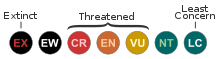
IUCN Red List of Threatened Plants Status :
| Related Plants
|
| Latin Name | Common Name | Habit | Height | Hardiness | Growth | Soil | Shade | Moisture | Edible | Medicinal | Other |
| Polygonum alaskanum | Alaska Wild Rhubarb | Perennial | 1.8 |
-
| | LMH | SN | M | 2 | 1 | |
| Polygonum alpinum | Alpine Knotweed, Alaska wild rhubarb | Perennial | 1.0 |
4-8
| | LMH | SN | M | 2 | 1 | |
| Polygonum amphibium | Willow Grass, Water knotweed, Longroot smartweed, Water smartweed | Perennial | 0.3 |
4-8
| | LMH | SN | WeWa | 1 | 2 | 1 |
| Polygonum arenastrum | Small-Leaved Knotweed, Oval-leaf knotweed | Annual | 0.3 |
4-8
| | LMH | SN | M | 2 | 3 | 1 |
| Polygonum aviculare | Knotweed, Prostrate knotweed | Annual | 0.3 |
4-8
| | LMH | SN | M | 2 | 3 | 1 |
| Polygonum barbatum | Joint Weed | Perennial | 0.8 |
-
| | LMH | SN | M | 1 | 1 | |
| Polygonum bistorta | Bistort, Meadow bistort, Snakeweed | Perennial | 0.5 |
4-7
| F | LMH | SN | MWe | 3 | 3 | 2 |
| Polygonum bungeanum | Bunge's smartweed | Annual | 0.8 |
0-0
| | LMH | SN | M | 1 | 0 | |
| Polygonum coccineum | Water Smartweed | Perennial | 0.5 |
4-8
| | LMH | SN | WeWa | 1 | 0 | |
| Polygonum conspicuum | | Perennial | 0.6 |
-
| | LMH | SN | M | 1 | 0 | |
| Polygonum convolvulus | Black Bindweed | Annual | 1.2 |
0-0
| | LMH | SN | M | 1 | 0 | 0 |
| Polygonum divaricatum | | Perennial | 1.0 |
-
| | LMH | SN | DM | 1 | 0 | |
| Polygonum douglasii | Knotweed, Douglas' knotweed, Austin knotweed, Engelmann's knotweed, Johnston's knotweed, Large kno | Annual | 0.3 |
0-0
| | LMH | SN | DM | 2 | 0 | |
| Polygonum dumetorum | Climbing false buckwheat | Annual | 1.8 |
0-0
| | LMH | SN | M | 1 | 1 | |
| Polygonum equisetiforme | | Perennial | 1.0 |
7-10
| | LMH | N | DM | 1 | 0 | 2 |
| Polygonum fugax | | Perennial | 0.0 |
-
| | LMH | SN | M | 3 | 0 | |
| Polygonum hydropiper | Smartweed, Marshpepper knotweed | Annual | 0.8 |
0-0
| | LMH | N | WeWa | 2 | 2 | 1 |
| Polygonum japonicum | Japanese Knotweed, Mexican Bamboo, Japanese Knotweed | Perennial | 3.0 |
4-10
| F | LMH | SN | M | 3 | 3 | 3 |
| Polygonum lapathifolium | Curlytop Knotweed | Annual | 0.8 |
4-8
| | LMH | SN | MWe | 1 | 1 | 1 |
| Polygonum limosum | | Perennial | 1.8 |
-
| | LMH | SN | M | 1 | 0 | |
| Polygonum longisetum | Oriental lady's thumb | Annual | 0.5 |
0-0
| | LMH | SN | MWe | 1 | 0 | |
| Polygonum maackianum | | Annual | 0.8 |
-
| | LMH | SN | MWe | 1 | 0 | |
| Polygonum manshuriense | Asian Bistort | Perennial | 0.8 |
-
| | LMH | SN | Mwe | 0 | 1 | |
| Polygonum microcephalum | | Perennial | 0.5 |
-
| | LMH | SN | M | 1 | 0 | |
| Polygonum minus | Pygmy smartweed | Annual | 0.3 |
0-0
| | LMH | SN | MWe | 1 | 0 | |
| Polygonum molle | | Perennial | 2.5 |
6-9
| F | LMH | SN | M | 2 | 1 | 2 |
| Polygonum multiflorum | He Shou Wu, Tuber fleeceflower | Perennial Climber | 4.5 |
6-9
| | LMH | SN | M | 2 | 3 | |
| Polygonum nepalense | Nepalese smartweed | Annual | 0.3 |
0-0
| | LMH | SN | MWe | 1 | 1 | 1 |
| Polygonum orientale | Prince's Feather, Kiss me over the garden gate | Annual | 1.5 |
0-0
| | LMH | SN | M | 2 | 2 | 0 |
|
|
Growth: S = slow M = medium F = fast. Soil: L = light (sandy) M = medium H = heavy (clay). pH: A = acid N = neutral B = basic (alkaline). Shade: F = full shade S = semi-shade N = no shade. Moisture: D = dry M = Moist We = wet Wa = water.
Now available:
Food Forest Plants for Mediterranean Conditions
350+ Perennial Plants For Mediterranean and Drier Food Forests and Permaculture Gardens.
[Paperback and eBook]
This is the third in Plants For A Future's series of plant guides for food forests tailored to
specific climate zones. Following volumes on temperate and tropical ecosystems, this book focuses
on species suited to Mediterranean conditions—regions with hot, dry summers and cool, wet winters,
often facing the added challenge of climate change.
Read More
Expert comment
Author
Pursh.
Botanical References
43200
Links / References
For a list of references used on this page please go here
Readers comment
| Add a comment |
|
If you have important information about this plant that may help other users please add a comment or link below. Only comments or links that are felt to be directly relevant to a plant will be included. If you think a comment/link or information contained on this page is inaccurate or misleading we would welcome your feedback at [email protected]. If you have questions about a plant please use the Forum on this website as we do not have the resources to answer questions ourselves.
* Please note: the comments by website users are not necessarily those held by PFAF and may give misleading or inaccurate information.
|
Subject : Polygonum bistortoides
|
|
|
|