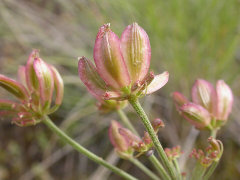
 |
|
Matt Lavin. Creative Commons Attribution-Share Alike 4.0 |
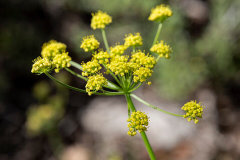 |
| aspidoscelis. Creative Commons Zero, Public Domain Dedication |
Translate this page:
Summary
Simple biscuitroot is a native perennial found throughout much of western North America, particularly in sagebrush valleys, open grasslands, and dry mountain habitats. It is one of several species traditionally grouped under the name "biscuitroot," whose starchy roots were an important spring food for Indigenous peoples. Although generally less well known than fernleaf biscuitroot (Lomatium dissectum) or cous (Lomatium cous), it is a useful native edible where abundant.
Physical Characteristics

 Lomatium simplex is a PERENNIAL growing to 0.6 m (2ft) by 0.2 m (0ft 8in) at a medium rate.
See above for USDA hardiness. It is hardy to UK zone 5. The flowers are pollinated by Bees, Insects.
It is noted for attracting wildlife.
Suitable for: light (sandy) and medium (loamy) soils, prefers well-drained soil and can grow in nutritionally poor soil. Suitable pH: mildly acid, neutral and basic (mildly alkaline) soils. It cannot grow in the shade. It prefers dry or moist soil and can tolerate drought.
UK Hardiness Map
US Hardiness Map
Synonyms
Cogswellia simplex (Nutt. ex S.Watson) M.E.Jones. Peucedanum simplex Nutt. ex S.Watson.
Plant Habitats
Edible Uses
Simple biscuitroot is another valuable member of the traditional biscuitroot group that provided Indigenous peoples with dependable spring food across western North America. Although it is less famous than species such as fernleaf biscuitroot or cous, its nutritious starchy roots make it a worthwhile native edible for experienced foragers who can confidently distinguish it from poisonous look-alikes [2-3]. The roots are edible after cooking and were traditionally gathered as a seasonal food. Like other members of the Lomatium genus, the roots should be soaked or cooked before consumption to reduce naturally occurring furanocoumarins. Accurate identification is essential because biscuitroots closely resemble the deadly spotted hemlock (Conium maculatum) before fruits develop [2-3]. Edibility Rating: 4 out of 5 – A good native root crop with traditional food value, although generally less productive than the largest biscuitroot species. Taste and Preparation: The roots are rich in starch with a pleasant, mildly aromatic flavor similar to other biscuitroots. They were traditionally roasted, baked, boiled, or dried for later use. Cooking softens the roots, enhances their flavor, and reduces naturally occurring phototoxic compounds [2-3]. Seasonality (Phenology): Flowers from April to June, depending on elevation and seasonal conditions. The roots are best harvested during spring while the plant is actively growing [2-3]. Traditional Uses: Indigenous peoples gathered simple biscuitroot throughout parts of the western United States as an important spring carbohydrate source. People could eat the roots fresh after cooking or dry and store them for later use [2-3]. Safety: Like all species of Lomatium, simple biscuitroot contains furanocoumarins, which may increase skin sensitivity to sunlight and occasionally cause skin irritation. The greatest hazard is misidentification. Members of the parsley family can closely resemble spotted hemlock (Conium maculatum), one of North America's most poisonous plants. Only positively identified plants should ever be harvested [2-3].
References More on Edible Uses
Medicinal Uses
Plants For A Future can not take any responsibility for any adverse effects from the use of plants. Always seek advice from a professional before using a plant medicinally.
Lomatium simplex shares broad traditional food and medicinal uses with other members of the Lomatium genus, though specific modern medical backing is lacking. Traditional and Reported Uses: Indigenous Food Source: Indigenous peoples of western North America historically used the starchy roots of Lomatium species—including Lomatium simplex—as an essential dietary staple, eating them raw, roasted, baked, or ground into flour. Respiratory and General Remedies: While the famous antiviral reports from the 1918 influenza pandemic primarily center on Lomatium dissectum (fernleaf biscuitroot), Lomatium roots in general share an ethnobotanical reputation for treating fevers, coughs, and lung congestion. Other Ethnobotanical Records: Certain tribes recorded minor uses of plant parts for ceremonial or first-aid purposes. Modern Medical Context: Lack of Evidence: No robust clinical evidence or scientific testing validates Lomatium simplex as an effective treatment for medical conditions. Risks and Side Effects: Plants in the Lomatium genus can contain furanocoumarins (phototoxins) that cause severe skin rashes, photosensitivity, or allergic reactions in sensitive individuals.
References More on Medicinal Uses
The Bookshop: Edible Plant Books
Our Latest books on Perennial Plants For Food Forests and Permaculture Gardens in paperback or digital formats.

Edible Tropical Plants
Food Forest Plants for Hotter Conditions: 250+ Plants For Tropical Food Forests & Permaculture Gardens.
More
Edible Temperate Plants
Plants for Your Food Forest: 500 Plants for Temperate Food Forests & Permaculture Gardens.
More
More Books
PFAF have eight books available in paperback and digital formats. Browse the shop for more information.
Shop Now
Other Uses
Can be cultivated in native plant gardens with excellent drainage and minimal summer watering. The early yellow flower clusters provide nectar and pollen for native bees, flies, and a variety of other early-season pollinating insects.
Special Uses
References More on Other Uses
Cultivation details
Prefers well-drained sandy, gravelly, or rocky soils in full sun. It is highly drought-tolerant and well adapted to semi-arid climates. Habitat: Found in sagebrush communities, desert grasslands, open woodlands, rocky slopes, foothills, and dry mountain meadows across much of western North America. USDA Hardiness Zones: USDA Zones 4–8. Growth Rate: Moderate. Plants emerge in early spring from perennial taproots, then become dormant during the dry summer. Mature Size: Typically grows 20–60 cm (8–24 in.) tall. Cultivation: Can be cultivated in native plant gardens with excellent drainage and minimal summer watering. Like other biscuitroots, it develops a deep taproot and is difficult to transplant successfully once established. Identification: Simple biscuitroot is an upright perennial arising from a stout taproot. It has finely divided parsley-like leaves and compound umbels of small yellow flowers, followed by broad, flattened winged fruits typical of the genus. Compared with some other biscuitroots, its leaves are generally less finely divided, giving rise to the common name "simple" biscuitroot. Similar Species: May be confused with numerous other biscuitroots (Lomatium spp.), as well as immature spotted hemlock (Conium maculatum) and other members of the parsley family. Mature fruits are often required for reliable identification.
References Carbon Farming Information and Carbon Sequestration Information
Temperature Converter
Type a value in the Celsius field to convert the value to Fahrenheit:
Fahrenheit:
The PFAF Bookshop
Plants For A Future have a number of books available in paperback and digital form. Book titles include Edible Plants, Edible Perennials, Edible Trees,Edible Shrubs, Woodland Gardening, and Temperate Food Forest Plants. Our new book is Food Forest Plants For Hotter Conditions (Tropical and Sub-Tropical).
Shop Now
Plant Propagation
Usually propagated from seed, which benefits from a period of cold stratification before germination.
Other Names
If available other names are mentioned here
Simple biscuitroot, desert parsley, nine-leaf biscuitroot or Great Basin desert parsley
Native Range
US. USA. Alberta, Arizona, British Columbia, Colorado, Idaho, Montana, Nevada, Oregon, Utah, Washington, Wyoming
Weed Potential
Right plant wrong place. We are currently updating this section.
Please note that a plant may be invasive in one area but may not in your area so it's worth checking.
Low. A native perennial with no known invasive tendencies.
Conservation Status
IUCN Red List of Threatened Plants Status : Not listed.

Growth: S = slow M = medium F = fast. Soil: L = light (sandy) M = medium H = heavy (clay). pH: A = acid N = neutral B = basic (alkaline). Shade: F = full shade S = semi-shade N = no shade. Moisture: D = dry M = Moist We = wet Wa = water.
Now available:
Food Forest Plants for Mediterranean Conditions
350+ Perennial Plants For Mediterranean and Drier Food Forests and Permaculture Gardens.
[Paperback and eBook]
This is the third in Plants For A Future's series of plant guides for food forests tailored to
specific climate zones. Following volumes on temperate and tropical ecosystems, this book focuses
on species suited to Mediterranean conditions—regions with hot, dry summers and cool, wet winters,
often facing the added challenge of climate change.
Read More
Expert comment
Author
(Nutt. ex S.Watson) J.F.Macbr.
Botanical References
Links / References
For a list of references used on this page please go here
Readers comment
| Add a comment |
|
If you have important information about this plant that may help other users please add a comment or link below. Only comments or links that are felt to be directly relevant to a plant will be included. If you think a comment/link or information contained on this page is inaccurate or misleading we would welcome your feedback at [email protected]. If you have questions about a plant please use the Forum on this website as we do not have the resources to answer questions ourselves.
* Please note: the comments by website users are not necessarily those held by PFAF and may give misleading or inaccurate information.
|
Subject : Lomatium simplex
|
|
|
|