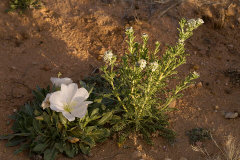
 |
|
Patrick Alexander from Las Cruces, NM. Creative Commons Zero, Public Domain Dedication |
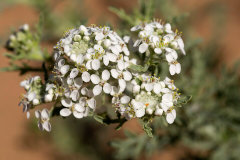 |
| Patrick Alexander from Las Cruces, NM. Creative Commons Zero, Public Domain Dedication |
Translate this page:
Summary
Thurber's pepperweed is a native desert mustard found in southeastern Arizona, southwestern New Mexico, and northern Mexico. It is a characteristic species of creosote bush, mesquite, and juniper communities, where it often grows in abundance. Although specific studies of its edibility are limited, it is highly likely that its seeds are edible like those of other members of the Lepidium genus. The leaves are also probably edible, but this has not been conclusively documented. As with many pepperweeds, the seeds are the most useful food resource and can likely be used as a pepper substitute or ground into meal.
Physical Characteristics

 Lepidium thurberi is a ANNUAL growing to 0.5 m (1ft 8in) by 0.3 m (1ft) at a fast rate.
See above for USDA hardiness. It is hardy to UK zone 8. The flowers are pollinated by Bees, Insects.
It is noted for attracting wildlife.
Suitable for: light (sandy), medium (loamy) and heavy (clay) soils, prefers well-drained soil and can grow in nutritionally poor soil. Suitable pH: mildly acid, neutral and basic (mildly alkaline) soils. It cannot grow in the shade. It prefers dry or moist soil and can tolerate drought.
UK Hardiness Map
US Hardiness Map
Synonyms
None Known.
Plant Habitats
Edible Uses
Thurber's pepperweed is a little-known but potentially valuable native desert food plant. Although little has been written about its culinary uses, its close relationship to other edible pepperweeds strongly suggests its seeds can be used much the same way—as a spicy seasoning or supplementary grain. While additional ethnobotanical research would be valuable, this hardy desert annual represents another useful member of the diverse and edible Lepidium genus. The seeds are edible and can be used whole or ground as a seasoning [2-3]. The leaves are likely edible, but reliable documentation confirming their traditional use is lacking. As with other Lepidium species, treat them cautiously until their edibility is confirmed [2-3]. Edibility Rating: 3 out of 5 – A potentially useful native pepperweed, but limited information on its culinary qualities prevents it from being rated more highly [2-3]. Taste and Preparation: Although Thurber's pepperweed was not specifically evaluated during the original fieldwork, closely related pepperweeds produce seeds with a pleasant spicy, mustard-like flavor that can substitute for black pepper or ground mustard. The seeds can be eaten fresh, dried, or ground into seasoning. Cooking softens their pungency, making them suitable for soups, stews, and porridges [2-3]. If you eat the leaves, young spring growth will likely provide the best flavor. Older foliage is expected to become increasingly spicy and somewhat bitter, as is typical throughout the genus. Seasonality (Phenology): Plants generally flower from April through August, with seeds maturing from late spring into early autumn. Nutritional Value: The seeds likely contain carbohydrates, oils, protein, fiber, and minerals similar to those of other pepperweeds, making them a concentrated seasonal food source despite their small size [2-3]. Traditional Uses: Documented traditional food uses are scarce. However, given its close relationship to other edible Lepidium species, Indigenous peoples likely occasionally used the seeds as a seasoning or supplementary food where the plant occurred [2-3]. Safety: No significant toxicity has been reported. As with other members of the mustard family, the plant contains glucosinolates that produce its characteristic peppery flavor. Consumption of the documented edible seeds is generally considered safe in normal quantities.
References More on Edible Uses
Medicinal Uses
Plants For A Future can not take any responsibility for any adverse effects from the use of plants. Always seek advice from a professional before using a plant medicinally.
No specific or extensive medicinal properties are formally documented for Lepidium thurberi (Thurber's pepperweed) in mainstream botanical and pharmacological literature. While some broader studies on traditional markets note that certain regional Lepidium species (locally known as chichira) are used orally without roots to address gynecological complaints, literature specific to L. thurberi lacks dedicated pharmacological validation or traditional medicinal records.
References More on Medicinal Uses
The Bookshop: Edible Plant Books
Our Latest books on Perennial Plants For Food Forests and Permaculture Gardens in paperback or digital formats.

Edible Tropical Plants
Food Forest Plants for Hotter Conditions: 250+ Plants For Tropical Food Forests & Permaculture Gardens.
More

Edible Temperate Plants
Plants for Your Food Forest: 500 Plants for Temperate Food Forests & Permaculture Gardens.
More

More Books
PFAF have eight books available in paperback and digital formats. Browse the shop for more information.
Shop Now
Other Uses
Seeds provide food for small birds, while the flowers support a variety of native pollinating insects. The plant also contributes to the diversity of spring annuals in desert ecosystems.
Special Uses
References More on Other Uses
Cultivation details
Thurber's pepperweed thrives in full sun on dry, well-drained soils. It is highly adapted to arid climates and tolerates prolonged drought and poor, rocky soils. Habitat: Native to southeastern Arizona, southwestern New Mexico, and northern Mexico. It commonly occurs in creosote bush flats, mesquite scrub, open juniper woodland, gravelly desert slopes, and other dry habitats. USDA Hardiness Zones: USDA Zones 7–10. Growth Rate: Fast. Plants establish quickly following seasonal rainfall and complete their life cycle within a single growing season. Mature Size: Typically 15–50 cm (6–20 in.) tall with an erect, branching habit. Cultivation: Easily grown from seed in full sun with excellent drainage. It performs best in dry climates with minimal irrigation and poor to moderately fertile soils. Pollinators: The numerous small white flowers attract native bees, hoverflies, flies, and other small pollinating insects. Identification: Thurber's pepperweed is a small native mustard with branching stems, alternate leaves, clusters of tiny white four-petalled flowers, and flattened rounded seedpods typical of the Lepidium genus. It closely resembles several related southwestern pepperweeds and is best identified by a combination of its habitat, growth form, and detailed botanical characters. Similar Species: Thurber's pepperweed resembles Fremont's pepperweed (Lepidium fremontii) and mountain pepperweed (Lepidium montanum), but is distinguished by its distribution in the deserts of southeastern Arizona, southwestern New Mexico, and northern Mexico. Detailed identification often depends on subtle differences in hairs, flowers, and seedpods.
References Carbon Farming Information and Carbon Sequestration Information
Temperature Converter
Type a value in the Celsius field to convert the value to Fahrenheit:
Fahrenheit:
The PFAF Bookshop
Plants For A Future have a number of books available in paperback and digital form. Book titles include Edible Plants, Edible Perennials, Edible Trees,Edible Shrubs, Woodland Gardening, and Temperate Food Forest Plants. Our new book is Food Forest Plants For Hotter Conditions (Tropical and Sub-Tropical).
Shop Now
Plant Propagation
Propagated by seed. Plants readily reseed themselves where suitable growing conditions exist.
Other Names
If available other names are mentioned here
Pepperweed
Native Range
US. USA. Arizona, California, Mexico Northeast, Mexico Northwest, New Mexico, Texas.
Weed Potential
Right plant wrong place. We are currently updating this section.
Please note that a plant may be invasive in one area but may not in your area so it's worth checking.
Low. Although locally abundant within its native range, Thurber's pepperweed behaves as a natural component of desert plant communities and is not considered invasive.
Conservation Status
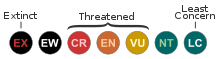
IUCN Red List of Threatened Plants Status : Not listed.
Growth: S = slow M = medium F = fast. Soil: L = light (sandy) M = medium H = heavy (clay). pH: A = acid N = neutral B = basic (alkaline). Shade: F = full shade S = semi-shade N = no shade. Moisture: D = dry M = Moist We = wet Wa = water.
Now available:
Food Forest Plants for Mediterranean Conditions
350+ Perennial Plants For Mediterranean and Drier Food Forests and Permaculture Gardens.
[Paperback and eBook]
This is the third in Plants For A Future's series of plant guides for food forests tailored to
specific climate zones. Following volumes on temperate and tropical ecosystems, this book focuses
on species suited to Mediterranean conditions—regions with hot, dry summers and cool, wet winters,
often facing the added challenge of climate change.
Read More
Expert comment
Author
Wooton
Botanical References
Links / References
For a list of references used on this page please go here
Readers comment
| Add a comment |
|
If you have important information about this plant that may help other users please add a comment or link below. Only comments or links that are felt to be directly relevant to a plant will be included. If you think a comment/link or information contained on this page is inaccurate or misleading we would welcome your feedback at [email protected]. If you have questions about a plant please use the Forum on this website as we do not have the resources to answer questions ourselves.
* Please note: the comments by website users are not necessarily those held by PFAF and may give misleading or inaccurate information.
|
Subject : Lepidium thurberi
|
|
|
|