 |
|
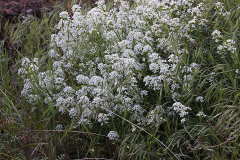
Andrey Zharkikh from Salt Lake City, USA. Creative Commons Attribution 2.0 |
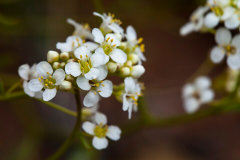 |
| Arches National Park. Public domain |
Translate this page:
Summary
Mountain pepperweed is a widespread native mustard of western North America, occurring from Texas and Wyoming west to California and Oregon. It is a highly variable species with numerous recognised varieties, leading to considerable taxonomic disagreement. Although only the seeds are reliably reported to be edible, the plant is abundant across much of its range and produces a dependable seed crop. The leaves are exceptionally bitter and peppery, making them far less desirable than those of many other pepperweeds.
Physical Characteristics

 Lepidium montanum is a ANNUAL/PERENNIAL growing to 0.6 m (2ft) by 0.4 m (1ft 4in) at a fast rate.
See above for USDA hardiness. It is hardy to UK zone 5. The flowers are pollinated by Bees, Insects.
It is noted for attracting wildlife.
Suitable for: light (sandy), medium (loamy) and heavy (clay) soils, prefers well-drained soil and can grow in nutritionally poor soil. Suitable pH: mildly acid, neutral and basic (mildly alkaline) soils. It cannot grow in the shade. It prefers dry or moist soil and can tolerate drought.
UK Hardiness Map
US Hardiness Map
Synonyms
Lepidium montanum var. typicum C.L.Hitchc. Lepidium montanum subsp. typicum C.L.Hitchc. Nasturtium montanum (Nutt.) Kuntze.
Plant Habitats
Edible Uses
Mountain pepperweed is a useful but relatively minor wild food. Its edible seeds provide some value and are likely to be comparable to those of other pepperweeds, but the exceptionally bitter foliage makes it one of the less desirable members of the genus. Foragers are generally better served by species such as shaggyfruit pepperweed (Lepidium lasiocarpum), shield pepperweed (Lepidium perfoliatum), or Virginia pepperweed (Lepidium virginicum), which offer superior flavor and broader culinary uses [2-3]. The seeds are edible and the only part consistently documented as safe to eat. Although the leaves have been sampled and are technically usable as a cooked green, they are not generally regarded as edible and are extremely bitter and pungent. They are therefore not recommended as a food source [2-3]. Edibility Rating: 2.5 out of 5 – The edible seeds provide some value, but the strongly bitter foliage and limited ethnobotanical use reduce its overall usefulness [2-3]. Taste and Preparation: The seeds were not personally sampled during the original fieldwork, but, like those of other pepperweeds, they are expected to possess a spicy mustard-like flavor and may be used whole or ground as a seasoning. The leaves, however, are intensely peppery and bitter. Among the species examined, they closely resemble Fremont's pepperweed (Lepidium fremontii) in flavor, although they are generally not quite as overpowering. Boiling reduces some of the pungency but fails to make the leaves particularly enjoyable. Plants growing on poor, dry mountain soils appear especially bitter, and flavor may vary between the many recognized varieties [2-3]. Seasonality (Phenology): Mountain pepperweed generally flowers from April through August, with seeds ripening from late spring into early autumn depending on elevation and local climate [2-3]. Nutritional Value: The seeds contain carbohydrates, oils, protein, and minerals typical of mustard-family species. Like many Lepidium seeds, they are likely to provide useful energy despite their small size. Traditional Uses: Few records document Indigenous peoples using mountain pepperweed as a food source. Where used, the seeds were the preferred edible portion. The species appears to have been of much less importance than several other western pepperweeds. Safety: No significant toxicity is reported. Like other members of the mustard family, the plant contains glucosinolates that produce its characteristic spicy flavor. The seeds are regarded as edible, while the leaves are generally avoided because of their intense bitterness rather than any known toxicity.
References More on Edible Uses
Medicinal Uses
Plants For A Future can not take any responsibility for any adverse effects from the use of plants. Always seek advice from a professional before using a plant medicinally.
Lepidium montanum has no documented medicinal uses. While it belongs to the Brassicaceae (mustard) family—which contains several species well-known for their pharmacological properties—botanical and ethnobotanical records indicate that specific traditional or modern medicinal applications for L. lasiocarpum are lacking.
References More on Medicinal Uses
The Bookshop: Edible Plant Books
Our Latest books on Perennial Plants For Food Forests and Permaculture Gardens in paperback or digital formats.
Edible Tropical Plants
Food Forest Plants for Hotter Conditions: 250+ Plants For Tropical Food Forests & Permaculture Gardens.
More
Edible Temperate Plants
Plants for Your Food Forest: 500 Plants for Temperate Food Forests & Permaculture Gardens.
More
More Books
PFAF have eight books available in paperback and digital formats. Browse the shop for more information.
Shop Now
Other Uses
The flowers provide nectar and pollen for insects, while small birds and mammals eat the seeds. The foliage also supports a range of native insects associated with the mustard family. Pollinators: The numerous small white flowers attract bees, hoverflies, flies, and other small pollinating insects throughout the flowering season. Wildlife Value
Special Uses
References More on Other Uses
Cultivation details
Mountain pepperweed grows best in full sun on well-drained soils. It tolerates dry conditions, poor soils, rocky slopes, and open grasslands, thriving in environments where many other leafy vegetables struggle. Habitat: Native throughout western North America, occurring from Texas and Wyoming westward to California and Oregon. It grows in grasslands, sagebrush communities, foothills, rocky slopes, open woodland, and mountain valleys over a broad range of elevations. USDA Hardiness Zones: USDA Zones 4–9. Growth Rate: Moderate to fast. Plants establish readily from seed and complete their life cycle during a single growing season or persist as short-lived perennials depending on the variety. Mature Size: Typically 20–60 cm (8–24 in.) tall, although some varieties may be larger under favorable conditions. Cultivation: Mountain pepperweed is easily grown from seed in full sun and well-drained soils. It is drought-tolerant once established and performs well in poor or gravelly ground. Pollinators: The numerous small white flowers attract bees, hoverflies, flies, and other small pollinating insects throughout the flowering season. Identification: Mountain pepperweed is an erect native mustard with branching stems, narrow alternate leaves, clusters of small white four-petalled flowers, and flattened, rounded seedpods typical of the Lepidium genus. The plant is highly variable across its range, with numerous recognized varieties differing in leaf shape, hairiness, and growth habit. Similar Species: Mountain pepperweed closely resembles Fremont's pepperweed (Lepidium fremontii), but generally occupies cooler and higher-elevation habitats. It also resembles other western Lepidium species, which differ mainly in subtle leaf shape, hairiness, flowers, and seedpods.
References Carbon Farming Information and Carbon Sequestration Information
Temperature Converter
Type a value in the Celsius field to convert the value to Fahrenheit:
Fahrenheit:
The PFAF Bookshop
Plants For A Future have a number of books available in paperback and digital form. Book titles include Edible Plants, Edible Perennials, Edible Trees,Edible Shrubs, Woodland Gardening, and Temperate Food Forest Plants. Our new book is Food Forest Plants For Hotter Conditions (Tropical and Sub-Tropical).
Shop Now
Plant Propagation
Propagated readily by seed. Natural reseeding commonly maintains wild populations.
Other Names
If available other names are mentioned here
Mountain pepperweed, Montana pepperweed
Native Range
US. USA. Arizona, California, Colorado, Idaho, Mexico Northeast, Mexico Northwest, Michigan, Montana, Nevada, New Mexico, Oregon, Utah, Wyoming.
Weed Potential
Right plant wrong place. We are currently updating this section.
Please note that a plant may be invasive in one area but may not in your area so it's worth checking.
Low to Moderate. Although locally abundant, mountain pepperweed generally behaves as a native component of western plant communities and rarely becomes invasive.
Conservation Status
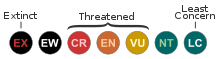
IUCN Red List of Threatened Plants Status : Not listed.
Growth: S = slow M = medium F = fast. Soil: L = light (sandy) M = medium H = heavy (clay). pH: A = acid N = neutral B = basic (alkaline). Shade: F = full shade S = semi-shade N = no shade. Moisture: D = dry M = Moist We = wet Wa = water.
Now available:
Food Forest Plants for Mediterranean Conditions
350+ Perennial Plants For Mediterranean and Drier Food Forests and Permaculture Gardens.
[Paperback and eBook]
This is the third in Plants For A Future's series of plant guides for food forests tailored to
specific climate zones. Following volumes on temperate and tropical ecosystems, this book focuses
on species suited to Mediterranean conditions—regions with hot, dry summers and cool, wet winters,
often facing the added challenge of climate change.
Read More
Expert comment
Author
Nutt.
Botanical References
Links / References
For a list of references used on this page please go here
Readers comment
| Add a comment |
|
If you have important information about this plant that may help other users please add a comment or link below. Only comments or links that are felt to be directly relevant to a plant will be included. If you think a comment/link or information contained on this page is inaccurate or misleading we would welcome your feedback at [email protected]. If you have questions about a plant please use the Forum on this website as we do not have the resources to answer questions ourselves.
* Please note: the comments by website users are not necessarily those held by PFAF and may give misleading or inaccurate information.
|
Subject : Lepidium montanum
|
|
|
|