 |
|
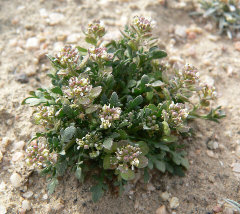
Stan Shebs. Creative Commons Attribution-Share Alike 3.0 |
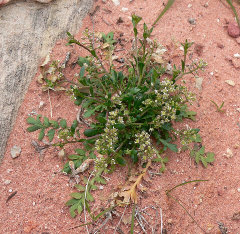 |
| Stan Shebs. Creative Commons Attribution-Share Alike 3.0 |
Translate this page:
Summary
Shaggyfruit pepperweed is one of the best edible pepperweeds of the American Southwest. This small native annual often carpets the northern Sonoran Desert soon after winter rains, producing vast numbers of woolly seedpods that contain highly useful edible seeds. Although separating the seeds from the chaff requires some effort, the seeds have an excellent flavour, work well as a seasoning, and become a useful thickener when cooked. Its abundance, ease of harvesting, and culinary versatility make it one of the most valuable wild mustards in desert regions.
Physical Characteristics

 Lepidium lasiocarpum is a ANNUAL growing to 0.3 m (1ft) by 0.2 m (0ft 10in) at a fast rate.
See above for USDA hardiness. It is hardy to UK zone 9. The flowers are pollinated by Bees, Insects.
It is noted for attracting wildlife.
Suitable for: light (sandy) and medium (loamy) soils, prefers well-drained soil and can grow in nutritionally poor soil. Suitable pH: mildly acid, neutral and basic (mildly alkaline) soils. It cannot grow in the shade. It prefers dry or moist soil and can tolerate drought.
UK Hardiness Map
US Hardiness Map
Synonyms
Lepidium lasiocarpum var. typicum C.L.Hitchc. Lepidium ruderale var. lasiocarpum (Nutt.) Engelm. ex A.Gray. Nasturtium lasiocarpum (Nutt.) Kuntze.
Plant Habitats
Edible Uses
Shaggyfruit pepperweed is one of the finest edible members of the Lepidium genus. Although the small seeds require careful processing, they reward the effort with a pleasant, spicy flavor, useful nutritional value, and impressive versatility in the kitchen. Its ability to produce abundant seed crops across the deserts of the American Southwest makes it an excellent native food plant that deserves far more attention from modern foragers [2-3]. The seeds are edible and the primary food resource this species produces. Like many members of the Lepidium genus, the leaves are also believed to be edible, although the seeds are by far the most useful part. You can eat the seeds fresh, toasted, boiled, or ground into meal. They also make an excellent natural seasoning and soup thickener [2-3]. Edibility Rating: 4 out of 5 – One of the better pepperweeds. The seeds are abundant, versatile, and pleasant to eat, although processing requires some patience [2-3]. Taste and Preparation: Each tiny woolly seedpod contains two brownish-orange seeds. The flavor ranges from mild to moderately spicy depending on the growing conditions and individual plants. Unlike many desert pepperweeds, the flavor is generally pleasant rather than overwhelmingly bitter. The seeds pair well with meat, potatoes, rice, beans, soups, and stews, where they contribute a mild mustard-like spice. When boiled, they release natural mucilage that thickens broths and sauces remarkably well. Use caution not to use excessive quantities, as the broth can become extremely thick. Harvesting is straightforward because each plant produces hundreds of seedpods. Processing is more difficult. Stem fragments closely resemble the seeds in both size and weight, making winnowing ineffective. Water separation also performs poorly because both seeds and debris may either float or sink. Fine sieving is generally the most effective method of cleaning the harvest [2-3]. Seasonality (Phenology): Plants commonly germinate after winter rains. Flowering usually occurs from December through March, with seeds maturing from March into early summer. Mature seeds often remain available for several weeks after ripening. Nutritional Value: The seeds contain carbohydrates, oils, protein, fiber, and minerals typical of mustard-family seeds. Their concentrated nutritional value makes them particularly useful compared with the tiny leaves [2-3]. Traditional Uses: Although detailed ethnobotanical records are limited, Indigenous peoples throughout western North America widely used pepperweed seeds. Shaggyfruit pepperweed was valued because of its reliable seed production in arid environments where relatively few seed crops were available. People likely ate the seeds whole, ground them into meal, or added them to other foods as a seasoning [2-3]. Safety: No significant toxicity is reported. As with other pepperweeds, the seeds contain mustard oils that provide their characteristic spicy flavor. They are generally safe when consumed in normal culinary quantities [2-3].
References More on Edible Uses
Medicinal Uses
Plants For A Future can not take any responsibility for any adverse effects from the use of plants. Always seek advice from a professional before using a plant medicinally.
Shaggyfruit pepperweed has no documented medicinal uses. While it belongs to the Brassicaceae (mustard) family—which contains several species well-known for their pharmacological properties—botanical and ethnobotanical records indicate that specific traditional or modern medicinal applications for L. lasiocarpum are lacking.
References More on Medicinal Uses
The Bookshop: Edible Plant Books
Our Latest books on Perennial Plants For Food Forests and Permaculture Gardens in paperback or digital formats.

Edible Tropical Plants
Food Forest Plants for Hotter Conditions: 250+ Plants For Tropical Food Forests & Permaculture Gardens.
More

Edible Temperate Plants
Plants for Your Food Forest: 500 Plants for Temperate Food Forests & Permaculture Gardens.
More

More Books
PFAF have eight books available in paperback and digital formats. Browse the shop for more information.
Shop Now
Other Uses
Wildlife Value: Seeds feed small birds and rodents, while the flowers support many native insects. The plant also contributes to the rich display of spring annuals that follows winter rains in the desert. Pollinators: The small white flowers attract bees, hoverflies, small flies, and other native pollinating insects during late winter and spring.
Special Uses
References More on Other Uses
Cultivation details
Shaggyfruit pepperweed grows best in full sun on sandy or gravelly, well-drained soils. It thrives after seasonal winter rainfall and completes its life cycle before the intense summer heat arrives. Habitat: Native throughout the southwestern United States at low elevations, particularly in the northern Sonoran Desert (Colorado Desert). It commonly occurs on desert flats, washes, disturbed ground, open shrublands, and sandy soils. USDA Hardiness Zones: USDA Zones 8–11. Growth Rate: Fast. This rapid-growing winter annual germinates, flowers, sets seed, and dies within a single growing season. Mature Size: Typically 5–30 cm (2–12 in.) tall with a spread of 10–25 cm (4–10 in.). Cultivation: Easily grown from seed in full sun and dry, well-drained soils. Once established, it requires little or no irrigation and readily self-seeds under favorable conditions. Identification: Shaggyfruit pepperweed is a small annual with branching stems, narrow leaves, tiny white four-petalled flowers, and numerous distinctive woolly seedpods. The dense covering of hairs on the fruits makes this one of the easiest Lepidium species to recognize. Each seedpod contains two brownish-orange seeds. Similar Species: Shaggyfruit pepperweed resembles several other Southwestern pepperweeds but is readily distinguished by its densely hairy seedpods. Field pepperweed (Lepidium campestre) and miner's pepperweed (Lepidium densiflorum) have much smoother fruits, while shield pepperweed (Lepidium perfoliatum) is recognized by its clasping upper leaves.
References Carbon Farming Information and Carbon Sequestration Information
Temperature Converter
Type a value in the Celsius field to convert the value to Fahrenheit:
Fahrenheit:
The PFAF Bookshop
Plants For A Future have a number of books available in paperback and digital form. Book titles include Edible Plants, Edible Perennials, Edible Trees,Edible Shrubs, Woodland Gardening, and Temperate Food Forest Plants. Our new book is Food Forest Plants For Hotter Conditions (Tropical and Sub-Tropical).
Shop Now
Plant Propagation
Propagated by seed. Natural reseeding is common following winter rainfall.
Other Names
If available other names are mentioned here
Shaggyfruit pepperweed, Hairypod pepperweed
Native Range
US. USA. Arizona, California, Colorado, Mexican Pacific Is., Mexico Central, Mexico Northeast, Mexico Northwest, Mexico Southwest, Nevada, New Mexico, Texas, Utah.
Weed Potential
Right plant wrong place. We are currently updating this section.
Please note that a plant may be invasive in one area but may not in your area so it's worth checking.
Moderate. It readily self-seeds and can form extensive seasonal colonies after favourable rainfall, but as a native annual it rarely becomes problematic outside its natural habitat.
Conservation Status
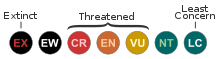
IUCN Red List of Threatened Plants Status : Not listed.
Growth: S = slow M = medium F = fast. Soil: L = light (sandy) M = medium H = heavy (clay). pH: A = acid N = neutral B = basic (alkaline). Shade: F = full shade S = semi-shade N = no shade. Moisture: D = dry M = Moist We = wet Wa = water.
Now available:
Food Forest Plants for Mediterranean Conditions
350+ Perennial Plants For Mediterranean and Drier Food Forests and Permaculture Gardens.
[Paperback and eBook]
This is the third in Plants For A Future's series of plant guides for food forests tailored to
specific climate zones. Following volumes on temperate and tropical ecosystems, this book focuses
on species suited to Mediterranean conditions—regions with hot, dry summers and cool, wet winters,
often facing the added challenge of climate change.
Read More
Expert comment
Author
Nutt.
Botanical References
Links / References
For a list of references used on this page please go here
Readers comment
| Add a comment |
|
If you have important information about this plant that may help other users please add a comment or link below. Only comments or links that are felt to be directly relevant to a plant will be included. If you think a comment/link or information contained on this page is inaccurate or misleading we would welcome your feedback at [email protected]. If you have questions about a plant please use the Forum on this website as we do not have the resources to answer questions ourselves.
* Please note: the comments by website users are not necessarily those held by PFAF and may give misleading or inaccurate information.
|
Subject : Lepidium lasiocarpum
|
|
|
|