 |
|
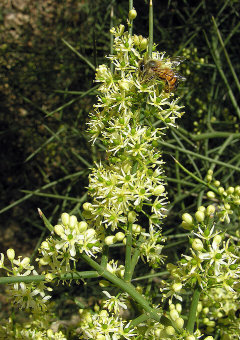
Dick Culbert from Gibsons, B.C., Canada. Creative Commons Attribution 2.0 |
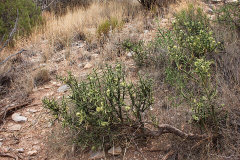 |
| Patrick Alexander from Las Cruces, NM. Creative Commons Zero, Public Domain Dedication |
Translate this page:
Summary
Allthorn is one of the most formidable shrubs of the American Southwest. Its dense framework of rigid, spine-tipped green branches creates an almost impenetrable barrier that offers excellent protection for wildlife but presents a considerable challenge for foragers. The plant produces small black berries that have occasionally been described as edible. While some authors have praised their sweetness, our field observations suggest a much less appealing food. Although the berries contain traces of grape-like sweetness, this is quickly overwhelmed by bitterness, slimy pulp, numerous large seeds, and other unpleasant flavors. The fruits are also difficult to harvest safely because of the dense spines and are frequently damaged by insects. For most modern foragers, allthorn is better appreciated as an interesting desert shrub than as a worthwhile food plant.
Physical Characteristics

 Koeberlinia spinosa is a SHRUB growing to 3 m (9ft) by 3 m (9ft) at a medium rate.
See above for USDA hardiness. It is hardy to UK zone 9. The flowers are pollinated by Bees, Insects.
It is noted for attracting wildlife.
Suitable for: light (sandy) and medium (loamy) soils, prefers well-drained soil and can grow in nutritionally poor soil. Suitable pH: mildly acid, neutral and basic (mildly alkaline) soils and can grow in very alkaline soils.
It cannot grow in the shade. It prefers dry or moist soil and can tolerate drought.
UK Hardiness Map
US Hardiness Map
Synonyms
Infraspecifics: Koeberlinia spinosa var. spinosa, Koeberlinia spinosa var. tenuispina Kearney & Peebles, Koeberlinia spinosa var. wivaggii W.C.Holmes, K.L.Yip & Rushing.
Plant Habitats
Edible Uses
Only the ripe black berries are considered edible [2-3]. The berries contain a thin layer of juicy pulp surrounding two to four large seeds, which occupy most of the fruit. Although they have mild sweetness, the edible portion is very limited. Neither the stems, leaves, roots, nor seeds are regarded as useful foods. Because of poor flavor, difficult harvesting, and uncertain safety information, consumption should remain occasional rather than routine [2-3]. Edibility Rating: 1.5/5. Allthorn receives an edibility rating of 1.5 out of 5. The berries are technically edible and have a history of occasional use, but numerous drawbacks—including poor flavor, large seeds, difficult harvesting, insect infestation, and limited edible flesh—greatly reduce their value. They are best regarded as an emergency or curiosity food rather than a desirable wild fruit [2-3]. Taste, Processing & Culinary Use: Ripe berries progress through green, red, orange or purple stages before finally becoming glossy black. Fresh fruits contain a trace of pleasant grape-like sweetness but also bitter, vegetable-like flavors and a slippery, somewhat slimy pulp. The numerous large seeds occupy approximately 90% of the berry's volume, leaving very little edible flesh. The thick skins further reduce eating quality. Boiling produces little improvement, and the bitterness largely remains. Adding sugar can make the berries more palatable, but they never develop into an especially desirable fruit. Only fully ripe berries should be considered for consumption. Discard berries showing insect holes, mould, or signs of decay. Seasonality (Phenology): Allthorn flowers during May and June. The berries mature during summer, gradually changing from green to red, purple or orange before becoming glossy black. Ripe fruits may persist for several weeks depending upon weather conditions. Harvesting is best undertaken soon after full ripening, before insect damage becomes widespread [2-3]. Safety & Cautions: Eat the berries only in moderation. Comprehensive safety information remains limited. The shrub's rigid spines present the greatest immediate hazard during harvesting and can easily puncture skin. Sensitive individuals may also experience irritation or dermatitis after contact with the spine-tipped branches. Many berries become infested by insects. Fruits showing tiny holes, decay, or mould should not be eaten. Correct identification is important because superficially similar shrubs commonly called crucifixion thorn (Canotia holacantha and Castela emoryi) produce dry, inedible fruits [2-3]. Harvest & Processing: Harvesting allthorn berries requires considerable care. Heavy gloves and long-handled tongs greatly reduce the risk of injury from the dense spines. Select only fully ripe black berries that are free from insect damage. Wash thoroughly before use. The berries may be eaten fresh or briefly cooked, although cooking does little to improve flavor. Because of their limited culinary quality, harvesting large quantities is rarely worthwhile [2-3]. Traditional Indigenous Uses: Historical references indicate occasional use of the berries as food by Indigenous peoples of the Southwest. Ethnobotanical records are relatively scarce, and some historical references may actually refer to similar thorny shrubs rather than true allthorn. Compared with many other desert food plants, allthorn appears to have played only a minor dietary role. Nutritional Value: No detailed nutritional analyses have been published. The berries contain small amounts of natural sugars together with moisture and dietary fiber. Because the edible pulp forms only a small proportion of each fruit, the overall nutritional contribution is relatively modest.
References More on Edible Uses
Medicinal Uses
Plants For A Future can not take any responsibility for any adverse effects from the use of plants. Always seek advice from a professional before using a plant medicinally.
Koeberlinia spinosa has minor traditional and ceremonial uses rather than a major reputation as a healing herb. Indigenous peoples of the American Southwest and Mexico historically used the smoke from burning its wood for ceremonial and medicinal purposes. Traditional & Cultural Uses: Ceremonial Smoke: The wood was burned so that the smoke could be used in regional indigenous rituals and traditional health practices. Edible Berries: Its small black berries are edible and served as a minor trailside food source for travelers and indigenous groups in desert regions, though they were never a dietary staple. Phytochemical Research: Modern chemical extraction studies have isolated specific compounds (such as chromanes and chromenes) from Koeberlinia spinosa and noted weak in vitro antiplasmodial activity. However, these findings are experimental and have not translated into mainstream or commercial medicinal applications.
References More on Medicinal Uses
The Bookshop: Edible Plant Books
Our Latest books on Perennial Plants For Food Forests and Permaculture Gardens in paperback or digital formats.
Edible Tropical Plants
Food Forest Plants for Hotter Conditions: 250+ Plants For Tropical Food Forests & Permaculture Gardens.
More
Edible Temperate Plants
Plants for Your Food Forest: 500 Plants for Temperate Food Forests & Permaculture Gardens.
More
More Books
PFAF have eight books available in paperback and digital formats. Browse the shop for more information.
Shop Now
Other Uses
Although rarely planted, allthorn can serve as an exceptionally effective security hedge because of its dense branching and formidable spines. It requires virtually no irrigation after establishment. Its unusual appearance also makes it an interesting specimen for desert botanical gardens. Wildlife & Ecology: Allthorn provides excellent shelter for birds, reptiles, and small mammals. Its dense spiny framework offers protection from predators and creates valuable nesting habitat. Many birds consume the berries and help disperse the seeds. The shrub also contributes to desert biodiversity by providing food and refuge in otherwise exposed landscapes.
Special Uses
References More on Other Uses
Cultivation details
Allthorn thrives in full sun and extremely well-drained soils. It tolerates sandy, gravelly, and rocky desert soils with ease. The shrub is exceptionally drought-tolerant and performs best under hot, arid conditions with minimal summer rainfall. It is highly tolerant of alkaline soils and prolonged heat. Poor drainage is the main condition it dislikes. Habitat & Distribution: Allthorn occurs throughout the deserts of southern California, Arizona, New Mexico, and Texas, extending south into northern Mexico. It inhabits desert flats, washes, rocky slopes, and open desert scrub, generally at low to moderate elevations. The species is particularly characteristic of the Chihuahuan and Sonoran Deserts. Cultivation: Although rarely planted, allthorn can serve as an exceptionally effective security hedge because of its dense branching and formidable spines. It requires virtually no irrigation after establishment. The shrub grows slowly to moderately and requires little maintenance. Its unusual appearance also makes it an interesting specimen for desert botanical gardens. Use caution when positioning plants near paths because of the sharp branches. Pollinators: The small white to pale greenish-yellow flowers attract a variety of native bees, flies, and other small insects seeking nectar and pollen. These insects serve as the primary pollinators. The abundant flowering provides a useful seasonal nectar source within desert ecosystems. Identification: Allthorn is an unmistakable shrub composed of green, rigid, intricately branched stems that terminate in sharp spines. Tiny scale-like leaves are produced briefly before being shed. Clusters of small white to greenish-yellow flowers appear during late spring. The shiny black berries measure approximately 3–5 mm in diameter, and each contains two to four seeds. Unlike the superficially similar crucifixion thorn shrubs, allthorn alone produces fleshy berries rather than dry woody fruits. Allthorn, Koeberlinia spinosa Zucc., belongs to the junco family (Koeberliniaceae), although it was formerly placed in the caper family (Capparaceae). It is the sole species of the genus found in the United States. Common names include allthorn, junco, crown of thorns, and crucifixion thorn. The name "allthorn" accurately reflects its appearance, as nearly every branch ends in a rigid, sharp spine. Allthorn is generally hardy in USDA Hardiness Zones 8–11. Mature shrubs typically grow 0.5–3 meters tall with a spread of 1–3 meters. It is highly drought tolerant and well adapted to the hot deserts of the southwestern United States and northern Mexico.
References Carbon Farming Information and Carbon Sequestration Information
Temperature Converter
Type a value in the Celsius field to convert the value to Fahrenheit:
Fahrenheit:
The PFAF Bookshop
Plants For A Future have a number of books available in paperback and digital form. Book titles include Edible Plants, Edible Perennials, Edible Trees,Edible Shrubs, Woodland Gardening, and Temperate Food Forest Plants. Our new book is Food Forest Plants For Hotter Conditions (Tropical and Sub-Tropical).
Shop Now
Plant Propagation
Propagation is primarily by seed. Fresh seed generally germinates more readily than stored seed. Young seedlings establish slowly but become increasingly drought tolerant as they mature. Propagation from cuttings is uncommon.
Other Names
If available other names are mentioned here
Allthorn, junco, crown of thorns and crucifixion thorn. The name "allthorn" accurately reflects its appearance, as nearly every branch ends in a rigid, sharp spine.
Native Range
US. USA. Arizona, California, Mexico Central, Mexico Gulf, Mexico Northeast, Mexico Northwest, New Mexico, Texas.
Weed Potential
Right plant wrong place. We are currently updating this section.
Please note that a plant may be invasive in one area but may not in your area so it's worth checking.
Allthorn has very low weed potential. It spreads naturally by seed but establishes slowly and remains confined to suitable desert habitats. Outside its native arid range it rarely naturalises. For PFAF purposes its weed potential is best rated 1/5 (very low).
Conservation Status
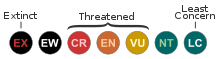
IUCN Red List of Threatened Plants Status : Koeberlinia spinosa is listed as Least Concern.
Growth: S = slow M = medium F = fast. Soil: L = light (sandy) M = medium H = heavy (clay). pH: A = acid N = neutral B = basic (alkaline). Shade: F = full shade S = semi-shade N = no shade. Moisture: D = dry M = Moist We = wet Wa = water.
Now available:
Food Forest Plants for Mediterranean Conditions
350+ Perennial Plants For Mediterranean and Drier Food Forests and Permaculture Gardens.
[Paperback and eBook]
This is the third in Plants For A Future's series of plant guides for food forests tailored to
specific climate zones. Following volumes on temperate and tropical ecosystems, this book focuses
on species suited to Mediterranean conditions—regions with hot, dry summers and cool, wet winters,
often facing the added challenge of climate change.
Read More
Expert comment
Author
Zucc.
Botanical References
Links / References
For a list of references used on this page please go here
Readers comment
| Add a comment |
|
If you have important information about this plant that may help other users please add a comment or link below. Only comments or links that are felt to be directly relevant to a plant will be included. If you think a comment/link or information contained on this page is inaccurate or misleading we would welcome your feedback at [email protected]. If you have questions about a plant please use the Forum on this website as we do not have the resources to answer questions ourselves.
* Please note: the comments by website users are not necessarily those held by PFAF and may give misleading or inaccurate information.
|
Subject : Koeberlinia spinosa
|
|
|
|