 |
|
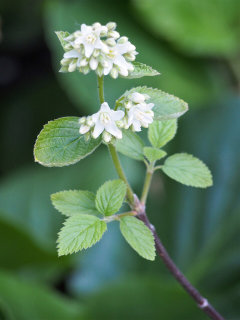
Agnieszka Kwiecien, Nova. Creative Commons Attribution-Share Alike 4.0 |
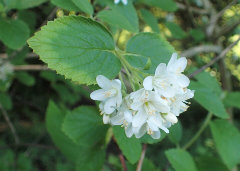 |
| Krzysztof Ziarnek, Kenraiz. Creative Commons Attribution-Share Alike 4.0 |
Translate this page:
Summary
American cliffbush is a distinctive western North American shrub of cliffs, rocky canyons, forested slopes, and mountain stream corridors. It is especially associated with cool, rocky sites in oak, juniper, pine and mixed montane communities, where its roots penetrate cracks and pockets of soil among boulders. The plant combines attractive white to pale pink flowers, toothed opposite leaves, reddish or shredding bark and colorful autumn foliage, making it valuable as both a native ornamental and a component of mountain ecosystems. Its food value is much more limited. Historical ethnobotanical evidence indicates that the fruits were occasionally eaten fresh by Mescalero and Chiricahua Apache people. Edward Castetter's 1936 account describes the hard fruits ripening in September and being eaten occasionally. That record provides credible evidence of traditional consumption, but the fruit structure makes the use difficult to interpret. The fruits are dry capsules rather than fleshy berries. As they mature, the capsule walls become increasingly woody, eventually reaching a texture that is virtually impossible to chew. Any edible stage must therefore occur relatively early, while the developing capsules and seeds remain at least partly tender. Immature capsules gathered in late August and September were already firm and only briefly suitable for chewing. Mature capsules were essentially woody. Their flavor was bland and bitter rather than fruity, and boiling did little to improve the texture. American cliffbush should therefore be regarded as a historically documented but very minor wild food. Its greatest value lies in native landscaping, wildlife habitat, erosion protection, and ornamental interest rather than human nutrition.
Physical Characteristics

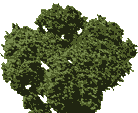 Jamesia americana is a deciduous Shrub growing to 1.8 m (6ft) by 1.8 m (6ft) at a medium rate.
See above for USDA hardiness. It is hardy to UK zone 4. The flowers are pollinated by Bees, Insects.
It is noted for attracting wildlife.
Suitable for: light (sandy) and medium (loamy) soils, prefers well-drained soil and can grow in nutritionally poor soil. Suitable pH: mildly acid, neutral and basic (mildly alkaline) soils. It can grow in semi-shade (light woodland) or no shade. It prefers dry or moist soil.
UK Hardiness Map
US Hardiness Map
Synonyms
Edwinia americana (Torr. & A.Gray) A.Heller
Plant Habitats
Edible Uses
The young fruits or capsules are reported to be edible, but only at an immature stage before the walls harden [2-3]. Mature capsules are dry, woody, and unsuitable for eating. They split into several sections at maturity and contain relatively large seeds, but neither mature capsules nor mature seeds have convincing practical food value. The immature capsules are small and require considerable gathering to produce even a modest serving. Your field estimate of roughly 70–90 capsules for a single portion illustrates how inefficient the plant is as a food source. Fresh young capsules have a bland, mildly bitter flavor. They lack the acridity, soapiness, strong resin, perfume-like aroma, or excessive astringency that sometimes signal more obvious chemical defenses, but the absence of those flavors does not establish safety. Because traditional documentation is limited to occasional use and modern toxicological information is scarce, consumption cannot be recommended beyond noting the historical edible use [2-3]. Edibility Rating: 1/5: American cliffbush receives an overall edibility rating of 1 out of 5. The rating recognizes that immature fruits were apparently eaten historically, but almost every practical feature works against their value. They are small, become woody rapidly, have poor flavor, provide little fleshy material, and require large numbers to make a serving. The uncertain safety of consuming substantial quantities further reduces their value. For a modern forager, American cliffbush is a plant worth recognizing for historical interest but not one worth seeking as food. Taste, Processing & Culinary Use: Young capsules are firm from the beginning and become tougher very quickly. Fresh immature fruits have a bland, somewhat bitter flavor. The bitterness is not intense, but there is little sweetness or other pleasant character to compensate for it. The lack of fruit-like aroma is notable. Despite being described ethnobotanically as fruits, the capsules taste more like dry reproductive structures than conventional berries. Seeds develop inside the capsules early and contribute further firmness. Boiling fails to transform the texture in the way it does with many wild vegetables. The capsule walls retain their toughness and the cooking liquid becomes a dull brown broth without a particularly appealing flavor. Longer cooking is unlikely to make mature capsules worthwhile because the walls eventually become lignified and wood-like. The young fruits might theoretically be chopped and incorporated into a mixed dish, but there is no strong historical or culinary reason to do so. Given their small size, limited flavor, and uncertain safety, culinary experimentation is not recommended [2-3]. Seasonality (Phenology): American cliffbush leafs out during spring and flowers from late spring through summer, with the precise timing varying considerably with elevation. We found a broad flowering period from May through October, which is plausible across the species' extensive elevational range [2-3]. Cultivated plants are more typically reported to flower in May and June. Fruit capsules develop after flowering and approach maturity during late summer and early autumn. Fruit is gathered in September, while field observations from the Sierra Blanca Mountains found suitable developing capsules from late August into the second week of September [2-3]. This timing is probably critical. Capsules gathered too early contain poorly developed seeds and very little material, while those gathered too late become woody and effectively inedible. Leaves develop autumn colors ranging from yellow and orange to reddish tones before falling. The peeling or shredding bark remains visible throughout winter and gives the shrub considerable dormant-season ornamental interest [2-3]. Safety & Cautions: American cliffbush should be approached conservatively as a food plant. The species has a documented ethnobotanical record of occasional fresh fruit consumption, but there is little modern toxicological information concerning the developing capsules or seeds. The word “occasionally” is significant. It suggests that the fruit was neither a major staple nor something consumed routinely in large quantities. Only immature capsules should ever be considered. Fully mature fruits are too hard to chew and may create a choking or dental hazard. Do not attempt to grind mature capsules indiscriminately into meal simply because they were historically called edible fruits. There is no evidence that this was a traditional preparation. The seeds likewise should not be treated as an established edible grain. Castetter's description indicates that fruits containing seeds were eaten, but this does not establish the mature seeds themselves as an independently consumed food. Plants growing on roadside cliffs, mine-affected slopes or contaminated drainage should not be harvested. Because shrubs often grow on steep rock faces, physical safety during harvesting is another important consideration. No wild food of such low value justifies climbing dangerous cliffs. Harvest & Processing: Identify fruiting shrubs from a safe, accessible location. Look for developing capsules clustered toward the ends of branches. The capsules are conical to somewhat rounded and remain tipped by the persistent styles. Select only young fruits that still yield slightly when pressed. Capsules that feel woody or extremely hard should be left alone. Harvest a very small experimental quantity rather than stripping a shrub. The plant's food value is too low to justify heavy removal. Wash the capsules carefully to remove dust and insects. If evaluating them ethnobotanically, the simplest preparation is probably fresh tasting at the immature stage, consistent with the historical account. Boiling may also be tried for research purposes, but your field experience indicates that cooking does little to improve either texture or flavor. Seeds should not be separated and consumed independently unless better evidence for their safety becomes available [2-3]. Traditional Indigenous Uses: The most important food-use evidence comes from Edward Castetter's 1936 account of the Mescalero and Chiricahua Apache. The hard fruits of Jamesia americana ripened in September and were “occasionally eaten fresh.” The brief description leaves uncertainty regarding the precise stage of maturity. Fully ripe cliffbush capsules become extremely hard, making it unlikely that truly mature fruits were chewed directly [2-3]. The Apache probably gathered them before complete maturity; therefore, this is reasonable. The late-August and September fruits sampled during fieldwork were already becoming very firm, suggesting the useful stage may be quite brief [2-3]. The seeds developing inside the capsules were presumably swallowed along with the young fruit, but there is no evidence that mature seeds were separately processed or valued. The historical record clearly characterizes American cliffbush as a minor food rather than an important seasonal resource.
References More on Edible Uses
Medicinal Uses
Plants For A Future can not take any responsibility for any adverse effects from the use of plants. Always seek advice from a professional before using a plant medicinally.
No major documented modern medical uses. Historical records show that certain Indigenous groups, such as the Chiricahua and Mescalero Apache, utilized the plant primarily for food by eating its fresh seeds, rather than for specific medicinal remedies.
References More on Medicinal Uses
The Bookshop: Edible Plant Books
Our Latest books on Perennial Plants For Food Forests and Permaculture Gardens in paperback or digital formats.
Edible Tropical Plants
Food Forest Plants for Hotter Conditions: 250+ Plants For Tropical Food Forests & Permaculture Gardens.
More
Edible Temperate Plants
Plants for Your Food Forest: 500 Plants for Temperate Food Forests & Permaculture Gardens.
More
More Books
PFAF have eight books available in paperback and digital formats. Browse the shop for more information.
Shop Now
Other Uses
The species deserves inclusion in an ethnobotanical database because the traditional food record is genuine, but it should not be promoted as a practical wild food. Its horticultural value is considerably greater. American cliffbush is cold hardy, drought tolerant once established, attractive in flower and autumn foliage, and particularly well suited to rock gardens and native mountain landscapes. Typical cultivated plants reach around 1.2–1.8 meters in both height and width, with USDA Hardiness Zones 3–8 providing a useful general guide. For PFAF users, American cliffbush is best understood as a distinctive western native shrub with an interesting but very minor ethnobotanical food use, rather than as a species worth cultivating or harvesting for edible fruits. Wildlife & Ecology: American cliffbush provides valuable structure and seasonal resources in mountain shrub communities. The flowers attract pollinating insects, including native bees and other small insects able to use the open five-petalled flowers. Fort Collins' native plant guidance lists the shrub as useful to pollinators and invertebrates as well as riparian, shrubland and woodland birds. Its branching structure provides cover for small birds and mammals. The capsules may provide limited seed resources after ripening, although specific wildlife use is not well documented. Roots help stabilize steep rocky slopes and canyon edges. The shrub's ability to grow in cliffs and rock fissures allows it to occupy ecological niches where larger woody species cannot establish readily. Its deciduous leaves contribute organic matter to otherwise shallow mountain soils.
Special Uses
References More on Other Uses
Cultivation details
American cliffbush is an attractive and ecologically useful mountain shrub with only marginal value as a food plant. Growing Conditions: American cliffbush grows best in full sun to partial shade, with some protection from intense afternoon sun particularly useful in hot, low-elevation gardens. Dappled shade and protection from afternoon heat can improve performance in warm landscapes. It prefers well-drained, rocky or loamy soils and is particularly suited to sites where roots remain relatively cool. Natural plants frequently grow at the base of cliffs, among large rocks and in canyon walls where shade from stone moderates root temperatures while upper branches receive abundant light. Moisture requirements are moderate while plants establish, but mature shrubs are reasonably drought tolerant. Plant Select classifies their water needs as moderate to dry. They are adapted to mountain climates with cold winters and comparatively cool nights. Hot, humid lowland climates are less suitable than dry continental conditions. Good drainage is essential. Constantly saturated soils are unlikely to suit a shrub adapted to rock crevices and steep slopes. Habitat & Distribution: American cliffbush is native across a broad region of the western United States extending into northeastern Mexico. Plants of the World Online describes its native range as western-central United States to northeastern Mexico [2-5]. Flora of North America recognizes four varieties occurring throughout the western United States and northern Mexico. Typical habitats include cliffs, rocky slopes, forested canyon bottoms, streambanks and mountain woodlands. The Lady Bird Johnson Wildflower Center specifically lists stream banks, forested canyon bottoms, rocky slopes and cliffs. The shrub commonly occurs with oak, juniper, ponderosa pine and other montane vegetation. Its rocky habitat explains the common name cliffbush particularly well; shrubs often appear rooted directly from cracks where very little soil is visible. Cultivation: American cliffbush is an excellent ornamental shrub for western native gardens, rock gardens and xeric mountain landscapes. It performs best where its root zone remains cool and well-drained. Planting beside a large boulder can reproduce its natural habitat and protect the roots from intense afternoon heat. Plant Select specifically recommends positioning plants near rock for root cooling in hot lower-elevation landscapes. Young plants should receive regular deep watering during establishment. Once established, irrigation can be reduced substantially, although extreme drought may reduce flowering and foliage quality. Little fertilizer is required. Excess nitrogen can produce soft growth less suited to the shrub's naturally lean mountain habitat. Pruning should be light. The naturally irregular branching and attractive bark are part of the plant's ornamental character. Remove dead or damaged stems after winter, but avoid repeated shearing into formal shapes. Its moderate size makes it suitable for mixed shrub borders, rocky slopes, wildlife gardens and naturalistic landscapes. Identification: American cliffbush is a thornless deciduous shrub commonly 1–2 meters tall, occasionally approaching 3 meters or more. Older stems often develop attractive shredding or peeling bark. Leaves are simple, opposite and stalked. The blades vary from elliptic and lance-ovate to broadly heart-shaped, with distinctly toothed margins. Surfaces may be softly hairy. Flowers occur in dense branching cymes near the ends of shoots. Each flower normally has five sepals and five separate white or pale pink petals, giving rise to the common name fivepetal cliffbush. There are usually three to five styles and ten stamens. The staminal filaments are flattened and lack the conspicuous lobes present in the rare related Jamesia tetrapetala. The ovary is partially inferior, consistent with the hydrangea family. Fruits are dry capsules that split into three to five sections at maturity. Persistent styles create small beak-like projections at the capsule tips. Four varieties are currently recognized within Jamesia americana by Flora of North America, based on relatively minor morphological and geographical differences. The only other North American Jamesia, fourpetal cliffbush (Jamesia tetrapetala), is an extremely restricted species associated with the Snake Range of eastern Nevada. Consequently, most wild Jamesia encountered throughout the Southwest will be J. americana. American cliffbush, Jamesia americana Torr. & A. Gray, belongs to the hydrangea family (Hydrangeaceae) and the genus Jamesia. Older botanical treatments sometimes placed the genus in the saxifrage family (Saxifragaceae). Common names include American cliffbush, cliffbush, fivepetal cliffbush and waxflower. Jamesia americana remains an accepted species, with a native range extending through the western and west-central United States into northeastern Mexico [2-5]. It is a deciduous perennial shrub generally suited to approximately USDA Hardiness Zones 3–8. In cultivation, plants commonly reach around 1.2–1.8 meters tall and 1.2–1.8 meters wide, although wild individuals growing in favorable canyon sites may approach 3 meters or more. Plant Select gives a typical cultivated height and width of 4–6 feet, while the Lady Bird Johnson Wildflower Center records wild plants reaching about 12 feet.
References Carbon Farming Information and Carbon Sequestration Information
Temperature Converter
Type a value in the Celsius field to convert the value to Fahrenheit:
Fahrenheit:
The PFAF Bookshop
Plants For A Future have a number of books available in paperback and digital form. Book titles include Edible Plants, Edible Perennials, Edible Trees,Edible Shrubs, Woodland Gardening, and Temperate Food Forest Plants. Our new book is Food Forest Plants For Hotter Conditions (Tropical and Sub-Tropical).
Shop Now
Plant Propagation
American cliffbush can be propagated from seed or cuttings. Seed should be collected from mature capsules shortly before or as they begin splitting naturally. The capsules can be dried in paper bags until they release the seed. Fresh seed may benefit from a period of cold, moist stratification reflecting the cold mountain winters experienced in its native habitat. Sow seed shallowly in a well-drained medium and maintain even moisture without saturation. Semi-ripe or softwood cuttings may also be used to propagate desirable plants. Vegetative propagation is particularly useful when preserving ornamental traits such as compact habit, pinkish flowers or good autumn color. Young plants should be transplanted carefully because established shrubs develop root systems adapted to penetrating rocky ground.
Other Names
If available other names are mentioned here
American cliffbush, cliffbush, fivepetal cliffbush and waxflower.
Native Range
US. USA. Arizona, California, Colorado, Mexico Northeast, Nevada, New Mexico, Utah, Wyoming [2-5].
Weed Potential
Right plant wrong place. We are currently updating this section.
Please note that a plant may be invasive in one area but may not in your area so it's worth checking.
American cliffbush has very low weed potential. It is a relatively slow-growing native shrub with specialized habitat requirements and no aggressive rhizomatous spread. Seedlings may establish around mature plants where suitable rocky or moist sites occur, but the species does not normally form invasive thickets. Its dependence on cool, rocky mountain environments further limits its ability to colonize disturbed agricultural or urban ground. In cultivation, it is generally well behaved and requires little containment.
Conservation Status
IUCN Red List of Threatened Plants Status : Not listed.

Growth: S = slow M = medium F = fast. Soil: L = light (sandy) M = medium H = heavy (clay). pH: A = acid N = neutral B = basic (alkaline). Shade: F = full shade S = semi-shade N = no shade. Moisture: D = dry M = Moist We = wet Wa = water.
Now available:
Food Forest Plants for Mediterranean Conditions
350+ Perennial Plants For Mediterranean and Drier Food Forests and Permaculture Gardens.
[Paperback and eBook]
This is the third in Plants For A Future's series of plant guides for food forests tailored to
specific climate zones. Following volumes on temperate and tropical ecosystems, this book focuses
on species suited to Mediterranean conditions—regions with hot, dry summers and cool, wet winters,
often facing the added challenge of climate change.
Read More
Expert comment
Author
Torr. & A.Gray
Botanical References
Links / References
For a list of references used on this page please go here
Readers comment
| Add a comment |
|
If you have important information about this plant that may help other users please add a comment or link below. Only comments or links that are felt to be directly relevant to a plant will be included. If you think a comment/link or information contained on this page is inaccurate or misleading we would welcome your feedback at [email protected]. If you have questions about a plant please use the Forum on this website as we do not have the resources to answer questions ourselves.
* Please note: the comments by website users are not necessarily those held by PFAF and may give misleading or inaccurate information.
|
Subject : Jamesia americana
|
|
|
|