 |
|
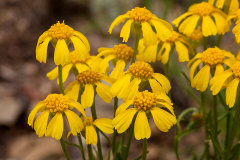
Hymenoxys richardsonii, Patrick Alexander from Las Cruces, NM. Creative Commons Zero, Public Domain Dedication |
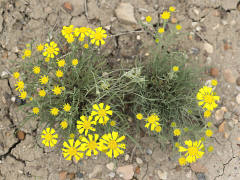 |
| Hymenoxys richardsonii, Cephas. Creative Commons Attribution-Share Alike 4.0 |
Translate this page:
Summary
Colorado rubberweed is one of the characteristic wildflowers of the Canyonlands region and the surrounding deserts and mountains of the American Southwest. During summer, its bright yellow flower heads are among the most conspicuous plants in pinyon-juniper woodland, sagebrush communities, and open rocky slopes. Despite its cheerful appearance, it has little value as a food plant and is better known for the toxic compounds that can poison livestock than for any culinary use. Historically, some Native American groups chewed the smaller roots or naturally occurring resins as a form of chewing gum. Unlike true gums, however, the plant produces only modest amounts of latex, especially in the dry climates where it naturally occurs. Modern field observations suggest that the finer secondary roots provide the best chewing texture, while the larger roots are coarse, bark-like and unsuitable for chewing. Although the roots possess a mild sweetness beneath their resinous flavor, safety concerns prevent them from being recommended as food. The plant is also notable for its remarkable drought tolerance. Dense clumps often dominate dry hillsides where few other flowering species persist through the intense summer heat. Its deep root system allows it to survive prolonged drought and produce bright displays of flowers when many surrounding plants have become dormant.
Physical Characteristics

 Hymenoxys richardsonii var. floribunda is a PERENNIAL growing to 0.5 m (1ft 8in) by 0.4 m (1ft 6in) at a fast rate.
See above for USDA hardiness. It is hardy to UK zone 5. The flowers are pollinated by Bees, Insects.
It is noted for attracting wildlife.
Suitable for: light (sandy) and medium (loamy) soils, prefers well-drained soil and can grow in nutritionally poor soil. Suitable pH: mildly acid, neutral and basic (mildly alkaline) soils. It cannot grow in the shade. It prefers dry or moist soil and can tolerate drought.
UK Hardiness Map
US Hardiness Map
Synonyms
Actinea richardsonii var. floribunda (A.Gray) Cory. Actinella richardsonii var. floribunda A.Gray. Picradenia richardsonii subsp. floribunda (A.Gray) W.A.Weber.
Plant Habitats
Edible Uses
Colorado rubberweed is not considered an edible species [2-3]. Ethnobotanical records indicate that the roots were occasionally chewed for their latex-like resins rather than eaten for nourishment. The smaller lateral roots gradually soften during chewing and eventually form a gum-like mass, while the larger woody roots remain fibrous and bark-like. Fresh secondary roots possess a surprisingly mild flavor. Beneath the light resinous taste is a noticeable sweetness derived from stored carbohydrates. Unlike many resinous members of the sunflower family, the resin content is relatively low, making the flavor less harsh than expected. The roots can also be simmered, producing a pleasant broth with a thin layer of floating resin on the surface. Despite this encouraging flavour, the presence of toxic sesquiterpene lactones means the plant cannot be recommended for culinary use. The leaves, stems, flowers and seeds have no recognized food value [2-3]. Edibility Rating: 0.5/5. Colorado rubberweed receives an edibility rating of 0.5 out of 5. While the smaller roots have an unexpectedly pleasant flavor and were occasionally chewed historically, documented toxicity makes the species unsuitable as a food plant [2-3]. Taste and Culinary Qualities: The root system consists of a thick, branching taproot clothed with numerous persistent leaf bases and surrounded by masses of slender secondary roots. These finer roots provide the only portions suitable for chewing. Fresh secondary roots begin with a mild earthy flavor followed by gentle sweetness and light resinous notes. Unlike the intensely bitter roots of several related species, Colorado rubberweed lacks excessive acridity, making it one of the milder members of the genus from a flavor standpoint. As chewing continues, the softer tissues gradually break down while the tougher fibers remain, eventually forming a surprisingly realistic gum-like consistency. This texture explains why Indigenous peoples occasionally chewed the roots despite the absence of large quantities of latex. The thicker central roots are entirely different. Their coarse bark-like texture resembles strips of woody mulch rather than edible roots. They remain tough even after prolonged chewing and contribute little beyond additional fiber. When gently simmered, the smaller roots produce an aromatic broth with a few resin droplets floating on the surface. The liquid has a mild herbal flavor, but the toxic constituents present in the plant outweigh any culinary interest [2-3]. Traditional Uses: Several Native American groups reportedly chewed the roots or their resin as a form of natural chewing gum. Unlike many other western food plants, Colorado rubberweed was not harvested as a staple food. Instead, its use appears to have been occasional and limited to chewing the smaller roots. Its traditional value therefore lies primarily in ethnobotanical interest rather than nutrition. Because the species is widespread throughout the Canyonlands region, it would have been readily available whenever fresh roots were required. Harvesting: Historically, roots could be collected throughout the growing season whenever the plants were actively growing. Excavation is relatively straightforward in the shallow rocky soils where the species commonly occurs, although older plants develop extensive woody root systems. The finer lateral roots are the preferred material. They require only washing before use, whereas the larger roots are generally discarded. Modern harvesting for consumption is not recommended because of the plant's toxic chemistry. Seasonality (Phenology): New growth begins during spring following seasonal rainfall. Flowering generally continues throughout the summer, making the species one of the dominant yellow wildflowers of the Canyonlands and adjacent regions. Seeds mature from late summer into early autumn. The perennial rootstock survives winter drought and cold before producing new shoots the following spring. Nutritional Value: No reliable nutritional analyses have been published. The roots contain carbohydrates that contribute to their mild sweetness, but the plant has never been regarded as a meaningful source of nutrition. Its toxic compounds greatly outweigh any potential dietary value [2-3]. Hazards: Colorado rubberweed contains toxic sesquiterpene lactones, including hymenoxon and hymenovin. These compounds are responsible for poisoning grazing animals, particularly sheep, producing the condition known as spewing sickness. Affected animals develop digestive disturbance, weakness, vomiting, and neurological symptoms resembling poisoning caused by death camas. Although humans would typically consume much smaller quantities than livestock, the presence of these toxins means regular consumption should be avoided. Chewing small quantities of root historically was unlikely to produce illness, but repeated or significant consumption cannot be considered safe. Pregnant or breastfeeding women, children, and individuals with chronic medical conditions should avoid the plant entirely. Livestock should not be forced to graze dense stands where other forage is unavailable [2-3].
References More on Edible Uses
Medicinal Uses
Plants For A Future can not take any responsibility for any adverse effects from the use of plants. Always seek advice from a professional before using a plant medicinally.
Colorado rubberweed has a relatively limited history of medicinal use compared with many other members of the sunflower family. Modern medicinal use is not recommended because biologically active sesquiterpene lactones are present throughout the plant. Scientific investigation has focused primarily on livestock poisoning rather than medicinal properties.
References More on Medicinal Uses
The Bookshop: Edible Plant Books
Our Latest books on Perennial Plants For Food Forests and Permaculture Gardens in paperback or digital formats.
Edible Tropical Plants
Food Forest Plants for Hotter Conditions: 250+ Plants For Tropical Food Forests & Permaculture Gardens.
More
Edible Temperate Plants
Plants for Your Food Forest: 500 Plants for Temperate Food Forests & Permaculture Gardens.
More
More Books
PFAF have eight books available in paperback and digital formats. Browse the shop for more information.
Shop Now
Other Uses
Colorado rubberweed is one of the defining wildflowers of the American Southwest's dry uplands. It is exceptionally well adapted to drought, produces masses of bright yellow flowers throughout summer, and plays an important ecological role by supporting native pollinators. Historically, the smaller roots were occasionally chewed as a natural gum and possess a surprisingly mild flavor with gentle sweetness. Nevertheless, the documented toxicity of the species cannot be overlooked. Today, Colorado rubberweed is best appreciated as an attractive native wildflower and a remarkable survivor of the harsh desert landscape rather than as a foraging plant. Wildlife Value: Colorado rubberweed provides nectar and pollen for a variety of native bees, butterflies, and other insects during its extended flowering season. Its flowers contribute valuable forage for pollinators in otherwise dry summer landscapes. Most grazing mammals avoid the foliage because of its toxicity, allowing mature plants to persist even under moderate grazing pressure. The seeds provide occasional food for small birds and rodents. Colorado rubberweed is occasionally cultivated in native wildflower gardens because of its exceptional drought tolerance and long flowering season.
Special Uses
References More on Other Uses
Cultivation details
Colorado rubberweed is one of the defining wildflowers of the American Southwest's dry uplands. It is exceptionally well adapted to drought, produces masses of bright yellow flowers throughout summer, and plays an important ecological role by supporting native pollinators. Historically, the smaller roots were occasionally chewed as a natural gum and possess a surprisingly mild flavor with gentle sweetness. Nevertheless, the documented toxicity of the species cannot be overlooked. Scientific investigations into livestock poisoning clearly demonstrate that harmful sesquiterpene lactones occur within the plant, making it unsuitable as a food resource. Today, Colorado rubberweed is best appreciated as an attractive native wildflower and a remarkable survivor of the harsh desert landscape rather than as a foraging plant. Colorado rubberweed is occasionally cultivated in native wildflower gardens because of its exceptional drought tolerance and long flowering season. It thrives in full sun and well-drained sandy or gravelly soils. Once established, it requires little irrigation and tolerates poor, alkaline soils remarkably well. Excessively rich or moist soils generally reduce its longevity. Growing Conditions: Colorado rubberweed prefers full sun and dry, open habitats. It thrives on rocky slopes, mesas, pinyon-juniper woodland, sagebrush communities, and other well-drained upland sites. The species is highly tolerant of drought, heat, wind and nutrient-poor soils. Its extensive root system enables survival in some of the harshest environments occupied by flowering perennials. Native Range and Habitat: This variety is widespread throughout the Canyonlands region and neighboring portions of the interior western United States. It occurs primarily from middle to upper elevations in Utah, Colorado, Arizona and adjacent states. It is particularly abundant in pinyon-juniper woodland where it often becomes one of the dominant flowering herbs. Its ability to withstand prolonged drought allows it to occupy habitats where many less hardy wildflowers cannot survive. Wildlife Value: Colorado rubberweed provides nectar and pollen for a variety of native bees, butterflies, and other insects during its extended flowering season. Its flowers contribute valuable forage for pollinators in otherwise dry summer landscapes. Most grazing mammals avoid the foliage because of its toxicity, allowing mature plants to persist even under moderate grazing pressure. The seeds provide occasional food for small birds and rodents. Identification: Colorado rubberweed is a perennial herb growing between 10 and 50 centimeters tall from a branching taproot. Numerous stems usually arise together from the crown and are often hairy near the base. The leaves are mostly alternate and become progressively smaller upwards. The well-developed lower leaves are deeply divided into narrow linear segments and may be either hairy or nearly hairless. Tiny glandular dots are frequently visible on the leaf surfaces. Flower heads are borne singly or in loose clusters near the ends of the stems. Each head consists of seven to twelve bright yellow ray florets surrounding numerous yellow disc florets. The outer involucral bracts are green, hairy, keeled and united near their bases, forming one of the distinguishing characteristics of the species. The fruits are five-sided obpyramidal cypselae bearing hairy surfaces and topped with short awned scales. Its compact stature, finely divided foliage and abundance throughout the Canyonlands region readily distinguish it from the taller orange sneezeweed (Hymenoxys hoopesii) and the generally larger Cooper's rubberweed (Hymenoxys cooperi). Family: Sunflower family (Asteraceae). Common Names: Colorado rubberweed, pingue. Botanical Name: Hymenoxys richardsonii (Hook.) Cockerell var. floribunda (A. Gray) K. F. Parker. Synonyms: Hymenoxys floribunda (A. Gray) Cockerell; Actinella richardsonii (Hook.) Nutt. var. floribunda A. Gray. USDA Hardiness Zones: Approximately USDA Zones 4–8. Plant Size: A perennial herb typically growing 10–50 cm tall with a spread of 20–45 cm, often forming rounded clumps from a branching taproot.
References Carbon Farming Information and Carbon Sequestration Information
Temperature Converter
Type a value in the Celsius field to convert the value to Fahrenheit:
Fahrenheit:
The PFAF Bookshop
Plants For A Future have a number of books available in paperback and digital form. Book titles include Edible Plants, Edible Perennials, Edible Trees,Edible Shrubs, Woodland Gardening, and Temperate Food Forest Plants. Our new book is Food Forest Plants For Hotter Conditions (Tropical and Sub-Tropical).
Shop Now
Plant Propagation
Propagation is usually by seed. Fresh seed germinates readily following exposure to winter cold. Plants may also be raised from divisions of young clumps, although seed propagation is considerably easier. Seedlings establish rapidly in open sunny sites with excellent drainage.
Other Names
If available other names are mentioned here
Colorado rubberweed, pingue.
Native Range
US. USA. Arizona, Colorado, New Mexico, Texas, Utah [2-5].
Weed Potential
Right plant wrong place. We are currently updating this section.
Please note that a plant may be invasive in one area but may not in your area so it's worth checking.
Colorado rubberweed has low weed potential. Although locally abundant in its native habitat, it spreads naturally rather than aggressively and is not regarded as invasive. It generally coexists with native grasses and shrubs without displacing established vegetation.
Conservation Status
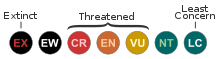
IUCN Red List of Threatened Plants Status : Not listed.
Growth: S = slow M = medium F = fast. Soil: L = light (sandy) M = medium H = heavy (clay). pH: A = acid N = neutral B = basic (alkaline). Shade: F = full shade S = semi-shade N = no shade. Moisture: D = dry M = Moist We = wet Wa = water.
Now available:
Food Forest Plants for Mediterranean Conditions
350+ Perennial Plants For Mediterranean and Drier Food Forests and Permaculture Gardens.
[Paperback and eBook]
This is the third in Plants For A Future's series of plant guides for food forests tailored to
specific climate zones. Following volumes on temperate and tropical ecosystems, this book focuses
on species suited to Mediterranean conditions—regions with hot, dry summers and cool, wet winters,
often facing the added challenge of climate change.
Read More
Expert comment
Author
(A.Gray) K.F.Parker
Botanical References
Links / References
For a list of references used on this page please go here
Readers comment
| Add a comment |
|
If you have important information about this plant that may help other users please add a comment or link below. Only comments or links that are felt to be directly relevant to a plant will be included. If you think a comment/link or information contained on this page is inaccurate or misleading we would welcome your feedback at [email protected]. If you have questions about a plant please use the Forum on this website as we do not have the resources to answer questions ourselves.
* Please note: the comments by website users are not necessarily those held by PFAF and may give misleading or inaccurate information.
|
Subject : Hymenoxys richardsonii var. floribunda
|
|
|
|