 |
|
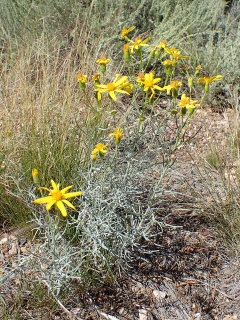
Krzysztof Ziarnek, Kenraiz. Creative Commons Attribution-Share Alike 4.0 |
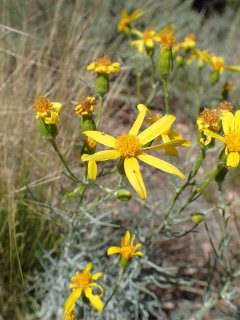 |
| Krzysztof Ziarnek, Kenraiz. Creative Commons Attribution-Share Alike 4.0 |
Translate this page:
Summary
Cooper's rubberweed is a drought-adapted perennial wildflower native to the deserts and lower foothills of the American Southwest, particularly southern Utah and northern Arizona. During midsummer it produces numerous bright yellow daisy-like flower heads that brighten otherwise dry landscapes, while its finely divided foliage helps the plant withstand prolonged periods of heat and drought. Despite its attractive appearance, this species has essentially no value as a food plant. Like several other members of the Hymenoxys genus, it produces toxic sesquiterpene lactones, including hymenoxon and hymenovin, compounds responsible for poisoning grazing livestock and causing a condition known as spewing sickness. Historically, several Native American groups occasionally chewed the roots or root resins as a form of natural chewing gum. This traditional practice should not be interpreted as evidence that the plant was eaten as food. The roots were chewed primarily for their texture and discarded rather than swallowed. Modern field observations indicate that the roots possess little of the elastic quality associated with true chewing gum and develop an unpleasant bitter, resinous flavour. Given the documented toxicity of the genus and the poor culinary qualities of the roots, Cooper's rubberweed should not be regarded as an edible species. Although unsuitable for foraging, the plant has considerable ecological value. It flowers during the hottest months of the year when relatively few native species remain in bloom, providing nectar and pollen for a range of native bees, butterflies and other insects. Its deep taproot also enables it to survive harsh desert conditions while helping stabilise fragile soils.
Physical Characteristics

 Hymenoxys cooperi is a PERENNIAL growing to 0.9 m (3ft) by 0.4 m (1ft 6in) at a fast rate.
See above for USDA hardiness. It is hardy to UK zone 6. The flowers are pollinated by Bees, Insects.
It is noted for attracting wildlife.
Suitable for: light (sandy) and medium (loamy) soils, prefers well-drained soil and can grow in nutritionally poor soil. Suitable pH: mildly acid, neutral and basic (mildly alkaline) soils and can grow in very alkaline soils.
It cannot grow in the shade. It prefers dry or moist soil and can tolerate drought.
UK Hardiness Map
US Hardiness Map
Synonyms
Actinea canescens S.F.Blake. Actinea cooperi Kuntze. Actinella cooperi A.Gray. Actinella richardsonii var. canescens D.C.Eaton. Hymenoxys canescens Cockerell. Hymenoxys cooperi var. argyrea Cockerell. Hymenoxys cooperi var. canescens (D.C.Eaton ex S.Watson) K.F.Parker. Hymenoxys cooperi subsp. grayi Cockerell. Picradenia canescens Greene. Picradenia cooperi Greene.
Plant Habitats
Edible Uses
Cooper's rubberweed is not considered an edible plant. Historical records indicate only that the roots or their resinous latex were occasionally chewed as gum by Native Americans. No reliable records suggest that the roots were swallowed in meaningful quantities or that the leaves, flowers, or seeds were eaten as food. The roots contain woody fibres and bitter resins that make them unpleasant to chew. Unlike genuine natural chewing gums, the roots gradually splinter into coarse fibres rather than forming a smooth elastic mass. Any slight starchy sweetness is quickly overwhelmed by resinous bitterness and a persistent latex-like flavour. No preparation method has been shown to improve the flavor or remove the toxic compounds present within the plant. Consequently, modern consumption cannot be recommended [2-3]. Edibility Rating: 0.5/5. Cooper's rubberweed receives an edibility rating of 0.5 out of 5. While the roots have a documented history of being chewed as gum, the plant possesses no meaningful food value and contains compounds capable of poisoning livestock. The unpleasant flavor, woody texture, and safety concerns make it unsuitable for human consumption. Taste and Culinary Qualities: Fresh roots initially appear more promising than they ultimately prove to be. Young roots are firm yet slightly flexible and produce a modest amount of resin when chewed. Their texture initially suggests that a gum-like material may develop. Instead, chewing causes the woody tissues to splinter into numerous irritating fibers. Rather than becoming smooth and elastic, the fibers separate into coarse strands that remain in the mouth and require repeated removal. The flavor is equally disappointing. Bitter resins dominate from the first few moments of chewing, accompanied by a distinctly latex-like quality. A faint starchy sweetness can occasionally be detected beneath the bitterness, but it never develops sufficiently to improve the experience. Older roots become increasingly woody and even less suitable for chewing. The leaves, stems, and flowers are regarded as inedible and have not traditionally been consumed [2-3]. Traditional Uses: Ethnobotanical records indicate that several Native American groups occasionally chewed the roots or collected their resinous exudates as a form of natural chewing gum. This appears to have been a minor use rather than an important cultural practice. Unlike many other edible native plants, Cooper's rubberweed was never gathered as a staple food, and there are no records of the roots being cooked, dried into flour or incorporated into other foods. Its traditional use demonstrates the ingenuity of Indigenous peoples in utilizing available natural resources, but it does not indicate that the species is safe or desirable for regular consumption [2-3]. Harvesting: Historically, roots would have been collected whenever plants were actively growing, most likely during spring or summer when soils remained soft enough for excavation. Young plants provide the best roots because their tissues remain less woody than those of mature specimens. The deep taproot requires careful digging to avoid breakage. Once lifted, the smaller lateral roots are easier to chew than the thick central root. Given the toxicity of the species, harvesting is not recommended except for botanical or ethnobotanical study [2-3]. Seasonality (Phenology): New foliage emerges during spring following seasonal rainfall. Flowering generally occurs from midsummer into early autumn, producing bright yellow flower heads during one of the driest periods of the year. Seeds mature during late summer and autumn. Roots remain present throughout the year and allow the plant to survive prolonged drought. During winter, the above-ground portions often die back while the taproot remains dormant until favorable moisture returns. Nutritional Value: No reliable nutritional analyses have been published for Cooper's rubberweed. Given its toxicity and lack of historical use as a food, nutritional evaluation has received little attention. The plant should not be considered a source of calories or nutrients. Hazards: Cooper's rubberweed contains toxic sesquiterpene lactones, particularly hymenoxon and hymenovin, compounds responsible for poisoning sheep and other grazing livestock. Consumption can lead to a condition known as spewing sickness, characterized by digestive disturbance, weakness, weight loss and persistent vomiting. The symptoms resemble poisoning caused by death camas. Although humans would normally consume far smaller quantities than grazing animals, the presence of these toxins makes regular consumption inadvisable. The roots should not be swallowed after chewing. Livestock managers generally regard dense populations of rubberweed as undesirable pasture plants. Pregnant or breastfeeding women, children and individuals with liver disorders should avoid all internal use [2-3]..
References More on Edible Uses
Medicinal Uses
Plants For A Future can not take any responsibility for any adverse effects from the use of plants. Always seek advice from a professional before using a plant medicinally.
Although several members of the genus have been used medicinally by Indigenous peoples, Cooper's rubberweed is much better known for its toxicity than for any medicinal applications. Traditional chewing of the roots appears to have been more related to obtaining resin than to therapeutic treatment. Because the plant contains biologically active sesquiterpene lactones, self-medication should be avoided.
References More on Medicinal Uses
The Bookshop: Edible Plant Books
Our Latest books on Perennial Plants For Food Forests and Permaculture Gardens in paperback or digital formats.

Edible Tropical Plants
Food Forest Plants for Hotter Conditions: 250+ Plants For Tropical Food Forests & Permaculture Gardens.
More

Edible Temperate Plants
Plants for Your Food Forest: 500 Plants for Temperate Food Forests & Permaculture Gardens.
More

More Books
PFAF have eight books available in paperback and digital formats. Browse the shop for more information.
Shop Now
Other Uses
Cooper's rubberweed is well suited to xeriscapes and native plant gardens. Cooper's rubberweed is an attractive and ecologically valuable native perennial that has adapted remarkably well to some of the driest landscapes of the American Southwest. Its long flowering season supports native pollinators, and its drought tolerance makes it an excellent candidate for native restoration and water-wise landscaping. Wildlife Value: Despite its toxicity to grazing mammals, Cooper's rubberweed provides valuable nectar and pollen for numerous native insects. Bees, butterflies and various pollinating flies regularly visit the bright yellow flower heads. The plant also contributes to soil stabilisation through its deep taproot. Most large herbivores avoid grazing it because of its bitter chemistry.
Special Uses
References More on Other Uses
Cultivation details
Cooper's rubberweed is well suited to xeriscapes and native plant gardens. It grows best in full sun with sharply drained sandy or gravelly soils. Once established, it tolerates prolonged drought and requires little supplemental irrigation. Excessive watering and poorly drained soils frequently reduce longevity. Because it is relatively short-lived, natural reseeding often maintains populations. Growing Conditions: The species thrives in full sun and dry climates. It tolerates alkaline, rocky and nutrient-poor soils exceptionally well. Natural habitats include open desert shrublands, rocky slopes, dry grasslands and disturbed roadsides. It performs best where competition from taller vegetation is limited. Native Range and Habitat: Cooper's rubberweed is native primarily to southern Utah, northern Arizona, and adjacent portions of the Colorado Plateau. It usually grows at lower to middle elevations in open, sunny habitats where rainfall is limited. Its drought tolerance enables it to dominate sites where relatively few perennial wildflowers can survive. Family: Sunflower family (Asteraceae). Common Names: Cooper's rubberweed. Botanical Name: Hymenoxys cooperi (A. Gray) Cockerell. Synonyms: Few widely accepted modern synonyms. USDA Hardiness Zones: Approximately Zones 5–9. Plant Size: A short-lived perennial typically growing 15–90 cm tall and 20–45 cm wide. Identification: Cooper's rubberweed is a short-lived perennial arising from a taproot and growing between 15 and 90 centimeters tall. One or several upright stems emerge from the base but are not especially woolly or hairy near ground level. The leaves are concentrated near the base of the plant, with progressively smaller alternate leaves ascending the flowering stems. Individual leaves are deeply pinnately divided into numerous narrow linear segments that give the foliage a finely textured appearance. The surfaces are hairless or only lightly hairy and often bear small glandular dots. Flower heads are borne singly or in loose corymb-like clusters on relatively long stalks. Each head possesses nine to fifteen bright yellow ray florets surrounding numerous yellow disc florets. The involucral bracts are arranged in two distinct rows, with the outer series thick, green and united near the base. The fruits are narrow five-sided cypselae bearing hairy surfaces and topped by translucent scale-like pappus structures ending in slender awns. The combination of finely divided foliage, yellow daisy-like flower heads, lower-elevation desert habitat and relatively long flower stalks readily distinguishes Cooper's rubberweed from most associated wildflowers. Overall Assessment: Cooper's rubberweed is an attractive and ecologically valuable native perennial that has adapted remarkably well to some of the driest landscapes of the American Southwest. Its long flowering season supports native pollinators, and its drought tolerance makes it an excellent candidate for native restoration and water-wise landscaping. From a foraging perspective, however, it has almost nothing to recommend it. The historical practice of chewing the roots as gum reflects resourcefulness rather than culinary merit. Modern observations confirm that the roots are woody, bitter and unpleasant, while the presence of toxic sesquiterpene lactones further argues against any experimentation. Cooper's rubberweed is therefore best appreciated as a resilient native wildflower rather than as a source of food.
References Carbon Farming Information and Carbon Sequestration Information
Temperature Converter
Type a value in the Celsius field to convert the value to Fahrenheit:
Fahrenheit:
The PFAF Bookshop
Plants For A Future have a number of books available in paperback and digital form. Book titles include Edible Plants, Edible Perennials, Edible Trees,Edible Shrubs, Woodland Gardening, and Temperate Food Forest Plants. Our new book is Food Forest Plants For Hotter Conditions (Tropical and Sub-Tropical).
Shop Now
Plant Propagation
Propagation is normally by seed. Fresh seed germinates readily following winter chilling or natural outdoor sowing. Young plants establish deep taproots rapidly and should therefore be transplanted only while still small. Division is generally impractical because of the taproot.
Other Names
If available other names are mentioned here
Rubberweed.
Native Range
US. USA. Arizona, California, Idaho, Nevada, Oregon, Utah [2-5].
Weed Potential
Right plant wrong place. We are currently updating this section.
Please note that a plant may be invasive in one area but may not in your area so it's worth checking.
Cooper's rubberweed has low to moderate weed potential. Although capable of forming local colonies in disturbed ground, it spreads relatively slowly and is seldom invasive outside its native range. In restoration projects it is often considered a useful native species rather than a troublesome weed.
Conservation Status
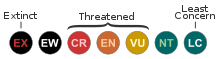
IUCN Red List of Threatened Plants Status : Not listed.
Growth: S = slow M = medium F = fast. Soil: L = light (sandy) M = medium H = heavy (clay). pH: A = acid N = neutral B = basic (alkaline). Shade: F = full shade S = semi-shade N = no shade. Moisture: D = dry M = Moist We = wet Wa = water.
Now available:
Food Forest Plants for Mediterranean Conditions
350+ Perennial Plants For Mediterranean and Drier Food Forests and Permaculture Gardens.
[Paperback and eBook]
This is the third in Plants For A Future's series of plant guides for food forests tailored to
specific climate zones. Following volumes on temperate and tropical ecosystems, this book focuses
on species suited to Mediterranean conditions—regions with hot, dry summers and cool, wet winters,
often facing the added challenge of climate change.
Read More
Expert comment
Author
(A. Gray) Cockerell.
Botanical References
Links / References
For a list of references used on this page please go here
Readers comment
| Add a comment |
|
If you have important information about this plant that may help other users please add a comment or link below. Only comments or links that are felt to be directly relevant to a plant will be included. If you think a comment/link or information contained on this page is inaccurate or misleading we would welcome your feedback at [email protected]. If you have questions about a plant please use the Forum on this website as we do not have the resources to answer questions ourselves.
* Please note: the comments by website users are not necessarily those held by PFAF and may give misleading or inaccurate information.
|
Subject : Hymenoxys cooperi
|
|
|
|