 |
|
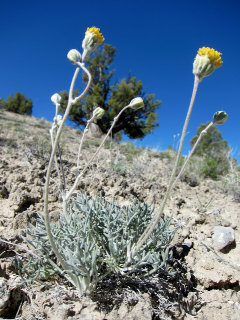
Mary Winter. Creative Commons Zero, Public Domain Dedication |
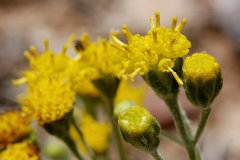 |
| Patrick Alexander from Las Cruces, NM. Creative Commons Zero, Public Domain Dedication |
Translate this page:
Summary
Fineleaf woollywhite is a conspicuous native wildflower of the American Southwest that produces finely divided silvery foliage and clusters of bright yellow flower heads over a remarkably long flowering season. Although attractive and common, it has almost no value as a food plant. Historical records indicate that several Native American groups occasionally chewed the roots as a natural chewing gum or prepared medicinal teas from the leaves, but these uses should not be interpreted as evidence that the plant is suitable for regular consumption. The species illustrates an important principle in ethnobotany. A plant may possess traditional uses without necessarily being a desirable food. Fineleaf woollywhite certainly falls into that category. While the roots possess a naturally chewy texture suitable for chewing, their flavour is intensely acrid and lacks the sweetness or pleasant aromatic qualities expected of natural gums. Likewise, the leaves can be prepared as tea, but the resulting drink is generally regarded as extremely unpleasant. Modern foragers have little reason to experiment with this species. The available evidence suggests that its culinary value is negligible and that consumption may carry unnecessary risk. Better edible species are available wherever fineleaf woollywhite grows.
Physical Characteristics

 Hymenopappus filifolius is a PERENNIAL growing to 0.9 m (3ft) by 0.5 m (1ft 8in) at a medium rate.
See above for USDA hardiness. It is hardy to UK zone 5. The flowers are pollinated by Bees, Insects.
It is noted for attracting wildlife.
Suitable for: light (sandy) and medium (loamy) soils and prefers well-drained soil. Suitable pH: mildly acid, neutral and basic (mildly alkaline) soils and can grow in very alkaline soils.
It cannot grow in the shade. It prefers dry or moist soil and can tolerate drought.
UK Hardiness Map
US Hardiness Map
Synonyms
Accepted Infraspecifics: Hymenopappus filifolius var. cinereus I.M.Johnst., Hymenopappus filifolius var. eriopodus (A.Nelson) B.L.Turner, Hymenopappus filifolius var. filifolius, Hymenopappus filifolius var. idahoensis B.L.Turner, Hymenopappus filifolius var. lugens (Greene) Jeps., Hymenopappus filifolius var. luteus (Nutt.) B.L.Turner, Hymenopappus filifolius var. megacephalus B.L.Turner, Hymenopappus filifolius var. nanus (Rydb.) B.L.Turner, Hymenopappus filifolius var. nudipes (Maguire) B.L.Turner, Hymenopappus filifolius var. parvulus (Greene) B.L.Turner, Hymenopappus filifolius var. pauciflorus (I.M.Johnst.) B.L.Turner, Hymenopappus filifolius var. polycephalus (Osterh.) B.L.Turner, Hymenopappus filifolius var. tomentosus (Rydb.) B.L.Turner.
Plant Habitats
Edible Uses
Traditional ethnobotanical records indicate that the roots were occasionally chewed as a form of natural chewing gum by the Zuni people, while the Hopi and Navajo reportedly used the leaves medicinally or mixed small amounts with cornmeal. These limited uses represent the extent of its documented food history. The roots are not eaten as food but simply chewed for their texture before being discarded. The leaves have occasionally been used in medicinal teas but are not considered edible vegetables. No part of the plant should be regarded as a worthwhile food resource. Because of its poor flavor, uncertain chemistry and lack of nutritional value, consumption of any part is best avoided [2-3]. Edibility Rating: 0.5/5. Fineleaf woollywhite receives an edibility rating of 0.5 out of 5. Although the roots have occasionally been chewed as gum and the leaves possess limited ethnobotanical uses, the plant offers virtually no practical food value. Extremely unpleasant flavor, probable defensive compounds and the availability of far better alternatives make it unsuitable as a foraged food. Taste, Processing & Culinary Use: The roots possess a naturally chewy consistency that initially gives the impression they might produce an acceptable chewing gum. Their texture remains resilient and elastic during chewing, especially when collected from young plants. Unfortunately, the flavor quickly overwhelms any positive qualities. Rather than sweetness, the roots produce an intensely acrid, resinous taste that persists in the mouth. There is little aromatic complexity and almost no pleasant aftertaste. The chewing experience is therefore defined almost entirely by texture rather than flavour. Young roots are preferable to older ones because they remain somewhat softer and less fibrous. Mature roots gradually become tougher and woodier while retaining the same unpleasant taste. The leaves are equally disappointing. Fresh foliage is bitter and resinous, while drying preserves these characteristics almost unchanged. Preparing the leaves as tea does little to improve their flavor. The infusion develops an unusual combination of rubbery, resinous and latex-like notes with virtually none of the floral or herbal qualities normally associated with pleasant herbal teas. Boiling, drying or prolonged storage fails to eliminate the undesirable flavor. The resulting beverage remains strongly resinous and generally unsuitable for drinking except perhaps as an ethnobotanical curiosity. Although historical references mention adding leaves to cornmeal, this practice almost certainly reflected medicinal or ceremonial traditions rather than any attempt to improve the flavor of food. Seasonality (Phenology): Fineleaf woollywhite is among the longest-flowering native composites of the Southwest. New basal leaves emerge during spring following seasonal rainfall. Flowering generally begins in late spring and may continue through summer and well into autumn, particularly where periodic rainfall stimulates renewed growth. Roots remain available throughout the year but are most succulent during spring when new growth begins. Seed heads mature progressively during summer and autumn. The dried flowering stems often remain standing throughout winter, helping locate colonies during the dormant season. Safety & Cautions: Consumption of fineleaf woollywhite is not recommended. The plant contains strongly bitter and resinous compounds that appear to function as natural chemical defenses. Although severe poisoning has not been widely documented, the combination of traditional medicinal use and extremely unpleasant flavor suggests moderation or complete avoidance is prudent. The roots should not be regarded as a confectionery gum despite their chewable texture. The leaves should not be consumed as a beverage except for ethnobotanical interest. People sensitive to members of the sunflower family should avoid handling or consuming the plant. Pregnant or breastfeeding women and young children should avoid internal use because safety has not been adequately studied [2-3]. Harvest & Processing: If collected for ethnobotanical study rather than consumption, young roots are easier to excavate and possess the best chewing texture. Roots should be washed thoroughly to remove soil before examination. Leaves intended for traditional tea are usually harvested while green and dried in a well-ventilated place. Dry leaves retain both their aroma and their unpleasant flavor for extended periods. No processing method has been shown to transform the plant into an acceptable food [2-3]. Traditional Indigenous Uses. The best-known ethnobotanical record comes from Matilda Stevenson's 1908 study of the Zuni, which simply records that "the root is used as chewing-gum." This brief observation has been repeated by many later authors. Additional records from the Hopi and Navajo indicate that the leaves were sometimes prepared as medicinal tea or mixed in small quantities with cornmeal. These uses appear to have been medicinal or cultural rather than nutritional. Unlike many traditional food plants, fineleaf woollywhite never became an important staple despite its abundance throughout much of the Southwest [2-3].
References More on Edible Uses
Medicinal Uses
Plants For A Future can not take any responsibility for any adverse effects from the use of plants. Always seek advice from a professional before using a plant medicinally.
No widely documented or specific historical medical uses of its own. However, it is closely related to other waterleaf species—such as Hydrophyllum virginianum (Virginia waterleaf)—which historically featured limited traditional herbal uses.
References More on Medicinal Uses
The Bookshop: Edible Plant Books
Our Latest books on Perennial Plants For Food Forests and Permaculture Gardens in paperback or digital formats.
Edible Tropical Plants
Food Forest Plants for Hotter Conditions: 250+ Plants For Tropical Food Forests & Permaculture Gardens.
More
Edible Temperate Plants
Plants for Your Food Forest: 500 Plants for Temperate Food Forests & Permaculture Gardens.
More
More Books
PFAF have eight books available in paperback and digital formats. Browse the shop for more information.
Shop Now
Other Uses
The plant is occasionally grown as a drought-tolerant native ornamental because of its finely divided silver foliage and prolonged display of yellow flower heads. Wildlife & Ecology: The long flowering season provides an important nectar and pollen source for native bees, butterflies and numerous other pollinating insects. Seeds are consumed by small birds and other wildlife. The extensive root system helps stabilize dry soils and contributes to erosion control. Its drought tolerance makes it an important component of native dryland plant communities. For gardeners, it is an excellent drought-tolerant ornamental and an important nectar source for native pollinators.
Special Uses
References More on Other Uses
Cultivation details
Growing Conditions: Fineleaf woollywhite thrives in full sun and well-drained soils. It tolerates sandy, gravelly, rocky, and alkaline substrates with ease. The species is particularly well adapted to drought and performs best where drainage is excellent. Established plants require little supplementary water and often survive prolonged dry periods that eliminate less-adapted vegetation. Excessively fertile or poorly drained soils generally reduce longevity. Habitat & Distribution: Fineleaf woollywhite is widespread across the Great Plains, Colorado Plateau, Great Basin and much of the American Southwest. It occupies open desert grasslands, sagebrush communities, rocky slopes, pinyon-juniper woodland, open pine forests and disturbed roadside habitats. The species occurs across a broad elevational range, extending from arid lowlands into mountain environments. Its adaptability explains why it is one of the most frequently encountered members of its genus. Cultivation: The plant is occasionally grown as a drought-tolerant native ornamental because of its finely divided silver foliage and prolonged display of yellow flower heads. It performs best in full sun with sharply drained soils. Once established, it requires very little maintenance and tolerates poor soils exceptionally well. Overwatering should be avoided. The deep taproot makes mature plants difficult to transplant successfully. Identification: Fineleaf woollywhite is an upright perennial arising from a deep, branching taproot and growing between 20 and 90 centimetres tall. The stems are often covered near the base with dense white woolly hairs. Most leaves form a basal rosette, with progressively smaller alternate leaves along the flowering stems. The leaves are deeply once or twice pinnately divided into numerous thread-like segments, giving the plant a delicate, feathery appearance. Their grey-green color and woolly hairs help reflect sunlight and reduce water loss. Unlike most members of the sunflower family, the flower heads contain only yellow disc florets and completely lack ray florets. Individual heads are borne singly or in loose corymb-like clusters on long stalks. The involucral bracts possess distinctive translucent margins that inspired the genus name Hymenopappus, meaning "membranous pappus." The fruits are narrow, four- to five-sided cypselae bearing numerous short translucent scales instead of the bristles typical of many other daisies. Numerous botanical varieties have been described throughout its extensive range, although all share the characteristic finely divided foliage and yellow rayless flower heads. Fineleaf woollywhite, Hymenopappus filifolius Hook., is a perennial member of the sunflower family (Asteraceae). It is commonly known as fineleaf woollywhite or yellow cutleaf. The species belongs to a genus centered in the Great Plains and the American Southwest, where it is one of the most widespread and familiar members. It is exceptionally well adapted to dry, open country and is frequently encountered on rocky slopes, desert grasslands, roadsides and disturbed ground. Fineleaf woollywhite is hardy in approximately USDA Hardiness Zones 4–9. Mature plants generally reach 20–90 cm in height and spread 20–50 cm, forming upright clumps from deep, branching taproots. Plants remain relatively compact despite producing tall flowering stems. Overall Assessment: Fineleaf woollywhite is a beautiful and ecologically valuable native wildflower but an exceptionally poor food plant. Historical records demonstrate that Indigenous peoples occasionally found specialized uses for its roots and leaves, yet these uses never developed into meaningful food traditions. The overwhelmingly unpleasant flavor described in both historical accounts and modern field observations supports that conclusion. For gardeners, it is an excellent drought-tolerant ornamental and an important nectar source for native pollinators. For foragers, however, it serves mainly as a reminder that not every traditionally used plant deserves a place on the menu. Better edible species are almost always available wherever fineleaf woollywhite grows.
References Carbon Farming Information and Carbon Sequestration Information
Temperature Converter
Type a value in the Celsius field to convert the value to Fahrenheit:
Fahrenheit:
The PFAF Bookshop
Plants For A Future have a number of books available in paperback and digital form. Book titles include Edible Plants, Edible Perennials, Edible Trees,Edible Shrubs, Woodland Gardening, and Temperate Food Forest Plants. Our new book is Food Forest Plants For Hotter Conditions (Tropical and Sub-Tropical).
Shop Now
Plant Propagation
Propagation is usually by seed. Fresh seed generally germinates readily after exposure to natural winter conditions. Young seedlings establish deep taproots quickly and should be transplanted only while very small. Division is generally impractical because of the extensive taproot system.
Other Names
If available other names are mentioned here
Native Range
US. USA. Alberta, Arizona, California, Colorado, Idaho, Kansas, Mexico Northwest, Montana, Nebraska, Nevada, New Mexico, North Dakota, Oregon, Saskatchewan, South Dakota, Texas, Utah, Washington, Wyoming [2-5].
Weed Potential
Right plant wrong place. We are currently updating this section.
Please note that a plant may be invasive in one area but may not in your area so it's worth checking.
Fineleaf woollywhite has low weed potential. Although common across its native range, it spreads primarily by seed and does not aggressively invade cultivated gardens. It is best regarded as a desirable native wildflower rather than a troublesome weed.
Conservation Status
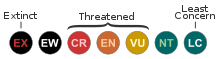
IUCN Red List of Threatened Plants Status : Not listed.
Growth: S = slow M = medium F = fast. Soil: L = light (sandy) M = medium H = heavy (clay). pH: A = acid N = neutral B = basic (alkaline). Shade: F = full shade S = semi-shade N = no shade. Moisture: D = dry M = Moist We = wet Wa = water.
Now available:
Food Forest Plants for Mediterranean Conditions
350+ Perennial Plants For Mediterranean and Drier Food Forests and Permaculture Gardens.
[Paperback and eBook]
This is the third in Plants For A Future's series of plant guides for food forests tailored to
specific climate zones. Following volumes on temperate and tropical ecosystems, this book focuses
on species suited to Mediterranean conditions—regions with hot, dry summers and cool, wet winters,
often facing the added challenge of climate change.
Read More
Expert comment
Author
Hook.
Botanical References
Links / References
For a list of references used on this page please go here
Readers comment
| Add a comment |
|
If you have important information about this plant that may help other users please add a comment or link below. Only comments or links that are felt to be directly relevant to a plant will be included. If you think a comment/link or information contained on this page is inaccurate or misleading we would welcome your feedback at [email protected]. If you have questions about a plant please use the Forum on this website as we do not have the resources to answer questions ourselves.
* Please note: the comments by website users are not necessarily those held by PFAF and may give misleading or inaccurate information.
|
Subject : Hymenopappus filifolius
|
|
|
|