 |
|
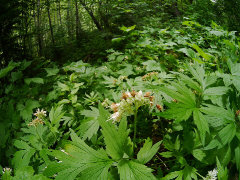
Thayne Tuason Creative Commons Attribution-Share Alike 4.0 |
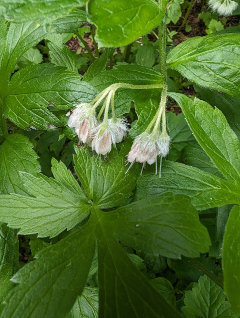 |
| Timothy McNitt. Creative Commons Attribution 4.0 |
Translate this page:
Summary
Fendler's waterleaf is one of the characteristic spring wildflowers of the southern Rocky Mountains. It thrives in cool canyons, moist woodland openings, mountain slopes and streamside forests where snowmelt provides abundant spring moisture before the dry season begins. Although never as conspicuous as many showy woodland flowers, its softly divided foliage and clusters of pale lavender to whitish-purple flowers make it an attractive component of mountain ecosystems. Unlike western waterleaf (Hydrophyllum occidentale), relatively little has been written specifically about the culinary qualities of Hydrophyllum fendleri. Nevertheless, ethnobotanical references consistently report the fleshy roots as edible, while your field notes indicate that the leaves are essentially equivalent to those of the other southwestern waterleaf species in flavour, aroma and texture. The leaves therefore appear suitable as an occasional cooked green, although direct historical references remain limited. The plant develops clusters of fleshy roots attached to short rhizomes rather than one large storage root. These roots provide only a modest food resource, but they remain relatively succulent throughout much of the growing season, particularly in shaded mountain habitats. The foliage is considerably more useful than the plant's modest stature might suggest. Young leaves possess a pleasant mild flavour and lack the bitterness, excessive tannins and harsh resins common in many spring greens. The soft hairs covering the leaves create a slightly velvety texture but are not normally irritating. Despite these encouraging characteristics, caution remains appropriate. Modern taxonomic treatments generally place Hydrophyllum within the borage family, a group that includes numerous species producing potentially harmful pyrrolizidine alkaloids. Whether Hydrophyllum fendleri contains these compounds has not been adequately investigated. Consequently, occasional consumption appears reasonable based upon historical use, but regular consumption cannot presently be recommended.
Physical Characteristics

 Hydrophyllum fendleri is a PERENNIAL growing to 0.6 m (2ft) by 0.6 m (2ft in) at a slow rate.
See above for USDA hardiness. It is hardy to UK zone 5. The flowers are pollinated by Bees, Insects.
It is noted for attracting wildlife.
Suitable for: light (sandy), medium (loamy) and heavy (clay) soils and prefers well-drained soil. Suitable pH: mildly acid, neutral and basic (mildly alkaline) soils. It can grow in semi-shade (light woodland). It prefers moist soil.
UK Hardiness Map
US Hardiness Map
Synonyms
Hydrophyllum albifrons var. fendleri (A.Gray) Brand. Hydrophyllum occidentale var. fendleri A.Gray
Plant Habitats
Edible Uses
The fleshy roots are the best documented edible part of the plant. They have been reported as edible by several ethnobotanical sources, although detailed descriptions of preparation methods are uncommon [2-3]. The leaves also appear edible and are essentially identical in flavor and texture to those of western waterleaf, according to your field observations. They are best gathered while young during spring and early summer. The flowers are not widely reported as edible, although they are unlikely to contribute significant food because of their small size. Young shoots emerging in spring may also be used together with the leaves as cooked greens. Because of the uncertainty surrounding the chemistry of the genus, all edible parts should be regarded as occasional rather than staple foods. Edibility Rating: 2/5. Fendler's waterleaf receives an overall edibility rating of 2 out of 5. The foliage is mild, pleasant, and easy to prepare, while the roots provide a modest vegetable. However, the limited amount of available food, scarcity of ethnobotanical documentation, and unresolved safety questions reduce its value as a dependable wild food [2-3]. Taste, Processing & Culinary Use: The leaves possess a surprisingly agreeable flavor for a wild woodland herb. Fresh foliage is mild, green and faintly sweet with little bitterness or astringency. Unlike many members of the borage family, the leaves do not exhibit harsh resinous or soapy characteristics. Soft hairs covering the leaves produce a velvety texture reminiscent of the fuzz on ripe peaches. These hairs are generally harmless and become even less noticeable after cooking. Brief boiling or steaming yields a pleasant cooked vegetable. Simmering also transfers some of the plant's sweetness into the cooking liquid, producing a delicate green broth with a mild herbal aroma. The leaves combine well with other spring vegetables and may be added near the end of soup preparation to preserve their texture and flavor. The fleshy roots are clustered together beneath the crown and are easier to gather than the roots of many woodland perennials. Fresh roots are moist and somewhat translucent beneath their reddish-brown skins. They possess an initially sharp flavor followed by a pleasant sweetness with subtle licorice-like notes, much like those described for western waterleaf. The fibrous texture makes the roots particularly suitable for soups and stews. Long simmering softens the fibers while preserving much of their sweetness. The flowers are delicate and attractive but contribute relatively little as food because of their small size. As with the other waterleaf species, cooking improves both flavor and hygiene but should not be regarded as a proven method for eliminating potentially harmful compounds if they are present [2-3]. Seasonality (Phenology): New growth begins shortly after snowmelt or spring rainfall in mountain habitats. Tender leaves and shoots are available from mid-spring into early summer, depending upon elevation. Flowering generally occurs from May through July, with lower elevations flowering earlier than high mountain populations. The leaves remain suitable for gathering throughout much of the flowering season before gradually becoming coarser and drying later in summer. The fleshy roots remain alive beneath the soil after the foliage disappears and may be collected throughout the growing season where harvesting is appropriate. Rounded capsules mature during mid to late summer before releasing seed. The plant enters dormancy during late summer or autumn as soil moisture declines. Safety & Cautions: Regular consumption cannot presently be recommended because comprehensive chemical studies of Hydrophyllum fendleri have not been completed. The genus is now commonly included within Boraginaceae, a family containing numerous species capable of producing pyrrolizidine alkaloids. Although these compounds have not been demonstrated in harmful concentrations within Hydrophyllum fendleri, their possible presence warrants a cautious approach. Occasional consumption is unlikely to present significant concern based upon available ethnobotanical evidence, but repeated or large servings should be avoided until more detailed safety information becomes available. People with liver disease, pregnant women and young children should avoid consuming the plant because of this uncertainty. Only collect plants growing well away from roadsides, contaminated waterways and agricultural chemical drift. Harvesting roots destroys individual plants and should only be undertaken where large colonies exist and collection is legally permitted. Positive identification while plants are flowering is essential before any harvesting is attempted [2-3]. Harvest & Processing: Young leaves should be gathered during spring while still soft, fully expanded and free from insect damage. Harvest only a small proportion of leaves from each plant so that normal growth and seed production can continue. Wash thoroughly to remove grit trapped by the soft hairs. The leaves are best lightly steamed or briefly boiled before serving. Roots should be dug only where populations are abundant. A narrow digging tool causes less disturbance than a large shovel. Remove the surrounding soil carefully and harvest only part of the root system whenever possible. Clean the roots thoroughly, trim away damaged sections, and cut them into short lengths before simmering. Initial tastings should always involve small portions. Traditional Indigenous Uses: Direct ethnobotanical records specifically referring to Hydrophyllum fendleri are relatively uncommon compared with those for Pacific Northwest waterleaf species. Most historical references simply report that roots of the genus were gathered as food by Indigenous peoples living in western North America. Three southwestern species possess edible roots, and their leaves are essentially similar in flavor and culinary qualities. Given its abundance throughout parts of the Rocky Mountains, it is likely that Fendler's waterleaf served as a seasonal spring vegetable wherever suitable colonies occurred, although detailed tribal accounts remain scarce. Like many mountain woodland herbs, its greatest value probably came as one component of a diverse seasonal diet rather than as a staple food [2-3].
References More on Edible Uses
Medicinal Uses
Plants For A Future can not take any responsibility for any adverse effects from the use of plants. Always seek advice from a professional before using a plant medicinally.
Fendler's waterleaf has no widely documented or specific historical medical uses of its own. However, it is closely related to other waterleaf species—such as Hydrophyllum virginianum (Virginia waterleaf)—which historically featured limited traditional herbal uses.
References More on Medicinal Uses
The Bookshop: Edible Plant Books
Our Latest books on Perennial Plants For Food Forests and Permaculture Gardens in paperback or digital formats.

Edible Tropical Plants
Food Forest Plants for Hotter Conditions: 250+ Plants For Tropical Food Forests & Permaculture Gardens.
More

Edible Temperate Plants
Plants for Your Food Forest: 500 Plants for Temperate Food Forests & Permaculture Gardens.
More

More Books
PFAF have eight books available in paperback and digital formats. Browse the shop for more information.
Shop Now
Other Uses
Fendler's waterleaf makes an attractive woodland perennial for native gardens. The species combines well with other native woodland perennials, including violets, columbines, woodland phlox, and native ferns. Wildlife & Ecology: The flowers provide nectar and pollen for a variety of native bees, particularly bumblebees and solitary woodland bees. The projecting stamens make pollen readily accessible to visiting insects. The foliage provides seasonal cover for numerous small woodland invertebrates. Its early spring growth contributes to the rich diversity of mountain woodland wildflowers that support pollinators emerging after winter. As the plant enters dormancy later in summer, nutrients are returned to the underground rhizomes in preparation for the following growing season. For native plant gardeners, the species offers additional value as an attractive woodland perennial that supports pollinating insects, thrives in shaded mountain gardens, and requires relatively little maintenance once established. Although modest as a food plant, Fendler's waterleaf represents an interesting example of the overlooked edible flora of the southern Rocky Mountains.
Special Uses
References More on Other Uses
Cultivation details
Fendler's waterleaf grows best in moist, humus-rich woodland soils receiving reliable spring moisture. Partial shade beneath deciduous woodland, mixed conifer forest or canyon vegetation provides ideal growing conditions. The species favors cool temperatures and performs poorly in prolonged summer heat combined with drought. Deep leaf litter and organically rich soils encourage vigorous growth. Although naturally occurring in moist habitats, plants benefit from good drainage during winter dormancy. Summer irrigation may be necessary in cultivation where natural rainfall is limited. Habitat & Distributio: .Fendler's waterleaf occurs primarily throughout the Rocky Mountains of Colorado, New Mexico, Arizona, Utah and neighboring states. It grows in moist canyons, mountain slopes, woodland openings, stream margins and shaded forest floors. Most populations occur from middle to upper elevations where snowmelt maintains cool soil conditions through spring. Colonies frequently develop beneath aspens, conifers, and mixed mountain woodland communities. The plant is considerably less common in the hotter low deserts of the Southwest. Cultivation: Fendler's waterleaf makes an attractive woodland perennial for native gardens. Plants establish best in fertile soils enriched with compost or leaf mould. Consistent spring moisture encourages vigorous foliage and abundant flowering. Once dormant, irrigation requirements decrease substantially. The species combines well with other native woodland perennials including violets, columbines, woodland phlox and native ferns. Heavy cultivation around established clumps should be avoided because shallow rhizomes and fleshy roots are easily damaged. Identification: Fendler's waterleaf is an upright perennial arising from fleshy roots and short rhizomes. Plants typically grow between 20 and 60 centimeters tall. The leaves are alternate, long-stalked and deeply pinnately divided with sharply toothed, tapering lobes. The divisions appear almost separate near the leaf base. Flower clusters are borne on long stalks extending above the surrounding foliage, distinguishing the species from ballhead waterleaf, whose flower heads are generally held below the leaves. The bell-shaped flowers range from white to pale lavender or light purple. Five hairy stamens project prominently beyond each flower. The fruits are small rounded capsules approximately 3–5 millimeters across and are often slightly bristly. Within its range, the combination of deeply divided foliage, elevated rounded flower clusters and moist mountain habitat readily separates Fendler's waterleaf from the other southwestern species. Fendler's waterleaf, Rocky Mountain waterleaf, Hydrophyllum fendleri (A. Gray) A. Heller, belongs to the waterleaf family (Hydrophyllaceae), a group now frequently included within the borage family (Boraginaceae) as subfamily Hydrophylloideae. It is one of three native Hydrophyllum species found in the Southwest and Rocky Mountains. The species was named in honor of the nineteenth-century botanist August Fendler, whose extensive collections greatly advanced knowledge of the flora of the American Southwest. It is a hardy herbaceous perennial, generally suited to USDA Hardiness Zones 4–8. Mature flowering plants usually grow 20–60 cm tall and spread 30–60 cm through short rhizomes and expanding clumps of fleshy roots. Established colonies slowly enlarge over time where moisture and shade remain favorable.
References Carbon Farming Information and Carbon Sequestration Information
Temperature Converter
Type a value in the Celsius field to convert the value to Fahrenheit:
Fahrenheit:
The PFAF Bookshop
Plants For A Future have a number of books available in paperback and digital form. Book titles include Edible Plants, Edible Perennials, Edible Trees,Edible Shrubs, Woodland Gardening, and Temperate Food Forest Plants. Our new book is Food Forest Plants For Hotter Conditions (Tropical and Sub-Tropical).
Shop Now
Plant Propagation
Propagation is readily achieved from seed or by dividing established clumps. Fresh seed sown outdoors during autumn often germinates after natural winter chilling. Stored seed generally benefits from several weeks of cold stratification. Division is best undertaken during dormancy or immediately before spring growth begins. Each division should retain healthy roots together with viable buds on the crown. Seed-grown plants help preserve natural genetic diversity and are preferable for restoration work.
Other Names
If available other names are mentioned here
Fendler's or Rocky Mountain Waterleaf
Native Range
US. USA. British Columbia, California, Colorado, Idaho, New Mexico, Oregon, Utah, Washington, Wyoming [2-5].
Weed Potential
Right plant wrong place. We are currently updating this section.
Please note that a plant may be invasive in one area but may not in your area so it's worth checking.
Fendler's waterleaf has very low weed potential. It spreads slowly through short rhizomes and occasional self-seeding but remains well-behaved in both gardens and natural habitats. Its preference for cool, moist woodland environments greatly limits any tendency toward invasive behavior. Small colonies gradually enlarge over many years rather than spreading aggressively.
Conservation Status
IUCN Red List of Threatened Plants Status : Not listed.
Growth: S = slow M = medium F = fast. Soil: L = light (sandy) M = medium H = heavy (clay). pH: A = acid N = neutral B = basic (alkaline). Shade: F = full shade S = semi-shade N = no shade. Moisture: D = dry M = Moist We = wet Wa = water.
Now available:
Food Forest Plants for Mediterranean Conditions
350+ Perennial Plants For Mediterranean and Drier Food Forests and Permaculture Gardens.
[Paperback and eBook]
This is the third in Plants For A Future's series of plant guides for food forests tailored to
specific climate zones. Following volumes on temperate and tropical ecosystems, this book focuses
on species suited to Mediterranean conditions—regions with hot, dry summers and cool, wet winters,
often facing the added challenge of climate change.
Read More
Expert comment
Author
(A. Gray) A. Heller
Botanical References
Links / References
For a list of references used on this page please go here
Readers comment
| Add a comment |
|
If you have important information about this plant that may help other users please add a comment or link below. Only comments or links that are felt to be directly relevant to a plant will be included. If you think a comment/link or information contained on this page is inaccurate or misleading we would welcome your feedback at [email protected]. If you have questions about a plant please use the Forum on this website as we do not have the resources to answer questions ourselves.
* Please note: the comments by website users are not necessarily those held by PFAF and may give misleading or inaccurate information.
|
Subject : Hydrophyllum fendleri
|
|
|
|