 |
|
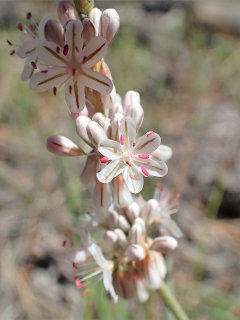
Kenraiz. Creative Commons Attribution-Share Alike 4.0 |
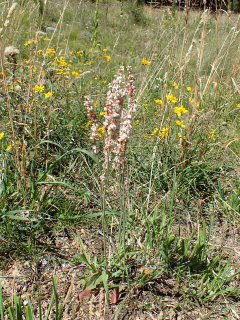 |
| Kenraiz. Creative Commons Attribution-Share Alike 4.0 |
Translate this page:
Summary
Redroot buckwheat is a perennial Eriogonum with edible stems and leaves. It is more of a green or stem food than a seed plant in the context of these listed uses. Its value is modest but interesting, especially because many buckwheats are used chiefly for seed. Redroot buckwheat, Eriogonum racemosum, belongs to the buckwheat family (Polygonaceae). Common names include redroot buckwheat. It is a perennial western buckwheat, generally suited to USDA Zones 4–8. Plants commonly grow about 20–60 cm tall and 20–50 cm wide.
Physical Characteristics

 Eriogonum racemosum is a PERENNIAL growing to 0.6 m (2ft) by 0.5 m (1ft 8in) at a fast rate.
See above for USDA hardiness. It is hardy to UK zone 5. The flowers are pollinated by Bees, Insects.
It is noted for attracting wildlife.
Suitable for: light (sandy) and medium (loamy) soils, prefers well-drained soil and can grow in nutritionally poor soil. Suitable pH: mildly acid, neutral and basic (mildly alkaline) soils. It cannot grow in the shade. It prefers dry or moist soil and can tolerate drought.
UK Hardiness Map
US Hardiness Map
Synonyms
Eriogonum racemosum var. typicum S.Stokes
Plant Habitats
Edible Uses
The edible parts are stems and leaves. Edible Uses & Rating [2-3]. Redroot buckwheat ranks as a modest wild vegetable. Its leaves and stems may provide sour or astringent greens, but it should not be treated as a bulk food. Taste, Processing & Kitchen Notes [2-3]. Leaves and stems are likely tangy, tannic, or astringent. Cooking may reduce harshness. Use young growth, as older stems become fibrous. Seasonality (Phenology) [2-3]. Young edible growth is best in spring and early summer. Flowering and seed production follow later in the growing season. Safety & Cautions (Food Use) [2-3]. Use moderately because buckwheat greens can contain tannins and oxalates. Avoid older fibrous material. Harvest & Processing Workflow [2-3]. Gather young stems and leaves, rinse, sample for astringency, and cook if harsh. Avoid stripping plants heavily. Cultivar/Selection Notes [2-3]. No food cultivars are known. Look-Alikes & Confusion Risks [2-3]. Can resemble other perennial buckwheats. Red roots and growth habit may assist identification, but close botanical work may be needed. Traditional/Indigenous Use Summary [2-3]. Redroot buckwheat belongs to the broader western tradition of using buckwheats as greens, stems, and seed plants.
References More on Edible Uses
Medicinal Uses
Plants For A Future can not take any responsibility for any adverse effects from the use of plants. Always seek advice from a professional before using a plant medicinally.
Eriogonum racemosum (commonly known as Redroot Buckwheat) has a long history of traditional medicinal use, particularly among Native American tribes such as the Navajo (Diné) and Zuni. It is highly regarded for its diverse applications, often termed a "life medicine" for treating internal ailments. Internal Ailments & Poisoning: The Navajo use a cold infusion of the roots as a "life medicine" to treat internal issues, including cases of poisoning. Respiratory Issues: A cold root infusion is used to treat bad coughs.Gastrointestinal Health: The plant is used to treat diarrhea. The Zuni specifically use it as an emetic (to induce vomiting) for stomachaches. Pain Relief & Orthopedics: The plant acts as an analgesic and has been used to treat broken bones and back pain. Skin and Wound Care: It has been used to create a lotion for rashes. Pounded roots have been applied as a dressing on a baby's sore navel. Oral Health: A decoction is used as a mouthwash for sore gums.Venereal Disease: Reports exist of its use in treating venereal diseases. The plant is generally used by preparing cold infusions of the roots or creating poultices, as highlighted in the Native American Ethnobotany Database.
References More on Medicinal Uses
Other Uses
A modest native perennial useful in dry native plantings. Ecology & Wildlife: Provides nectar, pollen, and plant structure in dryland communities.
Special Uses
References More on Other Uses
Cultivation details
Redroot buckwheat is a minor edible perennial with useful young growth but limited culinary importance. Growing Conditions: Dry open soils, full sun, and well-drained upland sites. Habitat & Range: Western North America, especially dry mountain and plateau habitats. Size & Landscape Performance: A modest native perennial useful in dry native plantings. Cultivation (Horticulture): Grow from seed in lean, well-drained soil. Pests & Problems: Overwatering and competition from aggressive plants are the main issues. Identification & Habit: A perennial buckwheat with simple leaves, flowering stalks, and typical Eriogonum flower clusters. Pollinators: Likely supports small bees, flies, and butterflies. Redroot buckwheat, Eriogonum racemosum, belongs to the buckwheat family (Polygonaceae). Common names include redroot buckwheat. It is a perennial western buckwheat, generally suited to USDA Zones 4–8. Plants commonly grow about 20–60 cm tall and 20–50 cm wide.
References Carbon Farming Information and Carbon Sequestration Information
Temperature Converter
Type a value in the Celsius field to convert the value to Fahrenheit:
Fahrenheit:
Plant Propagation
Seed.
Other Names
If available other names are mentioned here
Redroot Buckwheat (Eriogonum racemosum).
Native Range
US. USA. Arizona, Colorado, Nevada, New Mexico, Utah.
Weed Potential
Right plant wrong place. We are currently updating this section.
Please note that a plant may be invasive in one area but may not
in your area so it's worth checking.
Low.
Conservation Status
IUCN Red List of Threatened Plants Status : Not listed.
IUCN Red List
Growth: S = slow M = medium F = fast. Soil: L = light (sandy) M = medium H = heavy (clay). pH: A = acid N = neutral B = basic (alkaline). Shade: F = full shade S = semi-shade N = no shade. Moisture: D = dry M = Moist We = wet Wa = water.
Support Plants For A Future
Plants For A Future relies on regular donations to keep our free database and search facilities going, to pay for ongoing research, improvements and enhancements, and to develop and publish new books.
Read more
Choose Currency
Donate in £ GBP
Donate in $ USD
Donate in € EUR
Securely pay via PayPal or Credit/Debit Card without an account.
Expert comment
Author
Nutt.
Botanical References
Links / References
For a list of references used on this page please go here
Readers comment
| Add a comment |
|
If you have important information about this plant that may help other users please add a comment or link below. Only comments or links that are felt to be directly relevant to a plant will be included. If you think a comment/link or information contained on this page is inaccurate or misleading we would welcome your feedback at [email protected]. If you have questions about a plant please use the Forum on this website as we do not have the resources to answer questions ourselves.
* Please note: the comments by website users are not necessarily those held by PFAF and may give misleading or inaccurate information.
|
Subject : Eriogonum racemosum
|
|
|
|