 |
|
|
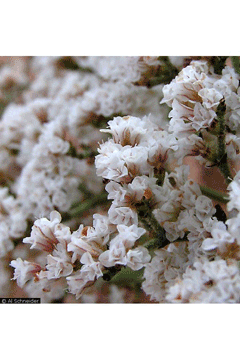 |
| Al Schneider @ USDA-NRCS PLANTS Database |
Translate this page:
Summary
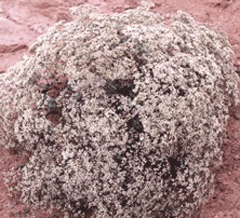
Crispleaf buckwheat is a valuable dryland shrub-buckwheat with edible leaves and seeds. It is also one of the better landscape buckwheats because it offers drought tolerance, long-lasting flower clusters, wildlife value, and strong pollinator support. As a food plant, it is useful but not usually a staple; as a habitat plant, it is excellent. Crispleaf buckwheat, Eriogonum corymbosum, belongs to the buckwheat family (Polygonaceae). Common names include crispleaf buckwheat and sometimes wild buckwheat in regional use. It is a perennial subshrub or shrub of the interior West, generally suitable to USDA Zones 5–9. Plants commonly grow 30–120 cm tall and 60–150 cm wide, depending on variety and site.
Physical Characteristics

 Eriogonum corymbosum is an evergreen Shrub growing to 0.3 m (1ft) by 0.6 m (2ft in) at a slow rate.
See above for USDA hardiness. It is hardy to UK zone 4. It is in leaf all year, in flower from July to August. The species is hermaphrodite (has both male and female organs) and is pollinated by Bees.
It is noted for attracting wildlife.
Suitable for: light (sandy) and medium (loamy) soils, prefers well-drained soil and can grow in nutritionally poor soil. Suitable pH: mildly acid, neutral and basic (mildly alkaline) soils. It cannot grow in the shade. It prefers dry or moist soil. The plant can tolerates strong winds but not maritime exposure.
UK Hardiness Map
US Hardiness Map
Synonyms
KB Homotypic Synonyms Eriogonum effusum var. corymbosum (Benth.) S.Stokes
Plant Habitats
Cultivated Beds;
Edible Uses
Edible Parts: Leaves
Edible Uses:
The edible parts are leaves and seeds. The leaves are more likely a minor green or tea-like resource, while seeds are the more traditional food use. Edible Uses & Rating: Crispleaf buckwheat ranks as a moderate wild food and a high-value ecological plant. Seeds may be gathered where abundant, and leaves may be used cautiously in small amounts [2-3]. Taste, Processing & Kitchen Notes: Seeds can be toasted, boiled, or ground. Leaves are likely tannic or astringent and are better used sparingly, cooked, or as a minor sour/astringent green rather than a salad staple. As with many buckwheats, processing is likely needed to improve flavor [2-3]. Seasonality (Phenology): Flowering usually occurs from summer into autumn, with seeds following late in the season. Shrubby buckwheats often hold dried flower structures for a long time. Safety & Cautions (Food Use): Buckwheat leaves may contain oxalates and tannins, so use in moderation. Seeds should be mature and cleaned well [2-3]. Harvest & Processing Workflow: For seeds, gather dry heads, thresh, winnow, and toast or grind. For leaves, gather young, clean leaves sparingly and cook if harsh. Cultivar/Selection Notes: Some Eriogonum corymbosum forms are grown ornamentally, often selected for compactness, flower color, and drought tolerance rather than food use. Look-Alikes & Confusion Risks: Shrubby buckwheats can be difficult to separate. Leaf texture, inflorescence structure, and range are important. Traditional/Indigenous Use Summary: Seeds of several buckwheats were important traditional foods in the West, and crispleaf buckwheat fits within that broader seed-use pattern [2-3]. Leaves and stems - cooked[46, 61, 161]. The leaves can be boiled, mixed with water and cornmeal and baked into a bread[257]. The stems are boiled, pressed into cakes then dried and eaten with salt[270].
References More on Edible Uses
Medicinal Uses
Plants For A Future can not take any responsibility for any adverse effects from the use of plants. Always seek advice from a professional before using a plant medicinally.
Eriogonum corymbosum (commonly known as crispleaf buckwheat) has a history of medicinal use, particularly among Native American tribes such as the Navajo (Diné) and Hopi, who utilized it for both internal and external ailments. Medicinal Uses and Applications: Headaches: A decoction (boiled extract) of the leaves has been used to treat headaches.Respiratory Issues: The plant has been used to treat coughs and tuberculosis. External Remedies: A poultice of the leaves has been applied to cuts, bruises, swellings, and for removing pus from sores or boils. It has also been used to treat rashes. Internal Ailments: A cold infusion of the root has been used to treat diarrhea. The Navajo have considered it a "life medicine" for treating various internal ailments. Mouth and Gums: It has been used as a mouthwash for sore gums.Obstetrics: Powdered root has been mixed with oil and used as a dressing on a baby's sore navel.Important Safety Information: According to PFAF, all parts of the plant should be treated as potentially poisonous. The leaves can contain nicotine, which can be toxic. It is important to consult a professional before using this plant medicinally. Note: The var. glutinosum is often specifically cited in relation to these medicinal uses. A decoction of the leaves, taken three times a day, is a remedy for headache[257]. The var glutinosum was most probably used[270]. This variety was also used as a treatment for TB, or at least to treat coughs[270].
References More on Medicinal Uses
The Bookshop: Edible Plant Books
Our Latest books on Perennial Plants For Food Forests and Permaculture Gardens in paperback or digital formats.
Edible Tropical Plants
Food Forest Plants for Hotter Conditions: 250+ Plants For Tropical Food Forests & Permaculture Gardens.
More
Edible Temperate Plants
Plants for Your Food Forest: 500 Plants for Temperate Food Forests & Permaculture Gardens.
More
More Books
PFAF have eight books available in paperback and digital formats. Browse the shop for more information.
Shop Now
Other Uses
Ecology & Wildlife: Excellent nectar plant, seed source, and dryland habitat shrub. Excellent dryland landscape plant with long-lasting flowers and strong habitat value.
Special Uses
Attracts Wildlife
References More on Other Uses
Cultivation details
Crispleaf buckwheat is more valuable as a native shrub and pollinator plant than as a major food, but its edible seeds and leaves add practical interest. Growing Conditions: Full sun, dry rocky or sandy soils, excellent drainage, and low water. Habitat & Range: It is widespread in the interior West, especially in dry shrublands, slopes, and desert uplands. Size & Landscape Performance: Excellent dryland landscape plant with long-lasting flowers and strong habitat value. Cultivation (Horticulture): Grow in lean, well-drained soil. Avoid overwatering. Pests & Problems: Root rot in wet soils is the main issue. Identification & Habit: A perennial shrub or subshrub with simple leaves and corymb-like flower clusters typical of shrubby Eriogonum. Pollinators: Highly attractive to bees, butterflies, flies, and other dryland pollinators. Crispleaf buckwheat, Eriogonum corymbosum, belongs to the buckwheat family (Polygonaceae). Common names include crispleaf buckwheat and, in regional use, wild buckwheat. It is a perennial subshrub or shrub of the interior West, generally suitable to USDA Zones 5–9. Plants commonly grow 30–120 cm tall and 60–150 cm wide, depending on variety and site. Requires a loose lean gritty well-drained soil in a very sunny position[200]. Succeeds in dry soils. Tolerates exposed positions[200]. Requires some protection from winter wet[1]. A very variable species, it has been divided into a number of distinct varieties[270]. Established plants resent root disturbance[200], though small plants can be moved successfully[270]. A slow growing plant[270]. A good bee plant[94].
References Carbon Farming Information and Carbon Sequestration Information
Temperature Converter
Type a value in the Celsius field to convert the value to Fahrenheit:
Fahrenheit:
The PFAF Bookshop
Plants For A Future have a number of books available in paperback and digital form. Book titles include Edible Plants, Edible Perennials, Edible Trees,Edible Shrubs, Woodland Gardening, and Temperate Food Forest Plants. Our new book is Food Forest Plants For Hotter Conditions (Tropical and Sub-Tropical).
Shop Now
Plant Propagation
Seed - best sown as soon as it is ripe in the autumn in a sandy compost in a greenhouse. Sow stored seed in early spring in a warm greenhouse[1]. As soon as they are large enough to handle, prick the seedlings out into individual pots and grow them on in the greenhouse for at least their first winter. Plant out in late spring or early summer, after the last expected frosts. Division in early spring[1]. This has to be done with care because the plant resents root disturbance[200]. Try to obtain divisions from around the edges of the plants without digging up the whole clump. Tease the divisions out with as much root on them as possible and pot them up. Grow them on in light shade in the greenhouse until they are rooting well and plant them out in the summer. Cuttings of greenwood with a heel in the summer[200]. Cuttings of almost ripe shoots with a heel, July/August in a frame.
Other Names
If available other names are mentioned here
Las Vegas wild buckwheat. wild buckwheat.
Native Range
NORTHERN AMERICA: United States (Colorado (west), Wyoming, New Mexico (northwest), Arizona (north), Nevada, Utah)
Weed Potential
Right plant wrong place. We are currently updating this section.
Please note that a plant may be invasive in one area but may not in your area so it's worth checking.
Low.
Conservation Status
IUCN Red List of Threatened Plants Status : Not listed.

Growth: S = slow M = medium F = fast. Soil: L = light (sandy) M = medium H = heavy (clay). pH: A = acid N = neutral B = basic (alkaline). Shade: F = full shade S = semi-shade N = no shade. Moisture: D = dry M = Moist We = wet Wa = water.
Now available:
Food Forest Plants for Mediterranean Conditions
350+ Perennial Plants For Mediterranean and Drier Food Forests and Permaculture Gardens.
[Paperback and eBook]
This is the third in Plants For A Future's series of plant guides for food forests tailored to
specific climate zones. Following volumes on temperate and tropical ecosystems, this book focuses
on species suited to Mediterranean conditions—regions with hot, dry summers and cool, wet winters,
often facing the added challenge of climate change.
Read More
Expert comment
Author
Benth.
Botanical References
200235270
Links / References
For a list of references used on this page please go here
Readers comment
| Add a comment |
|
If you have important information about this plant that may help other users please add a comment or link below. Only comments or links that are felt to be directly relevant to a plant will be included. If you think a comment/link or information contained on this page is inaccurate or misleading we would welcome your feedback at [email protected]. If you have questions about a plant please use the Forum on this website as we do not have the resources to answer questions ourselves.
* Please note: the comments by website users are not necessarily those held by PFAF and may give misleading or inaccurate information.
|
Subject : Eriogonum corymbosum
|
|
|
|