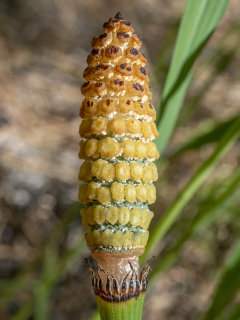
 |
|
Alex Abair. Creative Commons Attribution 4.0 |
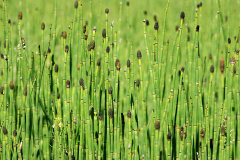 |
| Patrick Alexander from Las Cruces, NM. Creative Commons Zero, Public Domain Dedication |
Translate this page:
Summary
Smooth horsetail is a more refined, smoother-stemmed species compared to others in the genus. Like its relatives, it has limited food value but can be used in early growth stages.
Physical Characteristics

 Equisetum laevigatum is a PERENNIAL growing to 0.9 m (3ft) by 0.3 m (1ft in) at a fast rate.
See above for USDA hardiness. It is hardy to UK zone 4. The flowers are pollinated by None; reproduces via spores.
It is noted for attracting wildlife.
Suitable for: light (sandy), medium (loamy) and heavy (clay) soils. Suitable pH: mildly acid, neutral and basic (mildly alkaline) soils. It cannot grow in the shade. It prefers moist or wet soil.
UK Hardiness Map
US Hardiness Map
Synonyms
E. praealtum var. laevigatum (A.Braun & Engelm.) Bush. Hippochaete laevigata (A.Braun & Engelm.) Farw.
Plant Habitats
Edible Uses
Smooth horsetail is a more refined, smoother-stemmed species compared to others in the genus. Like its relatives, it has limited food value but can be used in early growth stages [2-3]. Edibility Summary: Young shoots and rhizomes are edible when cooked, though rarely used due to limited palatability [2-3]. Edible Uses & Rating: Low-value wild food, mainly of academic or survival interest [2-3]. Taste, Processing & Kitchen Notes: Young shoots may soften with cooking and provide mild, starchy flavors. Mature stems are too tough to use [2-3]. Seasonality (Phenology): Emerges in spring, with edible stages very short-lived. Safety & Cautions (Food Use): Contains thiaminase and other compounds. Cooking is required, and consumption should be limited. Harvest & Processing Workflow: Harvest very young shoots. Boil thoroughly. Rhizomes can be collected and prepared similarly [2-3]. Cultivar/Selection Notes: No cultivated forms. Look-Alikes & Confusion Risks: Distinguished by smoother stems and fewer ridges compared to related species. Traditional/Indigenous Use Summary: Limited documentation of use as food; more often used medicinally or for practical purposes [2-3].
References More on Edible Uses
Medicinal Uses
Plants For A Future can not take any responsibility for any adverse effects from the use of plants. Always seek advice from a professional before using a plant medicinally.
Equisetum laevigatum, commonly known as smooth scouring rush, has a history of traditional medical use, primarily serving as a diuretic and astringent. It has been used to treat kidney and bladder troubles, arthritis, bleeding ulcers, and tuberculosis. The plant's medicinal properties are often substituted for those of Equisetum hyemale (scouring rush). Traditional Medical Uses: Based on historical and ethnobotanical records, E. laevigatum has been utilized for genitourinary issues, including treating kidney and bladder ailments, gravel, and dropsy. Internal Bleeding: Used to treat hematuria (blood in urine) and as a hemostatic agent for internal hemorrhage. Topical Applications: Applied to wounds, burns, and for skin conditions like poison ivy rashes. Other Uses: Historically used for arthritis and tuberculosis. Active Components and Mechanisms: High Silica Content: The plant's high silica (silicic acid) content is believed to aid in connective tissue repair, bone health, and collagen synthesis, which supports its use in wound healing. Phytochemicals: It contains flavonoids and phenolic acids, which contribute to antioxidant and anti-inflammatory properties. Safety Concerns: Thiaminase: Like many Equisetum species, E. laevigatum contains the enzyme thiaminase, which breaks down thiamine (Vitamin B1). Chronic ingestion can lead to severe thiamine deficiency. Misidentification: It can be mistaken for the highly toxic Equisetum palustre (marsh horsetail), which should not be consumed.
References More on Medicinal Uses
The Bookshop: Edible Plant Books
Our Latest books on Perennial Plants For Food Forests and Permaculture Gardens in paperback or digital formats.
Edible Tropical Plants
Food Forest Plants for Hotter Conditions: 250+ Plants For Tropical Food Forests & Permaculture Gardens.
More
Edible Temperate Plants
Plants for Your Food Forest: 500 Plants for Temperate Food Forests & Permaculture Gardens.
More
More Books
PFAF have eight books available in paperback and digital formats. Browse the shop for more information.
Shop Now
Other Uses
Ecology & Wildlife: Important in wetland ecosystems, contributing to soil stabilization and habitat diversity.
Special Uses
References More on Other Uses
Cultivation details
Smooth horsetail is a marginal food plant with occasional utility in early spring. Growing Conditions: Thrives in moist soils with full sun. Habitat & Range: Common in wetlands and along waterways across central and western North America. Size & Landscape Performance: Moderate height, spreading colonies. Cultivation (Horticulture): Rarely cultivated intentionally; may become invasive. Pests & Problems: Minimal pest issues; persistence is the main concern. Identification & Habit: Unbranched, smooth, jointed stems with fewer ridges and lighter coloration. Pollinators: None; reproduces via spores. Smooth horsetail, Equisetum laevigatum, is a member of the horsetail family (Equisetaceae). It occurs in USDA Zones 3–9 and grows 20–90 cm tall, spreading via rhizomes.
References Carbon Farming Information and Carbon Sequestration Information
Temperature Converter
Type a value in the Celsius field to convert the value to Fahrenheit:
Fahrenheit:
The PFAF Bookshop
Plants For A Future have a number of books available in paperback and digital form. Book titles include Edible Plants, Edible Perennials, Edible Trees,Edible Shrubs, Woodland Gardening, and Temperate Food Forest Plants. Our new book is Food Forest Plants For Hotter Conditions (Tropical and Sub-Tropical).
Shop Now
Plant Propagation
Rhizomes and spores. Rarely cultivated intentionally; may become invasive.
Other Names
If available other names are mentioned here
Smooth horsetail, Equisetum laevigatum. Smooth scouring rush.
Native Range
US. USA. Alberta, Arizona, Arkansas, British Columbia, California, Colorado, Connecticut, Idaho, Illinois, Indiana, Iowa, Kansas, Kentucky, Manitoba, Mexico Central, Mexico Northeast, Mexico Northwest, Mexico Southeast, Mexico Southwest, Michigan, Minnesota, Missouri, Montana, Nebraska, Nevada, New Mexico, New York, North Dakota, Ohio, Oklahoma, Ontario, Oregon, Pennsylvania, Primorye, Québec, Sakhalin, Saskatchewan, South Dakota, Texas, Utah, Washington, Wisconsin, Wyoming
Weed Potential
Right plant wrong place. We are currently updating this section.
Please note that a plant may be invasive in one area but may not
in your area so it's worth checking.
High in suitable habitats.
Conservation Status
IUCN Red List of Threatened Plants Status : Not listed.

IUCN Red List
Growth: S = slow M = medium F = fast. Soil: L = light (sandy) M = medium H = heavy (clay). pH: A = acid N = neutral B = basic (alkaline). Shade: F = full shade S = semi-shade N = no shade. Moisture: D = dry M = Moist We = wet Wa = water.
Now available:
Food Forest Plants for Mediterranean Conditions
350+ Perennial Plants For Mediterranean and Drier Food Forests and Permaculture Gardens.
[Paperback and eBook]
This is the third in Plants For A Future's series of plant guides for food forests tailored to
specific climate zones. Following volumes on temperate and tropical ecosystems, this book focuses
on species suited to Mediterranean conditions—regions with hot, dry summers and cool, wet winters,
often facing the added challenge of climate change.
Read More
Expert comment
Author
A.Braun & Engelm.
Botanical References
Links / References
For a list of references used on this page please go here
Readers comment
| Add a comment |
|
If you have important information about this plant that may help other users please add a comment or link below. Only comments or links that are felt to be directly relevant to a plant will be included. If you think a comment/link or information contained on this page is inaccurate or misleading we would welcome your feedback at [email protected]. If you have questions about a plant please use the Forum on this website as we do not have the resources to answer questions ourselves.
* Please note: the comments by website users are not necessarily those held by PFAF and may give misleading or inaccurate information.
|
Subject : Equisetum laevigatum
|
|
|
|