 |
|
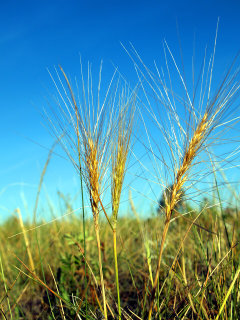
Jim Pisarowicz. Public domain |
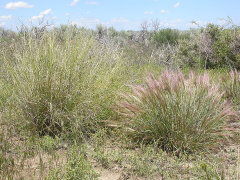 |
| Matt Lavin from Bozeman, Montana, USA. Creative Commons Attribution-Share Alike 2.0 |
Translate this page:
Summary
Bottlebrush squirreltail is one of the most recognizable native grasses of the dry interior West. Its dense, soft-looking but sharply awned seed heads give it the classic “squirreltail” appearance. It is strongly adapted to open, dry, and often poor soils, where it can appear in bunches across sagebrush country, rangelands, and disturbed sites. As a food plant it is useful for its grain, though processing is more troublesome than with softer-seeded grasses because of the long bristles.
Physical Characteristics

 Elymus elymoides is a PERENNIAL growing to 0.5 m (1ft 8in) by 0.3 m (1ft) at a fast rate.
See above for USDA hardiness. It is hardy to UK zone 5. The flowers are pollinated by Wind.
It is noted for attracting wildlife.
Suitable for: light (sandy) and medium (loamy) soils, prefers well-drained soil and can grow in nutritionally poor soil. Suitable pH: mildly acid, neutral and basic (mildly alkaline) soils. It cannot grow in the shade. It prefers dry or moist soil and can tolerate drought.
UK Hardiness Map
US Hardiness Map
Synonyms
E. sitanion Schult. Hordeum elymoides (Raf.) Schenck. Sitanion elymoides Raf.
Plant Habitats
Edible Uses
The edible part is the grain. This is the principal food used. The species is best regarded as a small-seeded dryland cereal rather than as a leafy or root food [2-3]. Edible Uses & Rating: Bottlebrush squirreltail ranks as a modest to moderate wild grain. It is genuinely edible and potentially useful, but the awns and relatively small seed size mean it is most worthwhile where large populations occur, and careful processing is possible [2-3]. Taste, Processing & Kitchen Notes: The grain is mild and cereal-like once cleaned. Toasting improves its flavor, and grinding makes it easier to use in porridge or coarse meal. The main challenge is not taste but the effort required to remove the bristles and chaff. Like many small wild grass grains, it is most practical when combined with grains from other gathered species or used as part of a mixed porridge or meal [2-3]. Seasonality (Phenology): Seeds typically mature from late spring into summer or early autumn, depending on elevation and rainfall. In hotter, lower sites, maturity may come earlier than in cooler uplands [2-3]. Safety & Cautions (Food Use): The seed heads are strongly awned and can irritate the skin and complicate harvest. Gloves can be helpful. The main safety issue is physical handling, not plant chemistry. As always, avoid polluted or chemically treated sites [2-3]. Harvest & Processing Workflow: Collect mature heads before they shatter. Dry them if necessary, then thresh thoroughly. Use rubbing, screening, and winnowing to remove the troublesome awns and chaff. Once reasonably clean, the grain can be toasted, cooked whole, or ground. Cultivar/Selection Notes: Bottlebrush squirreltail is more important in native restoration than in food cultivation. For seed gathering, the best stands are those with heavy seed set and accessible, uniformly mature heads: Look-Alikes & Confusion Risks: It resembles big squirreltail and other dryland awned grasses. Within this group, confusion is not usually a major food-safety issue because the grains are broadly edible, but it can affect expected yield and ease of handling [2-3]. Traditional/Indigenous Use Summary: Bottlebrush squirreltail belongs to the larger western tradition of using small grass seeds as seasonal grain foods. Its significance lies in abundance and resilience rather than in exceptional flavor [2-3].
References More on Edible Uses
Medicinal Uses
Plants For A Future can not take any responsibility for any adverse effects from the use of plants. Always seek advice from a professional before using a plant medicinally.
Elymus elymoides, commonly known as bottlebrush squirreltail, has limited documented direct medicinal uses compared to its relative Elymus repens (couch grass). However, it is recognized in ethnobotanical studies for its role in Native American food and forage, rather than as a primary medicine. Key information regarding Elymus elymoides: Edibility and Forage: It is used as a food source, particularly as "pinole," a coarse flour made from ground seeds. It is considered a valuable forage grass for sheep and horses, especially early in the season. General Medicinal Context: While the genus Elymus includes species with medicinal uses (such as treating renal issues or using as topicals for swollen limbs), specific medicinal applications for E. elymoides are not widely cited in the search results. Ethnobotanical Use: At least two Southwestern Native American communities, the Navajo and Ramah, use E. elymoides.
References More on Medicinal Uses
The Bookshop: Edible Plant Books
Our Latest books on Perennial Plants For Food Forests and Permaculture Gardens in paperback or digital formats.
Edible Tropical Plants
Food Forest Plants for Hotter Conditions: 250+ Plants For Tropical Food Forests & Permaculture Gardens.
More
Edible Temperate Plants
Plants for Your Food Forest: 500 Plants for Temperate Food Forests & Permaculture Gardens.
More
More Books
PFAF have eight books available in paperback and digital formats. Browse the shop for more information.
Shop Now
Other Uses
A valuable forage grass for sheep and horses, especially early in the season. Conservation Value: Its primary "use" today is for conservation, such as in erosion control, reseeding after fire, and oil shale/coal mine reclamation. Bottlebrush squirreltail forms neat bunches and can be attractive in native dryland plantings. It is commonly used in dryland restoration and low-water native seed mixes. Ecology & Wildlife: It helps stabilize dry soils, provides cover for small animals, and contributes seed to local food webs. It is often important in early-seral dryland restoration.
Special Uses
References More on Other Uses
Cultivation details
Bottlebrush squirreltail is a practical but somewhat labor-intensive wild grain of dry western landscapes. It is most useful where its abundance offsets the inconvenience of its bristly heads. Growing Conditions: This species thrives in full sun, dry open ground, and poor to moderate soils, especially sandy, gravelly, or rocky western sites. It is strongly drought-tolerant once established. Habitat & Range: It is widespread in the western United States in sagebrush country, dry grasslands, open woodlands, and disturbed sites. It is especially common in arid and semi-arid regions. Size & Landscape Performance: Bottlebrush squirreltail forms neat bunches and can be attractive in native dryland plantings, especially when the seed heads are fresh and well-formed. Cultivation (Horticulture): It is commonly used in dryland restoration and low-water native seed mixes. It establishes fairly readily in open sites with reduced competition. Pests & Problems: The biggest practical issue is the harsh, bristly head, which complicates handling and can be troublesome around livestock, pets, and bare skin. Otherwise it is generally resilient. Identification & Habit: Bottlebrush squirreltail is a perennial bunchgrass with narrow leaves and dense cylindrical seed heads packed with long awns, creating the bottlebrush or squirrel-tail effect. Pollinators: It is wind-pollinated. Bottlebrush squirreltail, now best referred to as Elymus elymoides, belongs to the grass family (Poaceae) and the genus Elymus. Common names include bottlebrush squirreltail and western bottlebrush. It is a perennial bunchgrass generally suited to USDA Zones 4–9. Mature plants usually stand about 20–70 cm tall and spread 15–40 cm across.
References Carbon Farming Information and Carbon Sequestration Information
Temperature Converter
Type a value in the Celsius field to convert the value to Fahrenheit:
Fahrenheit:
The PFAF Bookshop
Plants For A Future have a number of books available in paperback and digital form. Book titles include Edible Plants, Edible Perennials, Edible Trees,Edible Shrubs, Woodland Gardening, and Temperate Food Forest Plants. Our new book is Food Forest Plants For Hotter Conditions (Tropical and Sub-Tropical).
Shop Now
Plant Propagation
Propagation is by seed, and establishment is usually best in open ground with little competition.
Other Names
If available other names are mentioned here
Bottlebrush squirreltail and Western bottlebrush.
Native Range
US. USA. Alberta, Arizona, British Columbia, California, Colorado, Idaho, Kansas, Mexico Northeast, Montana, Nebraska, Nevada, New Mexico, North Dakota, Oklahoma, Oregon, Saskatchewan, South Dakota, Texas, Utah, Washington, Wyoming
Weed Potential
Right plant wrong place. We are currently updating this section.
Please note that a plant may be invasive in one area but may not
in your area so it's worth checking.
Low. It is a native bunchgrass rather than a strongly invasive species.
Conservation Status
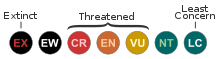
IUCN Red List of Threatened Plants Status : Not listed.
IUCN Red List
Growth: S = slow M = medium F = fast. Soil: L = light (sandy) M = medium H = heavy (clay). pH: A = acid N = neutral B = basic (alkaline). Shade: F = full shade S = semi-shade N = no shade. Moisture: D = dry M = Moist We = wet Wa = water.
Now available:
Food Forest Plants for Mediterranean Conditions
350+ Perennial Plants For Mediterranean and Drier Food Forests and Permaculture Gardens.
[Paperback and eBook]
This is the third in Plants For A Future's series of plant guides for food forests tailored to
specific climate zones. Following volumes on temperate and tropical ecosystems, this book focuses
on species suited to Mediterranean conditions—regions with hot, dry summers and cool, wet winters,
often facing the added challenge of climate change.
Read More
Expert comment
Author
(Raf.) Swezey
Botanical References
Links / References
For a list of references used on this page please go here
Readers comment
| Add a comment |
|
If you have important information about this plant that may help other users please add a comment or link below. Only comments or links that are felt to be directly relevant to a plant will be included. If you think a comment/link or information contained on this page is inaccurate or misleading we would welcome your feedback at [email protected]. If you have questions about a plant please use the Forum on this website as we do not have the resources to answer questions ourselves.
* Please note: the comments by website users are not necessarily those held by PFAF and may give misleading or inaccurate information.
|
Subject : Elymus elymoides
|
|
|
|