 |
|
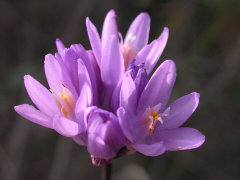
Copyright by Curtis Clark, licensed as noted. Creative Commons Attribution-Share Alike 2.5 |
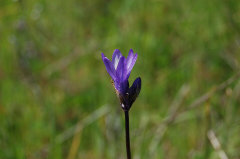 |
| Eugene Zelenko. Creative Commons Attribution-Share Alike 4.0 |
Translate this page:
Summary
Taxonomic Note: This genus was formerly classified in the family Agavaceae. Modern classifications include it within the Asparagaceae.
Snake lily is one of the most important traditional wild food plants of western North America, especially in California and adjacent regions. It produces small underground corms that are rich in carbohydrates and highly palatable, along with showy spring flowers that make identification easy during the prime harvest season. Despite the small size of individual corms, this species often grows in colonies, making it a reliable and historically significant food resource. Its ecological strategy of growing in rocky or difficult soils helps protect it from overharvesting, but also makes gathering physically demanding.
Physical Characteristics

 Dipterostemon capitatus is a BULB growing to 0.3 m (1ft) by 0.1 m (0ft 4in) at a medium rate.
See above for USDA hardiness. It is hardy to UK zone 8. The flowers are pollinated by Bees, Insects.
It is noted for attracting wildlife.
Suitable for: light (sandy) and medium (loamy) soils, prefers well-drained soil and can grow in nutritionally poor soil. Suitable pH: neutral and basic (mildly alkaline) soils. It cannot grow in the shade. It prefers dry or moist soil and can tolerate drought.
UK Hardiness Map
US Hardiness Map
Synonyms
Homotypic Synonyms: Brodiaea capitata Benth. Dichelostemma capitatum (Benth.) Alph.Wood. Dichelostemma pulchellum var. capitatum (Benth.) Reveal. Hookera capitata (Benth.) Kuntze. Milla capitata (Benth.) Baker.
Plant Habitats
Edible Uses
The corms and flowers are edible. The corms are the primary food source and are considered excellent in both flavor and nutritional value. The flowers are also edible but are of secondary importance [2-3]. Edible Uses & Rating: Snake lily ranks as a high-quality wild root crop. The corms are widely regarded as one of the better wild carbohydrate foods in its native range. While small, they offer excellent taste and digestibility, combined with their abundance in suitable habitats, making them a valuable resource. The flowers are edible and can be used as a garnish or minor vegetable, though they are not a staple [2-3]. Taste, Processing & Kitchen Notes. The corms have a pleasant, potato-like flavor with earthy, slightly salty, and tangy notes. When eaten raw, they are crisp and slightly mucilaginous, but unlike many mucilaginous plants, this quality enhances rather than detracts from the eating experience, giving a smooth, almost dressed texture. Cooking improves both flavor and texture. Roasting brings out sweetness and depth, while boiling or steaming produces soft, tender results suitable for soups and stews. The outer reddish-brown fringe and papery sheaths should be removed before consumption. The interiors are white, clean, and solid. The flowers are mild and can be eaten fresh or lightly cooked [2-3]. Seasonality (Phenology): Snake lily blooms from late winter through spring, typically February to May, depending on rainfall and location. This is the optimal time for identification and harvesting. Corms are present year-round, but are easiest to locate and harvest when the plant is above ground. Safety & Cautions (Food Use): There are no major toxicity concerns associated with this species when correctly identified. However, as with all geophytes, proper identification is critical to avoid confusion with potentially toxic look-alikes. Rotting corms should be avoided, as decay can occur in some conditions [2-3]. Harvest & Processing Workflow. Locate plants during flowering for accurate identification. Dig carefully around the base to extract the corms, which may be accompanied by smaller cormels. Remove the outer fringe and papery sheaths, retaining only the white interior. Rinse thoroughly to remove soil. Corms can be eaten raw, roasted, boiled, or added to soups. Sustainable harvesting involves leaving some corms behind to allow population regeneration [2-3]. Cultivar/Selection Notes: There are no cultivated varieties for agricultural use, but local ecotypes vary in size and productivity. Selection for cultivation would focus on larger corm size and ease of harvest, though this species is rarely domesticated. Look-Alikes & Confusion Risks: Snake lily may be confused with other members of the broader Dichelostemma, Brodiaea, and related genera, many of which are also edible but vary in quality. The grass-like leaves and blue-purple umbel flowers are distinctive. Care should be taken to avoid confusion with toxic bulb-forming species in unrelated families [2-3]. Traditional/Indigenous Use Summary: Snake lily was a staple food for many Indigenous peoples of western North America, particularly in California. The corms were widely harvested, often in large quantities, and formed an important part of seasonal diets. Its widespread use reflects both its abundance and its high food quality [2-3].
References More on Edible Uses
Medicinal Uses
Plants For A Future can not take any responsibility for any adverse effects from the use of plants. Always seek advice from a professional before using a plant medicinally.
While specific, widely cited medicinal remedies for this species are sparse compared to other plants, indigenous communities frequently used various Dichelostemma or related bulb species as part of their diet to maintain health.
References More on Medicinal Uses
The Bookshop: Edible Plant Books
Our Latest books on Perennial Plants For Food Forests and Permaculture Gardens in paperback or digital formats.
Edible Tropical Plants
Food Forest Plants for Hotter Conditions: 250+ Plants For Tropical Food Forests & Permaculture Gardens.
More
Edible Temperate Plants
Plants for Your Food Forest: 500 Plants for Temperate Food Forests & Permaculture Gardens.
More
More Books
PFAF have eight books available in paperback and digital formats. Browse the shop for more information.
Shop Now
Other Uses
During bloom, they produce attractive flower stalks that add ornamental value. It is suitable for xeriscaping and native plant gardens. Provides early-season nectar for pollinators and contributes to biodiversity in grassland and desert-edge ecosystems. Its underground corms also serve as a food source for some wildlife.
Special Uses
References More on Other Uses
Cultivation details
Snake lily is an outstanding wild food plant with deep cultural and ecological significance. Its small but highly nutritious corms, excellent flavor, and seasonal abundance make it one of the most valuable native root crops in its range. While harvesting can be labor-intensive, the rewards are considerable. Growing Conditions: This species thrives in well-drained soils, often in rocky or sandy substrates. It prefers full sun and is well adapted to Mediterranean climates with wet winters and dry summers. Habitat & Range: Snake lily is found across California and extends into parts of the southwestern United States, including desert margins, mesas, and rocky hillsides. It is especially common in regions with winter rainfall. Size & Landscape Performance: Plants are relatively small and unobtrusive outside of the flowering season. During bloom, they produce attractive flower stalks that add ornamental value. Cultivation (Horticulture): Snake lily can be grown from corms or seed in well-drained soils. It is suitable for xeriscaping and native plant gardens. Summer dormancy should be respected, with minimal watering during dry periods. Pests & Problems: Corms may be subject to rot in poorly drained soils. Grazing animals may consume aboveground parts, though rocky habitats often provide protection. Identification & Habit: A stemless perennial emerging from an underground corm. Leaves are basal, narrow, and grass-like. Flowering stalks bear umbels of bluish-purple, bell-shaped flowers. The plant is easily recognized when in bloom. Pollinators: Pollinated by bees and other generalist insects attracted to its nectar-rich flowers. Its early flowering period makes it an important resource for spring pollinators. Snake lily, now best referred to as Dipterostemon capitatus (formerly Dichelostemma capitatum), belongs to the asparagus family (Asparagaceae) and is closely related to the Dichelostemma group historically placed in the lily family. Common names include snake lily, blue dicks, and wild hyacinth. It is a perennial geophyte adapted to Mediterranean and arid climates, generally suited to USDA Zones 7–10. Plants typically reach 20–40 cm in height when flowering, with a narrow basal footprint of about 10–20 cm across.
References Carbon Farming Information and Carbon Sequestration Information
Temperature Converter
Type a value in the Celsius field to convert the value to Fahrenheit:
Fahrenheit:
The PFAF Bookshop
Plants For A Future have a number of books available in paperback and digital form. Book titles include Edible Plants, Edible Perennials, Edible Trees,Edible Shrubs, Woodland Gardening, and Temperate Food Forest Plants. Our new book is Food Forest Plants For Hotter Conditions (Tropical and Sub-Tropical).
Shop Now
Plant Propagation
By seed or division of corms. Seed-grown plants may take several years to reach maturity, while corm division provides quicker establishment.
Other Names
If available other names are mentioned here
Snakelily, blue dicks, and wild hyacinth.
Native Range
US. USA. Arizona, California, Mexico Northwest, Nevada, New Mexico, Oregon, Utah.
Weed Potential
Right plant wrong place. We are currently updating this section.
Please note that a plant may be invasive in one area but may not in your area so it's worth checking.
Low weed potential. It does not spread aggressively and is generally confined to suitable natural habitats.
Conservation Status
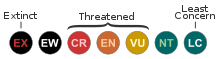
IUCN Red List of Threatened Plants Status : Not listed.
Growth: S = slow M = medium F = fast. Soil: L = light (sandy) M = medium H = heavy (clay). pH: A = acid N = neutral B = basic (alkaline). Shade: F = full shade S = semi-shade N = no shade. Moisture: D = dry M = Moist We = wet Wa = water.
Now available:
Food Forest Plants for Mediterranean Conditions
350+ Perennial Plants For Mediterranean and Drier Food Forests and Permaculture Gardens.
[Paperback and eBook]
This is the third in Plants For A Future's series of plant guides for food forests tailored to
specific climate zones. Following volumes on temperate and tropical ecosystems, this book focuses
on species suited to Mediterranean conditions—regions with hot, dry summers and cool, wet winters,
often facing the added challenge of climate change.
Read More
Expert comment
Author
(Benth.) Rydb.
Botanical References
Links / References
For a list of references used on this page please go here
Readers comment
| Add a comment |
|
If you have important information about this plant that may help other users please add a comment or link below. Only comments or links that are felt to be directly relevant to a plant will be included. If you think a comment/link or information contained on this page is inaccurate or misleading we would welcome your feedback at [email protected]. If you have questions about a plant please use the Forum on this website as we do not have the resources to answer questions ourselves.
* Please note: the comments by website users are not necessarily those held by PFAF and may give misleading or inaccurate information.
|
Subject : Dipterostemon capitatus
|
|
|
|