 |
|
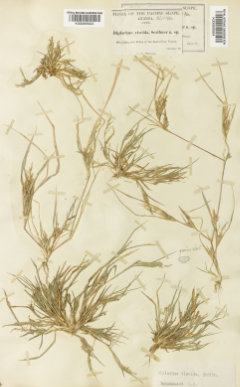
A specimen from Kew's Herbarium | Herbarium, RBG Kew |
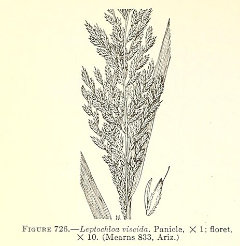 |
| Chase, Agnes; Hitchcock, A. S. Public domain |
Translate this page:
Summary
Sticky sprangletop is a warm-season native grass of the deserts and semi-arid regions of the southwestern United States and northern Mexico. Although often overlooked because of its weedy appearance, it produces edible grains that were traditionally gathered by Native Americans living along the lower Colorado River. While the grains were not personally evaluated during the original fieldwork, they are expected to resemble those of the closely related red sprangletop, making this another potentially valuable native cereal grass.
Physical Characteristics

 Dinebra viscida is a ANNUAL growing to 1 m (3ft 3in) by 0.3 m (1ft) at a fast rate.
See above for USDA hardiness. It is hardy to UK zone 9. The flowers are pollinated by Wind.
It is noted for attracting wildlife.
Suitable for: light (sandy), medium (loamy) and heavy (clay) soils. Suitable pH: mildly acid, neutral and basic (mildly alkaline) soils. It cannot grow in the shade. It prefers moist or wet soil.
UK Hardiness Map
US Hardiness Map
Synonyms
Diplachne viscida Scribn. Leptochloa viscida (Scribn.) Beal
Plant Habitats
Edible Uses
Sticky sprangletop is another overlooked native grass with documented traditional food use. Although direct field observations of its grains remain limited, historical records and its close relationship to red sprangletop strongly suggest that it is a worthwhile wild cereal. For foragers exploring the warm deserts and river valleys of the Southwest, it represents yet another example of the nutritious grains produced by many of the region's native grasses [2-3]. The grains are edible [2-3]. Historical records indicate that Native Americans of the lower Colorado River region collected the grains for food. Although the grains were not sampled during the original fieldwork, they are expected to have similar flavor, texture, and culinary qualities to those of red sprangletop. Edibility Rating: 4 out of 5 – A promising native grain with documented traditional use, although direct modern field evaluation remains limited [2-3]. Taste and Preparation: Based on its close relationship to other edible sprangletops, the grains are expected to have a mild cereal flavor comparable to wheat, although somewhat less robust. Fresh grains are extremely hard and should be cooked before consumption. Boiling for about 15–20 minutes should soften the grains, producing a pleasant cereal suitable for porridge, soups, or mixed grain dishes. Gentle toasting may also be used before storage, although the tiny grains are more likely to scorch than pop if exposed to excessive heat [2-3]. Seasonality (Phenology): Sticky sprangletop generally flowers during the warmer months, with mature grains becoming available from late summer into autumn. Exact flowering times vary according to local rainfall and temperature. Nutritional Value: Like other wild grasses, the grains provide carbohydrates, moderate amounts of protein, dietary fiber, minerals, and small quantities of healthy oils. They represent a concentrated source of energy compared with leafy wild foods [2-3]. Traditional Uses: Native Americans of the lower Colorado River region traditionally gathered the grains. Their inclusion among ethnobotanical food plants suggests they were recognized as a dependable seasonal grain wherever large populations occurred. No significant toxicity has been reported. The mature grains are considered safe when properly cleaned and cooked.
References More on Edible Uses
Medicinal Uses
Plants For A Future can not take any responsibility for any adverse effects from the use of plants. Always seek advice from a professional before using a plant medicinally.
There is no scientific evidence or traditional record indicating that Dinebra viscida possesses medicinal properties.
References More on Medicinal Uses
The Bookshop: Edible Plant Books
Our Latest books on Perennial Plants For Food Forests and Permaculture Gardens in paperback or digital formats.
Edible Tropical Plants
Food Forest Plants for Hotter Conditions: 250+ Plants For Tropical Food Forests & Permaculture Gardens.
More
Edible Temperate Plants
Plants for Your Food Forest: 500 Plants for Temperate Food Forests & Permaculture Gardens.
More
More Books
PFAF have eight books available in paperback and digital formats. Browse the shop for more information.
Shop Now
Other Uses
Wildlife Value: The seeds provide food for birds and small mammals, while the foliage provides habitat for insects and other wildlife associated with wet grasslands and riparian environments.
Special Uses
References More on Other Uses
Cultivation details
Sticky sprangletop grows best in full sun on moist or seasonally wet soils. It commonly occurs in floodplains, washes, irrigation channels, ditches, cultivated ground, and other disturbed sites with summer moisture. Habitat: Occurs from southern California east to southern Texas, primarily in warm desert valleys, floodplains, irrigation systems, roadsides, and disturbed habitats. USDA Hardiness Zones: USDA Zones 8–11. Growth Rate: Fast. Plants establish quickly in warm conditions and complete their life cycle in a single growing season. Mature Size: Typically 30–100 cm (1–3 ft) tall, occasionally larger where soil moisture and fertility are high. Cultivation: Sticky sprangletop grows readily from seed in sunny locations with reliable moisture. Although rarely cultivated intentionally, it establishes easily in disturbed ground and irrigated areas. Pollinators: Like nearly all grasses, sticky sprangletop is wind-pollinated. Identification: Sticky sprangletop is an erect annual grass with open, branched flowering panicles bearing numerous narrow spikelets. As its common name suggests, parts of the plant often feel slightly sticky or glandular. It closely resembles other sprangletops and is distinguished primarily by technical botanical characters. Similar Species: Sticky sprangletop closely resembles red sprangletop (Dinebra panicea subsp. brachiata), Mexican sprangletop (Diplachne fusca subsp. uninervia), and bearded sprangletop (Diplachne fusca subsp. fascicularis). All are edible grain-producing grasses with similar ecological roles.
References Carbon Farming Information and Carbon Sequestration Information
Temperature Converter
Type a value in the Celsius field to convert the value to Fahrenheit:
Fahrenheit:
The PFAF Bookshop
Plants For A Future have a number of books available in paperback and digital form. Book titles include Edible Plants, Edible Perennials, Edible Trees,Edible Shrubs, Woodland Gardening, and Temperate Food Forest Plants. Our new book is Food Forest Plants For Hotter Conditions (Tropical and Sub-Tropical).
Shop Now
Plant Propagation
Propagated by seed, which germinates readily in warm, moist soils.
Other Names
If available other names are mentioned here
Viscid sprangletop. Sprangletop. Can be listed as the synonym Leptochloa viscida (Scribn.) Beal.
Native Range
US. USA. Arizona, California, Mexico Northeast, Mexico Northwest, New Mexico, Texas.
Weed Potential
Right plant wrong place. We are currently updating this section.
Please note that a plant may be invasive in one area but may not in your area so it's worth checking.
Moderate. Sticky sprangletop readily colonises disturbed soils and agricultural areas, where it is sometimes regarded as a weed. It is generally not considered aggressively invasive outside suitable moist habitats.
Conservation Status
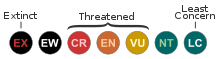
IUCN Red List of Threatened Plants Status : Not listed.
Growth: S = slow M = medium F = fast. Soil: L = light (sandy) M = medium H = heavy (clay). pH: A = acid N = neutral B = basic (alkaline). Shade: F = full shade S = semi-shade N = no shade. Moisture: D = dry M = Moist We = wet Wa = water.
Now available:
Food Forest Plants for Mediterranean Conditions
350+ Perennial Plants For Mediterranean and Drier Food Forests and Permaculture Gardens.
[Paperback and eBook]
This is the third in Plants For A Future's series of plant guides for food forests tailored to
specific climate zones. Following volumes on temperate and tropical ecosystems, this book focuses
on species suited to Mediterranean conditions—regions with hot, dry summers and cool, wet winters,
often facing the added challenge of climate change.
Read More
Expert comment
Author
(Scribn.) P.M.Peterson & N.Snow
Botanical References
Links / References
For a list of references used on this page please go here
Readers comment
| Add a comment |
|
If you have important information about this plant that may help other users please add a comment or link below. Only comments or links that are felt to be directly relevant to a plant will be included. If you think a comment/link or information contained on this page is inaccurate or misleading we would welcome your feedback at [email protected]. If you have questions about a plant please use the Forum on this website as we do not have the resources to answer questions ourselves.
* Please note: the comments by website users are not necessarily those held by PFAF and may give misleading or inaccurate information.
|
Subject : Dinebra viscida
|
|
|
|